
A Chinese podcast · Same story, 4 levels
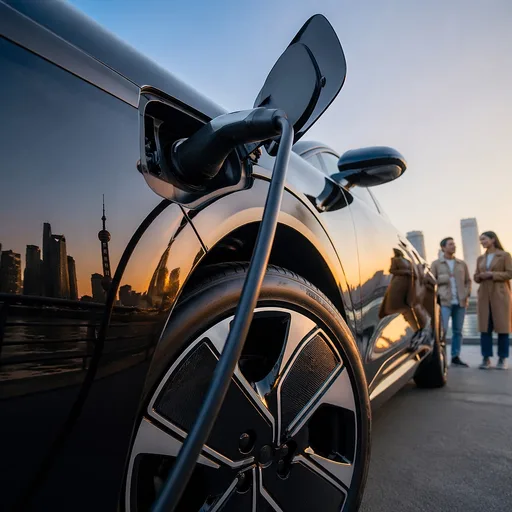
为什么中国电动车比特斯拉便宜?
Chinese EVs Beat Tesla on Manufacturing Cost
About this story
Rhodium Group breaks down why BYD's Seal costs less than Tesla's Model 3 — parts, scale, and China's manufacturing edge. HSK 3 Chinese listening practice.
This is an HSK 3-4 Chinese listening episode that runs about 10 minutes. The full Mandarin script is shown with tap-for-pinyin and a line-by-line English translation, so you can listen and read at once — comprehensible input in the sense of Stephen Krashen's i+1 theory. It teaches 15 key vocabulary words such as 效率、成本、零件 and walks through 5 grammar patterns, each explained in English with examples. The same news story is retold at 4 difficulty levels — use the level selector above to find the version that is challenging but still understandable for you.
Read at your level
原文Read the complete story in Chinese. Reveal pinyin and English only when you need them.
English transcript reference
Speaking of a big piece of news in the recent auto market, it is that the prices of Chinese electric cars are truly very competitive.
Especially when compared to America's Tesla, China's BYD is quite a bit cheaper.
Many people's first reaction is that this must be because the government gave a lot of money.
Everyone feels that if money wasn't given, how could they possibly sell so cheaply?
However, recently a very detailed report gave us a different answer.
This report comes from a research institution called Rhodium Group.
Their research found that while government help exists, it is not the most important reason.
The real reason is actually the companies' own capabilities and China's specific environment.
Let's first look at a concrete example so it's easier for everyone to understand.
Let's take two very similar cars to compare.
One is BYD's "Seal," which is a very beautiful sedan.
The other is the Tesla Model 3 that everyone knows.
These two cars are about the same in size and function, and are direct competitors.
Back in 2022, the prices of these two cars actually didn't differ that much.
But by 2025, the situation changed completely.
BYD lowered the price of the "Seal" significantly.
The current price is only around 24,000 US dollars.
This is more than 6,000 dollars cheaper than before.
For car buyers, this is a very big temptation.
But let's look again at Tesla's Model 3.
Its price has hardly changed, remaining around 32,000 US dollars.
Although Tesla has a large factory in Shanghai and high production efficiency.
It only dropped by a little over 200 dollars.
The difference between these 6,000 dollars and 200 dollars is truly too big.
So, where does this price difference come from?
The report did a very mathematical calculation.
BYD's cost per vehicle is about 4,700 dollars lower than Tesla's.
Within this 4,700 dollars, only 5 percent is due to government subsidies.
Five percent, that is really a very small number.
This shows that even without the government giving money, BYD is still much cheaper than Tesla.
So, if anyone says in the future that Chinese cars are cheap entirely because of subsidies, they are probably wrong.
The report says there are actually three more important reasons.
These three reasons are: scale, manufacturing parts themselves, and cheap talent.
Let's discuss them carefully one by one.
First is "manufacturing parts yourself," which is called "vertical integration" in business.
This is BYD's most formidable aspect.
Ordinary car companies are only responsible for design and assembly.
Many of the parts they need must be bought from other companies.
For example, brakes, seats, headlights, and of course the most important battery.
When you have to buy things from others, they definitely want to make money off you.
So costs naturally become high.
But BYD is different.
It started out by making batteries itself.
Except for glass and tires, it can make almost everything itself.
It doesn't need to let middlemen earn the price difference.
This is just like growing your own vegetables to eat; it's definitely cheaper than buying vegetables at the supermarket.
This is also something many Western companies can't learn, because building such factories takes many years.
The second reason is scale.
Which is the quantity of production.
In China, there are very many people buying electric cars.
The more cars BYD sells, the lower the fixed cost allocated to each car.
This is easy to understand.
If you open a factory and only make one car, that car will definitely have a sky-high price.
But if you make a million cars, each car becomes very cheap.
Although Tesla also sells a lot, in China, this largest market, BYD sells even more.
This huge sales volume allows BYD to suppress prices very low.
The third reason, which is also a very interesting point, is talent.
Making cars not only requires workers but even more so needs engineers.
You need people to design the car's shape, people to write software, and people to do testing.
All of these require spending a lot of money.
The report says that China's R&D costs are much lower than in the West.
Why?
Because Chinese engineers' wages are relatively lower.
Although Chinese engineers' wages have risen quite a bit now, compared to the US and Germany, they are still cheap.
Moreover, Chinese universities produce very many engineers every year.
This makes it very easy for car companies to find suitable people.
Furthermore, because many cars are sold, this R&D money is spread over more cars.
So the R&D expense spent on each car is even less.
This is why BYD can spend a lot of money researching new technologies, yet still sell cars cheaply.
Besides these three main reasons, there is another very hidden reason.
This was also specifically mentioned in the report.
That is the time taken to pay suppliers.
In China, large car companies are usually relatively dominant.
When they buy parts, they often won't pay immediately.
They might wait several months before paying.
This might be a bit stressful for suppliers, but it is very beneficial for car companies.
Because this means they always have cash in hand.
They don't need to borrow money from banks for turnover, so they don't need to pay interest.
The report calculated the figures.
Just because of this late payment item alone, BYD can save over 200 dollars per car.
And Geely Auto can save about 80 dollars.
This practice is relatively rare in Western countries, or the duration is not that long.
This is also an invisible cost advantage.
Precisely because of these reasons, the market has undergone great changes.
Previously, everyone felt foreign brand cars had good quality, and were willing to buy them even if they were a bit expensive.
In 2020, two-thirds of the electric cars sold in the Chinese market were foreign brands.
At that time, Tesla and Volkswagen were very glorious.
But by last year, the situation completely reversed.
The market share of foreign brands was left with only a little over one-third.
Most people started buying Chinese brand cars.
Because everyone discovered that Chinese brand cars are not only cheap but also have decent quality.
This makes foreign car companies feel very nervous.
Of course, we also cannot completely say there are no subsidies.
Subsidies still exist, and for BYD, the amount of subsidies is indeed increasing.
Data shows that the proportion of subsidies BYD receives relative to its net profit is rising.
It rose from 26 percent in 2024 to 35 percent in 2025.
This is not a small number.
However, we need to see clearly that this is mainly because it sells too many cars.
Moreover, Tesla also received subsidies in the past.
Before 2021, Tesla also received quite a bit of money from the Chinese government.
But now, Tesla receives almost no subsidies.
This is also why the gap between the two companies looks increasingly large.
Now, Western car companies face a very difficult problem.
They know why Chinese cars are cheap.
It is because of full industrial chain integration, cheap R&D, and a huge market.
If they want to compete at this price, they must change.
The report points out that the things they need to do are clear.
They need to invest more money in China.
They need to establish more R&D centers in China and hire Chinese engineers.
They need to establish their own supply chains like Chinese companies.
However, this is not just a business issue, but also a political issue.
The governments of the US and Europe are now both protecting their own industries.
They hope car companies build factories in their own countries and hire their own workers.
If Ford or General Motors moves all R&D to China, what about American workers?
If they don't move to China, their cars will be too expensive and won't sell.
If they move to China, although cars become cheaper, their home governments will be unhappy.
This is really a very difficult choice.
So, the current situation is that Chinese companies have already established a structural advantage.
This advantage cannot be broken by simple trade protection or tariffs.
As long as this gap in efficiency and cost exists, the price advantage of Chinese electric cars will always exist.
For consumers, this might be a good thing, because they can buy better cars with less money.
But for the global auto industry, this is indeed a huge reshuffle.
In the coming years, we will see more changes.
Perhaps more foreign companies will have to choose to cooperate with Chinese companies.
Or they will try to copy this model in their own countries, but this will definitely take a long time.
Listen again
Try it without the transcript and notice what sounds clearer.
What vocabulary does this episode teach?
词汇Refers to the ability to accomplish something with the least waste of time and effort.
The expense required to produce or sell something.
Individual pieces that make up a machine or vehicle.
The size or extent of an operation or organization.
Money in the form of coins or banknotes.
A condition or circumstance that puts one in a favorable or superior position.
HSK 1-3. country.
HSK 1-3. environment.
Financial aid extended to an economic sector (or institution, business, or individual).
Short for 研究 (research) and 开发 (development).
The sequence of processes involved in the production and distribution of a commodity.
To spread a cost or burden among several parties or over a large quantity.
A business term where a company controls multiple stages of production (e.g., raw materials to assembly).
A person or organization that provides something needed such as a product or service.
Literally shuffling cards; metaphorically refers to a major reorganization or shake-up of a market.
* beyond level超纲词
What grammar patterns appear in this episode?
语法Used to express the specific amount of difference between two things in a comparison.
比亚迪比特斯拉每辆车的成本要低大约四千七百美元。
这比以前便宜了六千多美元。
A concession pattern meaning 'Even if [condition], [result] still happens'.
这说明,即使没有政府给钱,比亚迪还是比特斯拉便宜很多。
Used to add information, meaning 'Besides/Apart from X, there is also Y'.
除了这三个主要原因,还有一个很隐蔽的原因。
除了玻璃和轮胎,它几乎什么都能自己做。
Meaning 'Take [object] to [verb]...'. Often used to introduce a topic or example for discussion.
我们拿两款很像的车来比较一下。
Progressive relationship meaning 'Not only..., but even more/also...'.
做汽车不仅需要工人,更需要工程师。
因为大家发现,中国品牌的车不仅便宜,而且质量也不错。
Proper Nouns
专有名词Sources
来源Free account
Keep learning from this story
Create a free account to keep saved words and your preferred level together.
- Keep words with their story context
- Remember your preferred level
- Build your vocabulary over time