
A Chinese podcast · Same story, 4 levels
上海的这场 AI 盛会:机器人、开源,与一场刚刚开始的全球竞赛
Shanghai World AI Conference Showcases Robots
About this story
Shanghai World AI Conference Showcases Robots. HSK 5-6 Chinese listening practice.
This is an HSK 5-6 Chinese listening episode that runs about 4 minutes. The full Mandarin script is shown with tap-for-pinyin and a line-by-line English translation, so you can listen and read at once — comprehensible input in the sense of Stephen Krashen's i+1 theory. It teaches 8 key vocabulary words such as 经济、机会、社会 and walks through 2 grammar patterns, each explained in English with examples. The same news story is retold at 4 difficulty levels — use the level selector above to find the version that is challenging but still understandable for you.
Read at your level
原文Read the complete story in Chinese. Reveal pinyin and English only when you need them.
English transcript reference
Today I want to talk with you about a major event in the tech world: the four-day World AI Conference just came to a close in Shanghai.
This conference, known as WAIC, is currently one of the largest and most significant AI gatherings in the world.
And this year's edition broke records on almost every dimension.
Let me start with a few numbers to give you a vivid impression.
This year, over 1,400 heavyweight guests came from around the world, and more than 1,100 companies exhibited.
Over 3,000 innovations were on display, including more than 100 chips and over 260 large AI models.
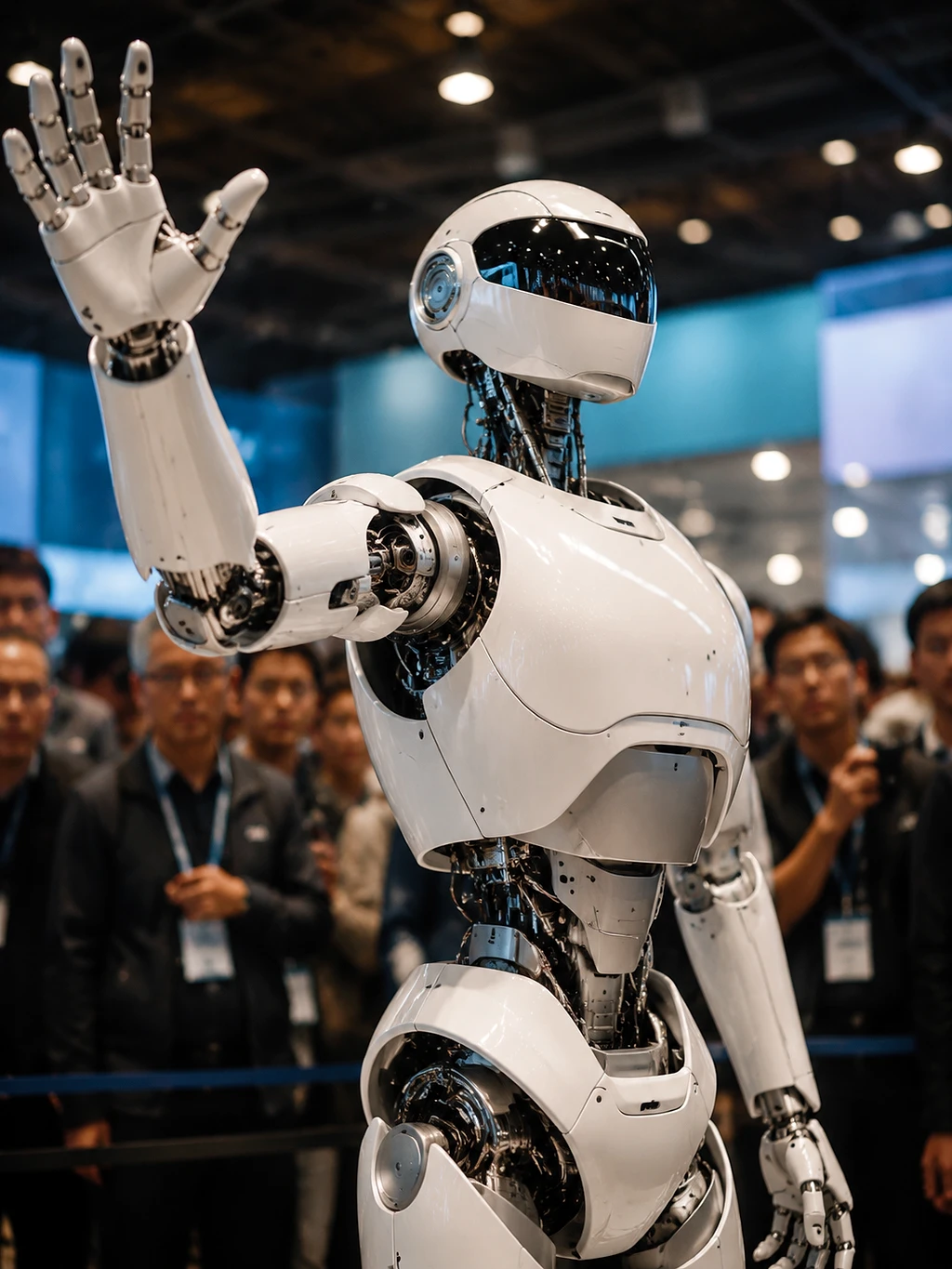
But the real show-stealers were the more than 200 robots that had "come alive."
Their appearance grows ever closer to real humans — they can walk, converse, and even do work.
More importantly, these robots are long past being mere samples for people to admire.
A good portion are built for real-world settings — guiding guests, delivering items, and answering questions in hotels, malls, and showrooms.
You could also see self-driving cars, systems that help doctors read medical images, and robotic arms swinging tirelessly on factory floors.
And this points precisely to the deepest shift at this year's conference.
In past years, this industry competed over whose model had more parameters and was smarter — an arms race centered on single-point technological breakthroughs.
But this year, the wind has clearly shifted.
People are no longer fixated on the models themselves, but care more about one thing: whether AI can truly be put into practice — whether it can help companies make money, boost industry efficiency, and improve ordinary people's lives.
Put bluntly, it's a shift from "showing off models" to "competing on applications" — from the lab out into the real world.
If technology is the skeleton of this conference, then the political and global significance it carries is its other major highlight.
This year, Chinese leader Xi Jinping attended the opening ceremony and delivered a speech.
He defined artificial intelligence as a rare, historic opportunity of our era.
He called on all nations to seize this opportunity together and deepen cooperation, rather than setting limits on one another and each fighting its own battle.
In his speech, he placed particular emphasis on the idea of "open source."
Open source means making core technology public, so the whole world can use it for free and improve it together — rather than it being tightly held by a handful of giants.
He said China is willing to extend a hand to developing countries, helping them build their own AI capabilities, so that no nation falls behind in this wave of technology.
His intent is not hard to read: China is trying to play the role of a "leader" in the global AI landscape.
And behind this, of course, lies the unspoken tug-of-war between China and the United States.
In recent years, China and the US have chased each other down the AI track, contesting nearly every inch, from chips to models.
Besides Xi Jinping, many other heavyweight figures attended this year's conference — even the UN Secretary-General showed up in person.
This itself shows that artificial intelligence has long transcended the realm of pure technology.
It deeply affects the economy, industry, national competition, and even the future world order.
In the end, this conference made two clear threads plain to us.
The first: AI is seeping into every one of our daily lives at an astonishing speed.
The second: the global race around AI has only just raised its curtain.
For us caught up in it, rather than growing anxious, we're better off understanding it and using it well.
After all, the future is already here — and its name is artificial intelligence.
OK, that's all for today — see you next time.
Listen again
Try it without the transcript and notice what sounds clearer.
What vocabulary does this episode teach?
词汇AI 关系到经济、产业、国家竞争 — AI bears on the economy, industry and national competition.
他将 AI 定义为一次难得的历史性机遇 — he framed AI as a rare historic opportunity.
AI 渗透进社会生活的方方面面 — AI is seeping into every corner of social life.
在人工智能的全球格局中扮演引领者 — playing a leader in the global AI landscape.
不让任何一个国家在技术浪潮中掉队 — so no nation falls behind in the wave of technology.
Beyond HSK 1-4. 中美两国在 AI 赛道上你追我赶 — China and the US race each other on AI.
Beyond HSK 1-4. Making core tech public and free, rather than locked up by a few giants.
Beyond HSK 1-4. 人工智能的全球格局 — the global landscape of AI.
* beyond level超纲词
What grammar patterns appear in this episode?
语法与其 A,不如 B
"Rather than A, better to B" — expresses a preferred alternative.
与其焦虑,不如去了解它、用好它。
而非 / 而不是...
Formal "rather than / instead of" — contrasts the intended meaning with a rejected one.
让全世界都能免费使用、共同改进,而非被少数巨头牢牢攥在手里。
加强合作,而不是彼此设限、各自为战。
Proper nouns
专有名词Free account
Keep learning from this story
Create a free account to keep saved words and your preferred level together.
- Keep words with their story context
- Remember your preferred level
- Build your vocabulary over time