
A Chinese podcast · Same story, 4 levels
世界人工智能大会落幕:AI 从"比模型",走向"拼落地"
Shanghai World AI Conference Showcases Robots
About this story
Shanghai World AI Conference Showcases Robots. HSK 3 Chinese listening practice.
This is an HSK 3-4 Chinese listening episode that runs about 4 minutes. The full Mandarin script is shown with tap-for-pinyin and a line-by-line English translation, so you can listen and read at once — comprehensible input in the sense of Stephen Krashen's i+1 theory. It teaches 8 key vocabulary words such as 国家、世界、重要 and walks through 2 grammar patterns, each explained in English with examples. The same news story is retold at 4 difficulty levels — use the level selector above to find the version that is challenging but still understandable for you.
Read at your level
原文Read the complete story in Chinese. Reveal pinyin and English only when you need them.
English transcript reference
Today let's talk about a big deal in the tech world: the World AI Conference just wrapped up in Shanghai.
This conference, known as WAIC for short, is one of the largest AI conferences in the world.
This year's edition was especially lively, with many figures hitting new highs.
Let me give you a few numbers to get a sense of the scale.
This year, more than 1,400 important guests came from countries around the world.
Over 1,100 companies exhibited.
The new products on display alone numbered more than 3,000.
Among them were over 100 chips and more than 200 large AI models.
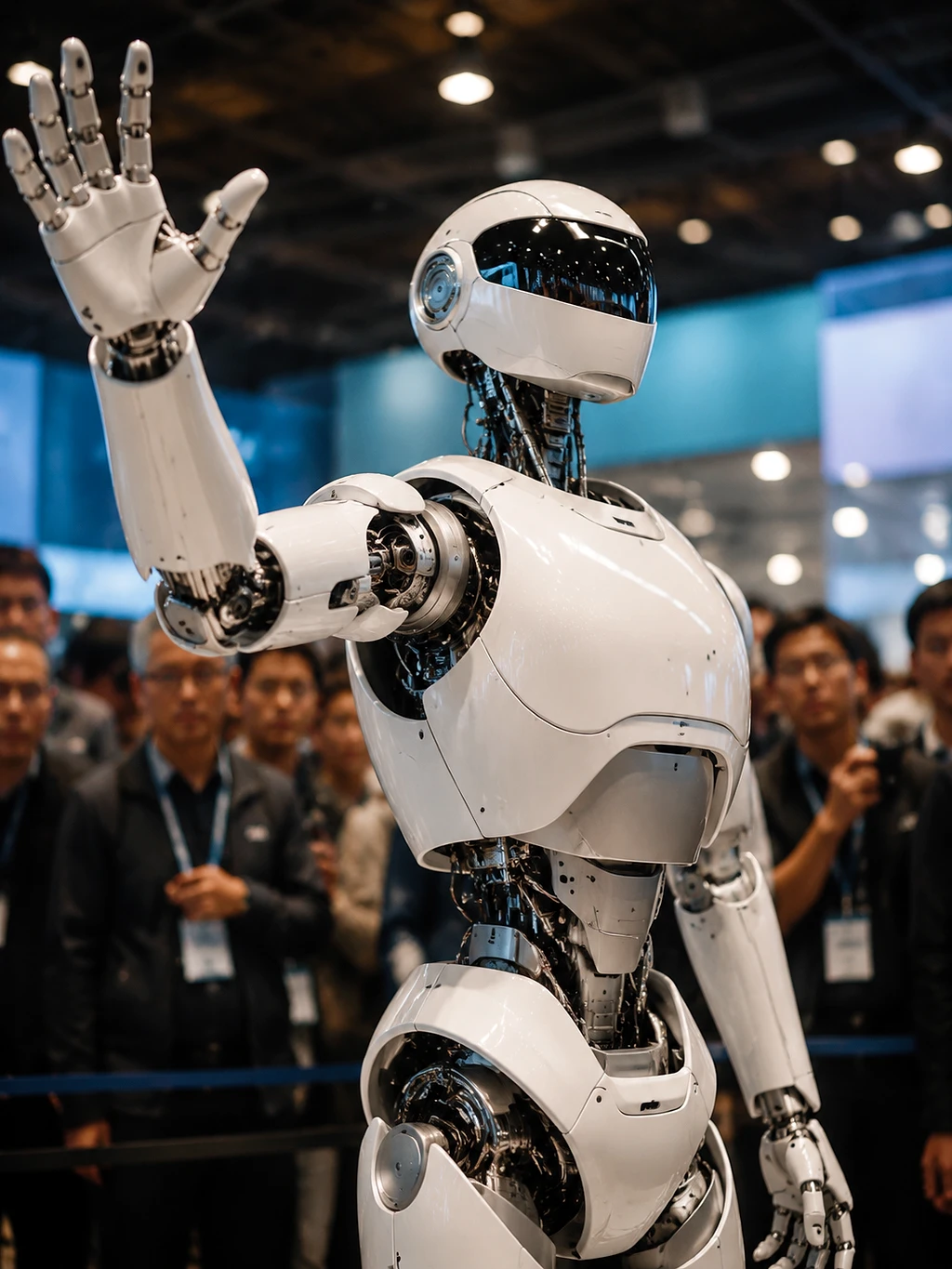
But the biggest eye-catchers this year were all kinds of robots.
The conference featured over 200 robots that could actually move.
They look more and more like humans — they can walk, hold conversations, and even do work.
These robots are no longer just samples standing there for people to look at.
Many can actually be put to use — guiding guests, carrying things, and answering questions in hotels, malls, and showrooms.
In fact, behind this lies the biggest change at this year's conference.
In past years, everyone competed over whose large model was smarter and more powerful.
But this year, the wind has shifted.
People now care more about whether AI can actually be put to use — whether it can help companies make money and help ordinary people live better.
Put plainly, it's shifted from "whose model is strongest" to "who can actually put it into practice."
For example, there were self-driving cars, systems that help doctors read scans, and robotic arms that work on factory floors.
Many of these are no longer just concepts — they already work, and some are already in use.
Beyond technology, this conference also drew attention on another level.
China's leader, Xi Jinping, gave a speech at the opening ceremony.
He described AI as a rare opportunity of our era.
He called on all nations to seize this opportunity and cooperate, rather than each going its own way.
He also placed special emphasis on "open source."
"Open source" means making the technology public, so the whole world can use it for free and improve it together.
He said China is willing to help less-developed developing countries gain access to AI, so they don't fall behind in this wave of technology.
Clearly, China wants to play the role of a "leader" when it comes to AI.
And this inevitably brings to mind the contest between China and the US over AI.
In recent years, China and the US have been in a neck-and-neck race in the AI field.
Besides Xi Jinping, many other heavyweight figures attended — the UN Secretary-General, for one, was also there.
This shows that AI has long since become more than just a technology.
It touches on the economy, on competition between nations, and even on the future shape of the world.
For us ordinary people, the most immediate feeling may be this: in the future, AI will quietly seep into every corner of our lives, like water and electricity.
So, one conference made two things clear.
First, AI is rapidly entering all of our lives.
Second, the competition surrounding AI has only just begun.
That's it for today — see you next time.
Listen again
Try it without the transcript and notice what sounds clearer.
What vocabulary does this episode teach?
词汇AI 变成了很多国家都很关心的大事 — AI has become a big deal many countries care about.
世界人工智能大会 — the World Artificial Intelligence Conference.
还有一件很重要的事 — there is one more very important thing.
谁家的大模型更聪明 — whose large model is smarter.
Beyond HSK 1-3. 中美之间在 AI 上的较量 — the competition between China and the US over AI.
大家更关心的是 AI 能不能真正用起来 — people care more about whether AI can really be used.
Beyond HSK 1-3. 一百多款芯片 — over 100 chips on display.
Beyond HSK 1-3. Making core technology public and free for the world to use and improve.
* beyond level超纲词
What grammar patterns appear in this episode?
语法从 A,变成了 B
"Shifted from A to B" — describes a change of state or focus.
从"比谁的模型强",变成了"比谁能真正落地"。
不再只是...
"No longer merely..." — signals that something has moved past its old role.
这些机器人,不再只是站在那里给大家看的样品。
Proper nouns
专有名词Free account
Keep learning from this story
Create a free account to keep saved words and your preferred level together.
- Keep words with their story context
- Remember your preferred level
- Build your vocabulary over time