
A Chinese podcast · Same story, 4 levels
义乌:世界杯背后的隐形冠军
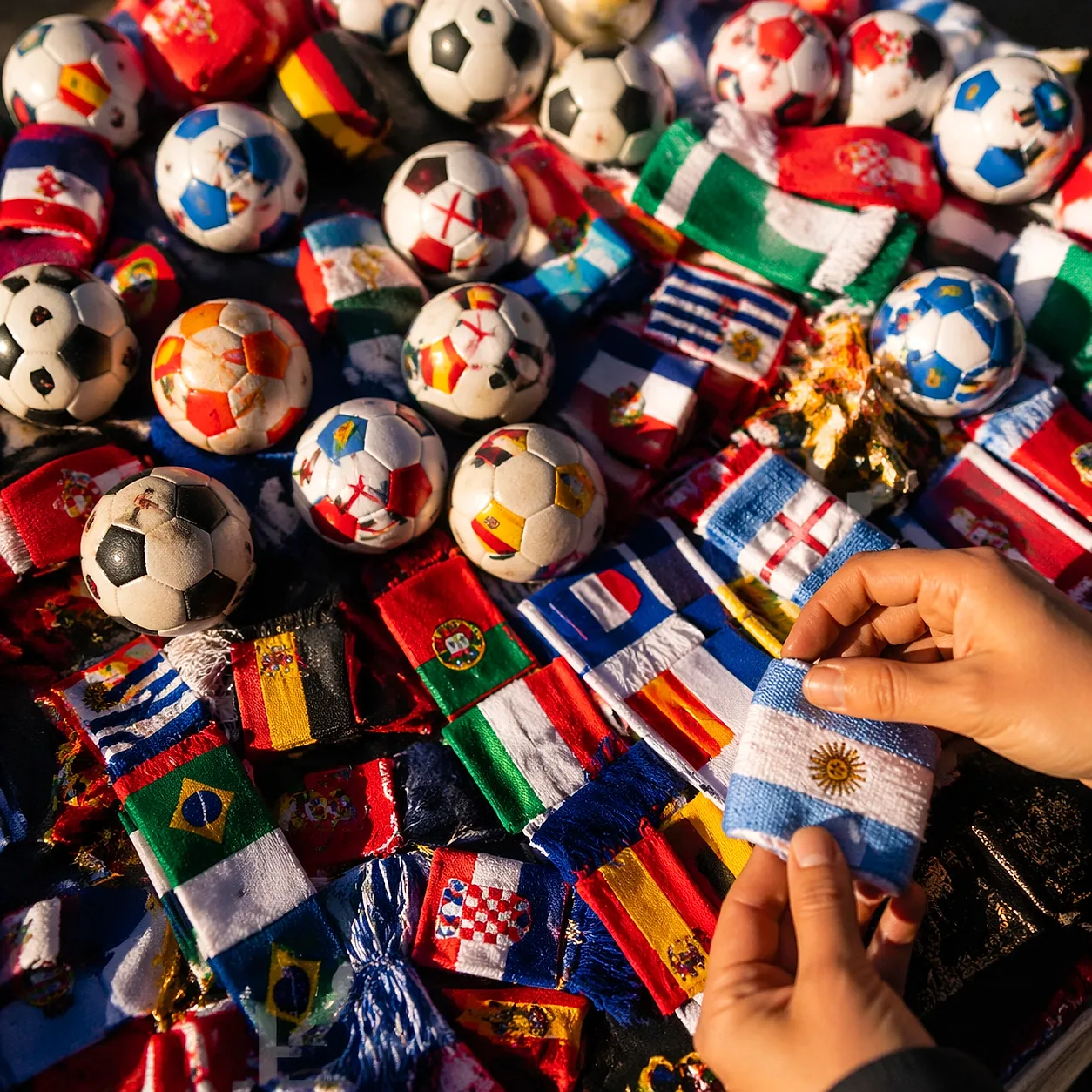
Yiwu Makes 70% of World Cup Merchandise
About this story
Yiwu, Zhejiang quietly supplies 70% of global 2026 World Cup merchandise — flags, jerseys, scarves from one trading city. HSK 5-6 Chinese listening practice.
This is an HSK 5-6 Chinese listening episode that runs about 5 minutes. The full Mandarin script is shown with tap-for-pinyin and a line-by-line English translation, so you can listen and read at once — comprehensible input in the sense of Stephen Krashen's i+1 theory. It teaches 16 key vocabulary words such as 出口、订单、工厂 and walks through 6 grammar patterns, each explained in English with examples. The same news story is retold at 4 difficulty levels — use the level selector above to find the version that is challenging but still understandable for you.
Read at your level
原文Read the complete story in Chinese. Reveal pinyin and English only when you need them.
English transcript reference
When it comes to a barometer of the global sports economy, there's one place more sensitive than any analyst report.
That's Yiwu, Zhejiang.
With less than sixty days until the 2026 US-Canada-Mexico World Cup, Yiwu's order volume has exploded once again.
In January and February, Yiwu's sports goods and equipment exports reached 2.34 billion yuan, a year-on-year increase of 38.5 percent.
This growth rate far exceeds the national average for foreign trade during the same period.
But for Yiwu, this is simply another World Cup cycle arriving.
Let's look at some specific numbers.
One football factory produces four thousand balls daily, machines running 24 hours, virtually no inventory backlog.
A merchant named Luo Tianle holds full-category official licenses for eight national teams and eight top club giants.
He launches twenty to fifty new products every week.
Some products go from approval to finished goods in under twenty-four hours.
Another merchant, Wen Congjian, holds thirty-nine patents and thirty-two registered trademarks.
He secured official fan jersey orders for Brazil, Argentina, and Portugal — roughly ten thousand pieces.
Global buyers are flooding into Yiwu.
A Saudi buyer placed a single order for ten thousand backpacks.
Procurement agents from Jordan and Mali are also browsing products.
Shanghai's Cui Lei made a special trip to Yiwu to purchase officially licensed merchandise.
Yiwu's ability to deliver doesn't come from any single outstanding factory.
It comes from the density of the entire supply chain.
You want to make a fridge magnet — there's a mold factory right next door.
Want to make a badge — there's an electroplating factory across the street.
Want to make a plush toy — the stuffing supplier might be upstairs.
From design to prototyping to mass production, every step happens within a few kilometers.
This kind of spatial density in a supply chain, honestly, can't be found anywhere else on Earth.
Put simply, Yiwu's core competitive advantage isn't being cheap — though it certainly is — it's being fast.
When buyers worldwide need to stock up on event merchandise within two months.
Only Yiwu can simultaneously meet all three requirements: full product range, fast speed, and low prices.
Here's a striking statistic.
During the 2022 Qatar World Cup, roughly seventy percent of all World Cup-related merchandise globally came from Yiwu.
The flags, horns, scarves, and mascot dolls you saw on Doha's streets.
Seven out of ten were shipped from this small Zhejiang city.
This US-Canada-Mexico World Cup is the first ever co-hosted by three countries.
The number of participating teams expanded from thirty-two to forty-eight.
The market scale is more than double what Qatar's edition offered.
Yiwu merchants estimate total orders will grow roughly fifty percent compared to the last tournament.
But behind the optimistic numbers, there are also undercurrents.
The South China Morning Post reported several noteworthy signals.
In the first half of 2025, Yiwu's business was actually on the cold side.
Some merchants admitted that visiting clients had noticeably decreased.
Some even encountered situations where an entire container was shipped but not a single cent of payment was received.
Geopolitical instability, Middle East turmoil, global economic uncertainty.
All are eroding confidence in international trade.
One merchant said something that really hits home.
"There are no permanent customers."
In today's environment, the person you worked with last season might simply vanish this season.
But even so, Yiwu keeps turning.
Because globally, there's no substitute.
You can dislike Yiwu, complain about quality, worry about delivery schedules.
But when you truly need one million flags, half a million horns, and three hundred thousand scarves within six weeks.
You'll still come back to Yiwu.
Yiwu is also quietly upgrading.
More and more merchants are no longer satisfied with simple contract manufacturing.
They're securing licenses, creating original designs, registering patents, building their own brands.
Luo Tianle's full-category licensing strategy is a prime example.
He's not just processing for others — he owns the design rights and brand usage rights.
Wen Congjian's thirty-nine patents illustrate the same trend.
From selling cheap goods to selling goods with intellectual property.
This is the transformation Yiwu is undergoing.
And the World Cup happens to be the ultimate test of this transformation's results.
In June 2026, when fans worldwide wave flags, put on scarves, and raise inflatable sticks.
They probably won't think of Yiwu.
But Yiwu is definitely there.
Behind every flag.
Inside every souvenir's packaging.
In every cheering horn blast.
A small Zhejiang city of under two million people.
Holding up half the global sports event merchandise economy.
This is Yiwu.
Silent, efficient, irreplaceable.
This is perhaps the most authentic snapshot of Chinese manufacturing.
Not some cutting-edge chip or rocket.
But individual fridge magnets, small flags, and fan jerseys.
Unremarkable, but omnipresent.
Cheap, but indispensable.
Yiwu won't appear on the World Cup playing field.
But every corner of the World Cup bears Yiwu's shadow.
This may be the quietest champion.
And the most enduring victory.
Listen again
Try it without the transcript and notice what sounds clearer.
What vocabulary does this episode teach?
词汇Selling goods to other countries. A key metric for Yiwu's economy.
A buyer's request for goods. 订单量再次爆发 = order volume exploded again.
Manufacturing facility. Yiwu has thousands of small factories.
打造自有品牌 = building their own brands.
Official permission to use a team's branding. 全品类官方授权.
HSK 1-4. percent.
HSK 1-4. economy.
HSK 1-4. politics.
Something that indicates a trend. 体育经济的风向标 = barometer of the sports economy.
The complete chain from raw materials to finished product delivery.
Products derived from a main event/brand — souvenirs, fan gear, etc.
The fundamental strength that makes a company/place stand out.
Making products for other brands. Common in Chinese manufacturing.
Legal rights to inventions, designs, and brands. 从卖便宜货到卖有知识产权的货.
义乌正在经历的转型 = the transformation Yiwu is undergoing.
Hidden trends or risks beneath the surface. 乐观数字的背后也有暗流.
* beyond level超纲词
What grammar patterns appear in this episode?
语法Proper nouns
专有名词Free account
Keep learning from this story
Create a free account to keep saved words and your preferred level together.
- Keep words with their story context
- Remember your preferred level
- Build your vocabulary over time