
A Chinese podcast · Same story, 4 levels
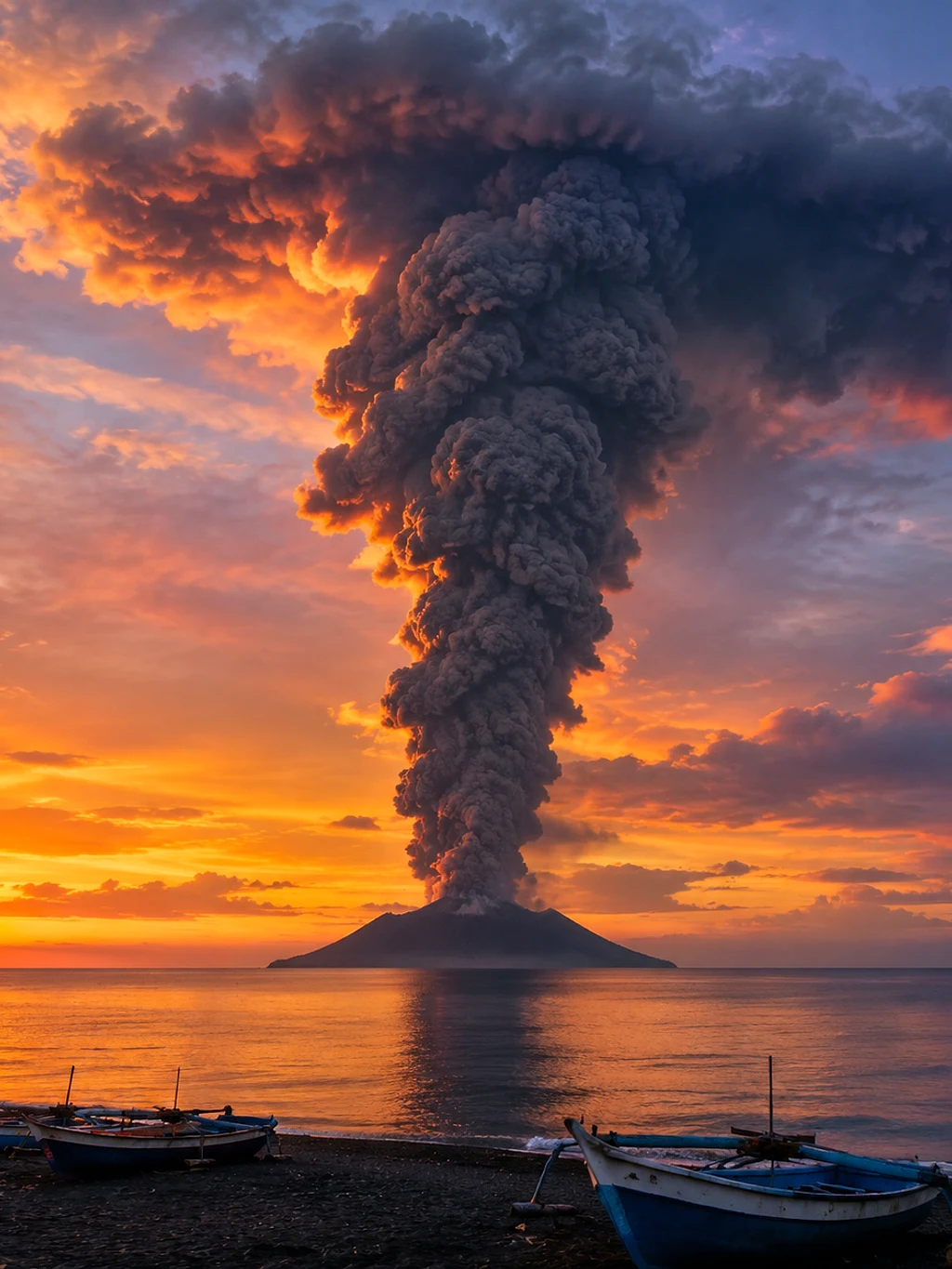
喀拉喀托之子在半夜醒了:七百公里外都听得见,八个机场关闭,二十七万人走不了,地面上没有一个人死
Anak Krakatau Eruption Strands 270,000 Travelers
About this story
Anak Krakatau erupted late on a Friday night in early September 2026, throwing ash to 15,000 metres and booming 700 km away. Eight Indonesian airports closed, 1,558 flights were cancelled and 270,000 passengers were stranded — and nobody died and no village was evacuated. The entire cost landed in the air. Chinese listening practice at four levels. HSK 5-6 Chinese listening practice.
This is an HSK 5-6 Chinese listening episode that runs about 5 minutes. The full Mandarin script is shown with tap-for-pinyin and a line-by-line English translation, so you can listen and read at once — comprehensible input in the sense of Stephen Krashen's i+1 theory. It teaches 12 key vocabulary words such as 规模、暴露、结构 and walks through 3 grammar patterns, each explained in English with examples. The same news story is retold at 4 difficulty levels — use the level selector above to find the version that is challenging but still understandable for you.
Read at your level
原文Read the complete story in Chinese. Reveal pinyin and English only when you need them.
English transcript reference
This episode is about the Indonesian eruption of early September, and the focus is not the eruption but where its cost landed.
Let me set out the subject first.
The volcano is Anak Krakatau, sitting in the Sunda Strait between Java and Sumatra.
In Indonesian, "anak" means "child", so the name translates directly as "Child of Krakatoa".
That name is not a figure of speech. It is a geological fact.
In 1883, the old Krakatoa volcano erupted — among the most violent volcanic events in the instrumented record of humanity.
The pressure wave from the explosion travelled thousands of kilometres, ash reached the stratosphere, and for a year or two afterwards global mean temperature showed a measurable drop.
That eruption all but destroyed the volcanic edifice itself, leaving a few remnant islands above water and a submarine caldera below.
Roughly forty years later, inside that caldera, submarine eruptions began building a new cone until it broke the surface.
That is the mountain standing there today.
It is the direct descendant of the old one, and it inherited the old one's machinery.
This child has a record.
In December 2018, an eruption triggered a flank collapse; a large mass of the edifice slid into the sea, generating a tsunami that killed more than four hundred people along the coast.
After that event, Indonesia's volcanology and geological hazard agency maintained a high monitoring density on it.
On 3 July this year the alert level was already raised to level three, "Siaga" — the second highest in a four-level system.
This September's eruption began late on a Friday night.
In volcanological terms the scale is moderate to large.
The ash column rose to about six thousand metres on the Java side, and reached fifteen thousand metres at its highest over Sumatra and Banten.
That height is worth pausing on.
Typical airliner cruise altitude runs between ten and twelve thousand metres.
Which is to say the top of the ash column exceeded the routine working airspace of commercial aviation.
The explosion was audible seven hundred kilometres away.
But here is the most counter-intuitive part of the event: ground casualties were zero.
No deaths, no villages evacuated.
The official measure was one line: a three-kilometre exclusion zone, with ships barred from entering.
An eruption audible seven hundred kilometres away left almost no bill on the ground.
The entire bill was settled in the air.
Understanding that requires knowing what volcanic ash actually is.
Its composition is rock and volcanic glass pulverised by the explosion, with particle diameters generally under two millimetres.
The melting point of these particles is below the operating temperature of a jet engine's combustion chamber.
Once ingested, particles melt inside the chamber, travel with the gas flow into the turbine section, and resolidify on the cooler blade surfaces as a glassy deposit.
The deposit changes blade geometry, the compressor stalls, thrust decays, and in severe cases the engine flames out in flight.
Beyond that, ash abrades cockpit windscreens until they lose transparency, and blocks pitot tubes so that airspeed indication fails.
Not one of the above is a fault that can be dealt with in flight.
International civil aviation therefore treats volcanic ash by avoidance: no acceptable concentration is defined, only rerouting or grounding.
On 6 September, Indonesia closed eight airports at once, including the country's highest-throughput one.
More than one thousand five hundred and fifty flights were cancelled or delayed in total; the largest airport alone accounted for over nine hundred.
Stranded passengers exceeded two hundred and seventy thousand.
The overwhelming majority of the people in that figure have no geographical relationship to this volcano.
They do not live on the Sunda Strait, they do not know this mountain, and many cannot name it.
But whether they got home during those days was decided by that mountain.
This is the part I actually want to talk about.
Put the mountain's three events side by side and something interesting shows up.
In 1883, its mechanism of harm was pyroclastic flows, tsunami and the famine that followed, and its target was the coastal population.
In 2018, it was a tsunami from a flank collapse, and the target was still the coastline.
In 2026, it did not touch a single person, and the target was the aviation network.
The mountain has not changed, and the physics of the eruption has not changed.
What changed is what we have moved into its range.
A hundred and forty years ago, what was exposed to this volcano was fishing villages and harbours.
Today, what is exposed to it is a flight network covering Southeast Asia, along with the supply chains, migrant workers, tourism and ordinary people's travel plans that depend on it.
The scale of a disaster is never set by the disaster alone. It is also set by how much value we have stacked next to it.
The range of that principle extends well beyond volcanoes.
Two questions to leave you with.
The first is concrete: if you were stranded in an airport and nobody could tell you when service would resume, what would you base "wait or go" on?
The second is bigger: have the networks we have built for efficiency made us more resilient, or just moved more of what we own in front of the same risk?
Listen again
Try it without the transcript and notice what sounds clearer.
What vocabulary does this episode teach?
词汇HSK 5. 灾害的规模从来不只由灾害本身决定 — the sentence the episode exists to deliver.
HSK 5. 暴露在这座火山面前的是渔村和港口 — then, versus an airline network now.
HSK 5. Used both for the bird's-eye argument and for the physiology of jet engines.
HSK 5. 人类有仪器记录以来 — how the 1883 claim is bounded rather than exaggerated.
HSK 6. 维持了很高的监测密度 — Indonesia was already watching closely.
HSK 5. 我们把多少价值堆在了它旁边 — the variable that actually sets disaster scale.
The bowl the 1883 eruption left, and the place the new cone grew back inside.
一次喷发引发侧翼垮塌 — how the 2018 tsunami started and 400 people died.
Ten to twelve thousand metres — the ash column went higher than that.
Ash melts in the combustion chamber and resolidifies on cooler turbine blades.
Where the glassy deposit forms, changing blade geometry until the compressor stalls.
No acceptable concentration is defined for ash — you reroute or you do not fly.
* beyond level超纲词
What grammar patterns appear in this episode?
语法这个……值得停一下
This is worth pausing on. An explicit signpost that slows the listener down at the one number that matters most.
这个高度值得停一下。
……从来不只由 A 决定,也由 B 决定
Never determined by A alone, but also by B. Adds a second cause without denying the first — more precise than replacing one with the other.
灾害的规模从来不只由灾害本身决定,也由我们把多少价值堆在了它旁边决定。
以上没有一项是……的
Not one of the above is X. Sums up a list and closes it off in a single stroke, common in technical spoken Chinese.
以上没有一项是可以在飞行中处置的故障。
Proper nouns
专有名词Sources
来源Free account
Keep learning from this story
Create a free account to keep saved words and your preferred level together.
- Keep words with their story context
- Remember your preferred level
- Build your vocabulary over time