
A Chinese podcast · Same story, 4 levels
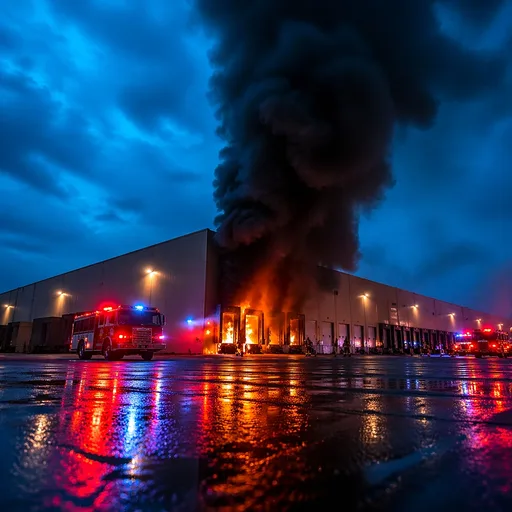
美国:一个工人烧了老板的仓库
California Warehouse Arson Destroys $650M Goods
About this story
A simple story about an angry worker in Ontario, California who set fire to his boss's warehouse near Los Angeles. HSK 1 Chinese listening practice.
This is an HSK 1 Chinese listening episode that runs about 5 minutes. The full Mandarin script is shown with tap-for-pinyin and a line-by-line English translation, so you can listen and read at once — comprehensible input in the sense of Stephen Krashen's i+1 theory. It teaches 12 key vocabulary words such as 生气、我们、你们 and walks through 4 grammar patterns, each explained in English with examples. The same news story is retold at 4 difficulty levels — use the level selector above to find the version that is challenging but still understandable for you.
Read at your level
原文Read the complete story in Chinese. Reveal pinyin and English only when you need them.
English transcript reference
Speaking of working and making money, let me tell you a very different story.
There was a young man.
He was twenty-nine years old.
He worked in a very big warehouse.
What is a warehouse?
A warehouse is a very very big building.
With many many things inside.
What things?
Toilet paper.
Yes, toilet paper.
Lots and lots of toilet paper.
The kind you use in the bathroom.
How big was this warehouse?
Very very big.
Bigger than a hundred basketball courts.
How much was the toilet paper inside worth?
Five hundred million dollars.
Five hundred million.
That is a very big number.
This warehouse was in America.
In California.
California has a city called Ontario.
Not Ontario in Canada.
It's Ontario in California.
Near Los Angeles.
This young man worked in this warehouse.
Every day he moved things.
Moved toilet paper.
Put it on trucks.
Very tiring.
The work was very hard.
But the money he earned was very little.
He said: "My money is not enough to live on."
He said: "I earn too little."
He was very unhappy.
He felt it was unfair.
He worked so hard.
But the money was too little.
The more he thought about it, the angrier he got.
Then one night.
He did a very bad thing.
He started a fire.
He used a lighter.
He lit the toilet paper.
Toilet paper burns very easily.
Because it's made of paper.
The fire got big right away.
Very fast.
Extremely fast.
The whole warehouse was on fire.
While it burned, he used his phone to record video.
Yes, he recorded a video.
He posted the video online.
What did he say in the video?
He said: "All you had to do was pay us enough to live."
He also said: "Your inventory is gone."
Then the whole warehouse burned.
All of it burned.
Five hundred million dollars worth of stuff.
Gone in one night.
The warehouse roof collapsed too.
The big trucks parked outside also burned.
But there is good news.
Nobody was hurt.
There were twenty people working in the warehouse at the time.
They all ran out.
Everyone was fine.
This is the most important thing.
The police caught him very quickly.
Why so fast?
Because he recorded the video himself.
He posted it online himself.
Everyone saw it.
The police saw it too.
So it was very easy to find him.
After he was caught.
He made a phone call to someone.
He said he felt like a certain person.
What person?
A person named Mangione.
Who is Mangione?
Mangione is a person from another case.
He killed the boss of an insurance company.
Many Americans think insurance companies are bad.
So some people think Mangione is a hero.
This young man who burned the warehouse thought he was also a hero.
But he is not a hero.
He broke the law.
Arson is a very serious crime.
He might go to jail for many many years.
At most, maybe for life.
This story makes people think about many things.
First, did what he said make sense?
Low wages is a real problem.
Many people feel they don't earn enough.
This is true.
Second, but burning things is not the answer.
If you're unhappy, you can speak up.
You can tell your boss.
You can find a new job.
You can go to court.
But you cannot start a fire.
Starting a fire can hurt other people.
This time nobody was hurt.
But next time might be different.
So this story tells us.
It's okay to be angry.
But don't do stupid things.
Doing stupid things only makes your life worse.
It won't get better.
He is now in prison.
No wages.
No freedom.
He has nothing left.
This is the saddest part.
Listen again
Try it without the transcript and notice what sounds clearer.
What vocabulary does this episode teach?
词汇Feeling upset or mad.
HSK 1. we; us.
HSK 1. you (plural).
HSK 1. they; them.
HSK 1. what.
HSK 1. now.
仓 (storage) + 库 (depot). A big building to store goods.
卫生 (hygiene) + 纸 (paper).
Money paid for work.
打 (strike) + 火 (fire) + 机 (device).
When something starts burning.
A recording of moving images.
* beyond level超纲词
What grammar patterns appear in this episode?
语法Proper nouns
专有名词Sources
来源Free account
Keep learning from this story
Create a free account to keep saved words and your preferred level together.
- Keep words with their story context
- Remember your preferred level
- Build your vocabulary over time