
A Chinese podcast · Same story, 4 levels
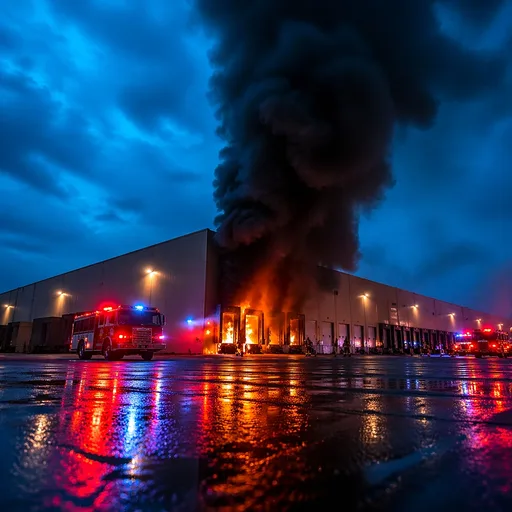
六亿五千万美元的愤怒:一个仓库工人的纵火与美国的阶级裂缝
California Warehouse Arson Destroys $650M Goods
About this story
NFI worker Chamel Abdulkarim torches an Ontario warehouse — $650M of Kimberly-Clark goods lost, US class wound reopens. HSK 5-6 Chinese listening practice.
This is an HSK 5-6 Chinese listening episode that runs about 7 minutes. The full Mandarin script is shown with tap-for-pinyin and a line-by-line English translation, so you can listen and read at once — comprehensible input in the sense of Stephen Krashen's i+1 theory. It teaches 12 key vocabulary words such as 社会、制度、政策 and walks through 5 grammar patterns, each explained in English with examples. The same news story is retold at 4 difficulty levels — use the level selector above to find the version that is challenging but still understandable for you.
Read at your level
原文Read the complete story in Chinese. Reveal pinyin and English only when you need them.
English transcript reference
Speaking of an undercurrent of emotion in American society in recent years, there's one case that can serve as a microcosm.
In Ontario, California, a 29-year-old warehouse worker used a lighter to ignite toilet paper shelves in a 1.2 million square foot warehouse.
Then he watched the fire spread while filming and posting to Instagram.
In the video he said one line: "All you had to do was pay us enough to live."
Hours later, the entire warehouse was reduced to ashes.
Product losses totaled about 500 million dollars.
Building losses totaled about 150 million dollars.
Nobody was hurt.
He was arrested.
But the story is far from that simple.
The suspect is Chamel Abdulkarim, 29, living in Highland, California.
He worked at a Kimberly-Clark distribution center through a staffing company called NFI Industries.
Note this structure: he was not a Kimberly-Clark employee.
He was a temp worker.
In America's warehouse industry, this employment model has become standard.
Large companies hire warehouse workers through third-party staffing firms.
The upside is flexibility, low cost, no need to cover benefits or severance.
The downside is workers get the lowest wages, the fewest benefits, and the most unstable employment.
You're not the company's person — you're just "rented" to do the work.
Kimberly-Clark is a consumer goods giant with annual revenue exceeding 20 billion dollars.
Producing toilet paper, tissues, baby diapers and other daily necessities.
This Ontario warehouse was one of their main West Coast distribution centers.
1.2 million square feet, roughly equivalent to twenty football fields.
All paper products inside.
500 million dollars worth of paper products.
The incident occurred around 12:30 AM on a Tuesday.
About twenty workers were on the night shift in the warehouse at the time.
Abdulkarim used a lighter to ignite toilet paper shelves at multiple locations.
Paper products are probably one of the most flammable materials you can think of.
The fire spread extremely fast.
Then he did something almost inconceivable in traditional criminology.
He filmed the arson and posted it to Instagram.
In the video, flames spread between shelves as he says: "All you had to do was pay us enough to live."
In another video he says: "Your inventory is gone."
About an hour later he texted a coworker, writing: "Pay us more of the value we create."
Don't just pay the corporate executives.
Haven't seen a shareholder come in for a single shift.
These words don't sound like someone acting on impulse.
They sound like someone who has thought about his situation for a long time and accumulated deep anger.
His behavior of filming and publicly posting is also thought-provoking.
He wasn't trying to escape.
He wanted to be seen.
He wanted the whole world to know why he did it.
This is completely different from the psychology of traditional arsonists.
Traditional arsonists want to destroy evidence and hide themselves.
Abdulkarim wanted attention.
He wanted a stage.
Ontario's prosecutor Jason Anderson said: "Arson to me is really hard to understand."
"This person did something that gets him no benefit."
From a legal perspective, this is correct.
Arson won't get him a raise.
Won't improve his life.
Will only make him lose his freedom.
But if you pull the lens back a bit.
From a social psychology perspective.
This is not a rational act.
This is a symbolic act.
Just as he himself said on the phone.
He compared himself to Luigi Mangione.
The name Mangione in today's America is a very complex symbol.
Last December, Mangione shot and killed UnitedHealthcare CEO Brian Thompson on a New York street.
UnitedHealthcare is one of America's largest health insurance companies.
After Mangione was arrested.
American society displayed a reaction many people didn't anticipate.
Large numbers of ordinary people expressed sympathy for Mangione online, even admiration.
Because too many Americans have long-held grievances against insurance companies.
Their claims get denied.
Their premiums go up every year.
They get sick and are told "not covered."
So when someone killed the insurance company's boss.
Some people's reaction wasn't fear, but "he served justice for us."
This emotion is extremely dangerous.
Abdulkarim was clearly infected by this emotion.
He felt he was doing the same thing.
Fighting big corporations for the working class.
Standing up for those workers who "can't make enough to live."
But the problem is.
What he burned wasn't "corporate money."
What he burned was real physical goods.
Those toilet paper rolls need to be produced again.
That warehouse needs to be rebuilt.
The supply chain needs to be readjusted.
And the ones who ultimately bear these costs are still consumers and other workers.
Corporate executives and shareholders won't earn a penny less because of one fire.
Insurance will pay.
Prices will be passed on.
The ones who get hurt are always the people at the bottom.
This is the most ironic part of this kind of "rebellion."
It thinks it's hurting power.
In reality it's hurting its own class.
Back to the legal consequences Abdulkarim himself faces.
At the federal level he's charged with "arson of a building used in interstate commerce."
Minimum sentence five years.
Maximum twenty years.
At the California level he faces one count of aggravated arson plus six counts of regular arson.
Because the damage exceeded 10.1 million dollars.
The aggravated arson charge carries ten years to life in prison.
Which means at 29 years old he may have already given away the rest of his freedom.
This case has sparked intense discussion on American social media.
Some people sympathize with him.
They say: "Nobody burns down a warehouse for fun."
"It's desperation."
"The company earns billions a year, workers can't even pay rent — that's the real crime."
Another group condemns him.
They say: "You can quit, you can strike, you can organize a union."
"But you can't start a fire."
"Arson is arson."
The very opposition of these two voices illustrates a problem.
America's class fracture has deepened to a point.
Where some people see crime as a form of expression, a form of resistance.
Not just crime.
So it was with Mangione.
So it is with Abdulkarim.
When more and more people start romanticizing crime.
It means the system itself has serious problems.
Not that the crime was right.
But that the system that drove a person to the point of committing crime has problems.
Wage stagnation.
Soaring prices.
Astronomical healthcare costs.
Unaffordable housing.
Record corporate profits while worker benefits get cut.
These are structural problems.
Not something one person setting one fire can solve.
Not something one person serving decades in prison can solve.
What it needs is policy-level change.
Adjustments to the minimum wage.
Strengthening labor protection laws.
Restoring union rights.
Regulating temp worker arrangements.
These are the real answers.
But before those answers arrive.
Anger is still accumulating.
Abdulkarim is not the first.
If nothing changes.
He won't be the last.
Listen again
Try it without the transcript and notice what sounds clearer.
What vocabulary does this episode teach?
词汇HSK 1-4. society.
HSK 1-4. system / institution.
HSK 1-4. policy.
HSK 1-4. right.
HSK 1-4. price.
HSK 1-4. cost.
A hidden emotional or social trend.
A small example representing a larger trend.
The expected or default way.
Idiom: worth thinking about deeply.
An act meant to represent something larger.
Resentment built up over time.
* beyond level超纲词
What grammar patterns appear in this episode?
语法Proper nouns
专有名词Sources
来源Free account
Keep learning from this story
Create a free account to keep saved words and your preferred level together.
- Keep words with their story context
- Remember your preferred level
- Build your vocabulary over time