
A Chinese podcast · Same story, 4 levels
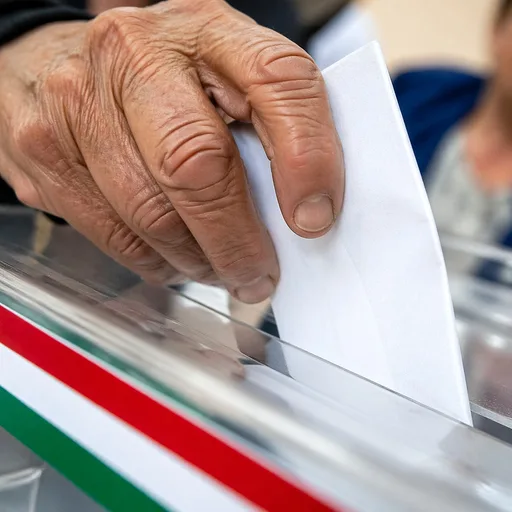
布达佩斯的风向:欧尔班模式第一次真正被挑战
Orbán Faces Magyar in Hungarian Election
About this story
Viktor Orbán's Fidesz meets its first real threat as Péter Magyar's Tisza party rises ahead of Hungary's vote. HSK 5-6 Chinese listening practice.
This is an HSK 5-6 Chinese listening episode that runs about 10 minutes. The full Mandarin script is shown with tap-for-pinyin and a line-by-line English translation, so you can listen and read at once — comprehensible input in the sense of Stephen Krashen's i+1 theory. It teaches 20 key vocabulary words such as 经济、政治、政府 and walks through 5 grammar patterns, each explained in English with examples. The same news story is retold at 4 difficulty levels — use the level selector above to find the version that is challenging but still understandable for you.
Read at your level
原文Read the complete story in Chinese. Reveal pinyin and English only when you need them.
English transcript reference
Speaking of the most-watched political event in Europe this weekend, Hungary's election is almost the only answer.
On Sunday April 12, Hungarian voters will vote to elect a new National Assembly.
Parliament has a total of 199 seats.
The leader of the largest party or coalition will become the next prime minister.
This election is important not just because it decides the future of a small country of ten million.
It may also decide the fate of a political model.
This model's name is "illiberal democracy."
The person who coined this term is none other than the current prime minister Viktor Orbán.
Let's start with him.
Orbán is 62 years old this year.
His political career is remarkable.
When he was young he was an anti-communist radical.
In 1989, at that famous funeral speech, he publicly demanded that Soviet troops withdraw from Hungary.
He was only 26 that year.
That speech made him famous overnight.
He was a symbol of Hungary's democracy movement at the time.
The party he founded, Fidesz, was initially a young, pro-European, liberal party.
He first served as prime minister from 1998 to 2002.
At that time, he was still a reform-minded star in Western eyes.
Then, he lost the 2002 election.
He spent the next eight years on opposition benches.
It was during those eight years that Orbán's political stance began to fundamentally shift.
He went from a liberal to a populist.
From pro-European to Euroskeptic.
From opposing concentration of power to pursuing power.
In 2010 he returned to the center of power with an overwhelming majority.
And he hasn't left since.
After returning to power, the first thing Orbán did was rewrite the constitution.
The new constitution expanded the prime minister's powers.
Weakened the Constitutional Court.
Redrew electoral districts to favor Fidesz.
Over the next few years, he did a series of things.
Turned state television into a government propaganda machine.
Had friends buy up most private media.
Lowered the retirement age for the Supreme Court, replacing a large number of disobedient judges at once.
Made it difficult for the opposition to access state funds.
Used state resources to reward supporters and punish critics.
Looked at individually, each of these measures can find a reasonable explanation.
But added together, they constitute a new political system.
A system that appears to still have elections, but whose election results are basically locked in.
Orbán himself gave this system a name.
Called "illiberal democracy."
Translated into Chinese it's "bu ziyou de minzhu."
He means: democracy doesn't necessarily need to be bound to individual liberty, judicial independence, and media freedom.
You can have a democracy that emphasizes national identity, Christian values, and collective interests.
Not individual rights.
The Western political science community has another name for this concept.
They call it "competitive authoritarianism."
Or using V-Dem Institute's classification, "electoral autocracy."
Meaning that although there are elections in form.
The ruling party has, through control of media, judiciary, and election rules.
Deprived the opposition of genuine competitiveness.
This is Hungary today.
Over the past sixteen years, the opposition has tried various approaches.
Forming united fronts.
Nominating joint candidates.
Accepting foreign advisors.
All have failed.
In the 2022 general election.
Six opposition parties formed a united front.
In the end they still lost to Fidesz.
And lost badly.
After that, many people thought Orbán's rule could no longer be challenged.
Until the emergence of Péter Magyar.
Magyar is 44 years old this year.
His background is interesting.
He himself came from within the Fidesz system.
His ex-wife Varga Judit was once the Minister of Justice.
He personally has experience in management positions at the national development bank and universities.
He was never an "opposition figure."
He was someone inside that system.
Then, in early 2024, something happened.
Hungary's president Novák Katalin pardoned a former deputy director of a child protection institution.
This person was accused of covering up another employee's sexual abuse of children at an orphanage.
After the pardon was made public, the whole country was shocked.
Hungarians are already used to corruption.
But this incident crossed a line.
Novák Katalin was forced to resign.
Varga Judit also resigned from her party position.
In this political earthquake, Magyar stood up.
He publicly criticized Fidesz.
He said this wasn't an accident.
It was corruption of the entire system.
He left Fidesz.
Joined a small party called Tisza.
Tisza is the name of a river in Hungary.
Magyar quickly became the leader of this party.
Over the next two years, he did something that the Hungarian opposition had never managed to do before.
He went to the streets.
Holding rallies city by city.
Not in big city salons.
But in small town squares.
He spoke directly with ordinary people.
He listened to them complain about high prices.
Listened to them complain about hospital queues.
Listened to them complain that young people can't find jobs and have to go abroad.
This political approach had disappeared from Hungary for over a decade.
Because Fidesz's politics is top-down.
Broadcast through media.
Not through face-to-face exchange.
Magyar activated an overlooked part.
The people who were already dissatisfied with Fidesz but felt there was no hope.
His rallies kept getting bigger.
Once in Budapest there were over a hundred thousand people.
That's rare in Hungary.
Magyar's core promises are four.
First, anti-corruption.
He promises to fully cooperate with the EU's anti-corruption agency.
To investigate how funds flowed during the sixteen years of Fidesz rule.
Second, restoring rule of law.
Making Hungary meet basic EU standards again.
So the roughly 20+ billion euros in structural funds frozen by the EU can be unfrozen.
The importance of this money to Hungary's economy goes without saying.
Third, repositioning relations with Russia.
Orbán has always been the most pro-Russia leader in the EU.
Even after Russia invaded Ukraine.
Hungary continues to import Russian natural gas and oil.
Magyar promises to accelerate energy diversification.
Reducing dependence on Moscow.
Fourth, repairing relations with the EU.
No longer being the "troublemaker" who gets all meeting agendas stuck.
But a constructive member state.
These promises sound very ordinary.
But placed in Hungary's context, they are revolutionary.
Because they are completely opposite to Orbán's sixteen-year ruling line.
Looking at the polling results.
This election really does have a chance of flipping.
Aggregating various polls, the average shows.
The Tisza party leads Fidesz by about nine to ten percentage points.
But the accuracy of polls in Hungary has long been disputed.
Pro-government polling agencies give numbers more favorable to Fidesz.
Independent polling agencies give numbers more favorable to Tisza.
The real results are probably somewhere in between.
But there's one thing everyone agrees on.
This is the most serious challenge Orbán has faced in sixteen years.
No exceptions.
The question is: even if he loses on the ballot, will Orbán honestly hand over power?
This is what many observers worry about most.
Because Orbán controls almost every part of the state machinery.
The election commission.
The Constitutional Court.
The Supreme Court.
State media.
Even senior military and police appointments are in his hands.
If the gap isn't big enough.
He has many ways to influence the final result.
Such as questioning mail-in ballots.
Such as alleging election fraud.
Such as using the Constitutional Court to overturn results.
These playbooks have been run in other countries.
Hungary is entirely possible too.
So all of Europe is watching nervously.
The European Commission's leaders have already issued statements.
Emphasizing that Hungary must respect the election results.
But how much binding force an EU statement has on Orbán.
No one knows.
There's another international factor.
Which is the Trump administration's attitude.
U.S. Vice President J.D. Vance visited Budapest last month.
Held talks with Orbán.
This is widely interpreted as open support for Orbán.
Trump himself has always regarded Orbán as a political idol and ally.
If Orbán faces a legitimacy crisis after the election.
He is very likely to get backing from Washington.
This will make it harder for the EU to pressure him.
So this election is not just a domestic political event.
It is a crossroads of international politics.
Involving the US, Russia, the EU, Ukraine.
All these forces are watching tomorrow's vote.
If Orbán wins again.
That shows his model can continue in Europe.
This will encourage similar politicians in other European countries.
France's Le Pen.
Germany's AfD.
Italy's Meloni.
Poland's PiS.
They will all gain confidence from it.
Conversely, if Magyar wins.
That shows that even a "veteran" like Orbán can be defeated through democratic procedures.
Even "illiberal democracy" can be flipped by real democracy.
This is a huge blow to the entire European right wing.
So regardless of the outcome.
April 12 will be a turning point in European politics.
On one side is the "illiberal democracy" model built over the past twenty years.
On the other side is a reform wave erupting from within the system.
Who will win.
We'll know tomorrow night.
But regardless of who wins.
One thing has already been determined.
That Orbán's sixteen-year rule is no longer unchallengeable.
It has already been shaken.
What to watch next is.
Whether this shaking will become a collapse.
Or be repaired.
The answer lies in tomorrow's ballot boxes.
Listen again
Try it without the transcript and notice what sounds clearer.
What vocabulary does this episode teach?
词汇HSK 1-4. economy.
HSK 1-4. politics.
HSK 1-4. government.
HSK 1-4. international.
HSK 1-4. reform.
HSK 1-4. democracy.
HSK 1-4. right.
HSK 1-4. institution, organization.
HSK 1-4. import.
HSK 1-4. data.
Hungary's parliament.
Someone who takes extreme positions.
A speech given at a funeral ceremony.
Political approach appealing to ordinary people against elites.
Someone skeptical of European integration.
Dominant to the point of being crushing.
Court that rules on constitutional matters.
A geographic division for elections.
A state apparatus for spreading propaganda.
Authoritarianism with nominal elections.
* beyond level超纲词
What grammar patterns appear in this episode?
语法Proper nouns
专有名词Sources
来源Free account
Keep learning from this story
Create a free account to keep saved words and your preferred level together.
- Keep words with their story context
- Remember your preferred level
- Build your vocabulary over time