
A Chinese podcast · Same story, 4 levels
工资不够活,他烧了五亿美元
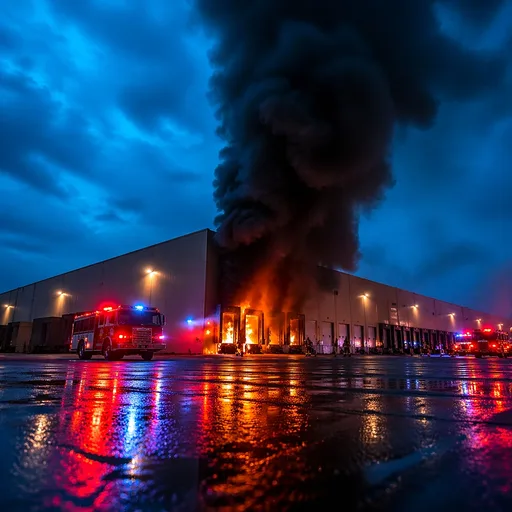
California Warehouse Arson Destroys $650M Goods
About this story
Warehouse worker Chamel Abdulkarim burns a Kimberly-Clark site in Ontario, California — $500M lost over low pay. HSK 2 Chinese listening practice.
This is an HSK 2 Chinese listening episode that runs about 6 minutes. The full Mandarin script is shown with tap-for-pinyin and a line-by-line English translation, so you can listen and read at once — comprehensible input in the sense of Stephen Krashen's i+1 theory. It teaches 12 key vocabulary words such as 有意思、公司、问题 and walks through 4 grammar patterns, each explained in English with examples. The same news story is retold at 4 difficulty levels — use the level selector above to find the version that is challenging but still understandable for you.
Read at your level
原文Read the complete story in Chinese. Reveal pinyin and English only when you need them.
English transcript reference
Speaking of wages and living costs, something happened in America recently that shocked everyone.
A warehouse employee burned down the place where he worked.
Not a small fire.
He burned the entire warehouse.
A 1.2 million square foot warehouse.
Completely burned down.
The stuff inside was worth 500 million dollars.
500 million.
Let's tell this story from the beginning.
This person's name is Chamel Abdulkarim.
Twenty-nine years old.
Living in California.
He worked in a very big warehouse.
This warehouse belongs to Kimberly-Clark.
Kimberly-Clark is a big company that makes tissues and toilet paper.
You may have used their products.
This warehouse is in Ontario, California.
Ontario is about forty miles east of Los Angeles.
How big is this warehouse?
1.2 million square feet.
About the size of a dozen football fields.
Inside it was all toilet paper and tissues.
Chamel didn't work directly for Kimberly-Clark.
He worked through a middleman company.
This kind of middleman company is called a "staffing agency."
Meaning your boss isn't the warehouse's boss.
Your boss is another company.
They send you to the warehouse to work.
This kind of job usually pays lower wages.
And fewer benefits.
Chamel was very unhappy with his wages.
He felt his pay was too low.
Not enough to live on.
He said: "All you had to do was pay us enough to live."
This frustration wasn't from just one or two days.
But he chose an extreme way to express it.
That night at about 12:30.
Chamel was inside the warehouse.
He used a lighter to set the toilet paper on the shelves on fire.
He didn't just light one spot.
He lit several spots.
Toilet paper is made of paper.
Paper burns very easily.
The fire spread quickly.
And he recorded video on his phone while it burned.
He posted the video to Instagram.
In the video you can see the fire spreading.
You can hear him say: "Your inventory is gone."
In another video he says: "All you had to do was pay us enough to live."
Later he also sent a message to a coworker.
He said: "Pay us more of the value we create."
"Don't just pay the executives."
"Haven't seen the shareholders come in for a single shift."
These words show he was very angry.
He felt workers did the hardest work.
But the money was all taken by the bosses and shareholders.
The fire burned for a long time.
Because everything inside was paper.
Paper is the best fuel.
Firefighters came but it was hard to save.
In the end the whole warehouse roof collapsed.
Several big trucks parked outside were also burned.
How big was the loss?
The products inside were worth about 500 million dollars.
The warehouse building itself was worth about 150 million dollars.
Together that's over 650 million dollars.
But the most important news is: nobody was hurt.
There were about twenty workers in the warehouse at the time.
They all evacuated safely.
Chamel was caught very quickly.
Because he recorded video himself and posted it online.
Police found him very easily.
After being caught he was put in jail.
No bail allowed.
He faces federal arson charges.
Minimum five years in prison.
Maximum twenty years.
He also faces seven California arson charges.
If all charges stick.
He could serve ten years to life in prison.
There's another interesting detail.
After being caught Chamel made a phone call.
In the call he compared himself to Luigi Mangione.
Who is Mangione?
Last year Mangione killed the boss of a big insurance company in New York.
That case caused a huge reaction in America.
Many people felt insurance companies are too greedy.
So some people treated Mangione as a hero.
Chamel felt he was the same.
He felt he was standing up for workers.
Fighting big companies for ordinary people.
But the prosecutors don't see it that way.
They say arson is a crime.
No matter what your reason is.
This story reflects a big problem in America.
Many ordinary workers' wages can't keep up with prices.
They feel they work very hard but life gets harder.
They see company bosses and shareholders getting richer.
While their own lives aren't getting better.
This kind of frustration is becoming more common in America.
The Mangione case and this arson case are both expressions of this frustration.
But burning things and killing people aren't ways to solve problems.
There are legal ways to express frustration.
You can go on strike.
You can organize a union.
You can vote for candidates who support workers.
These are the right ways.
Listen again
Try it without the transcript and notice what sounds clearer.
What vocabulary does this episode teach?
词汇HSK 1-2. interesting.
HSK 1-2. company.
HSK 1-2. problem / question.
HSK 1-2. meaning / interest.
HSK 1-2. mobile phone.
HSK 1-2. place.
Deliberately setting fire. A serious crime.
When workers are hired through a middleman company.
When fire or disease expands outward.
Goods stored in a warehouse.
Paying money to leave jail before trial.
Being in prison for your entire life.
* beyond level超纲词
What grammar patterns appear in this episode?
语法Proper nouns
专有名词Sources
来源Free account
Keep learning from this story
Create a free account to keep saved words and your preferred level together.
- Keep words with their story context
- Remember your preferred level
- Build your vocabulary over time