
A Chinese podcast · Same story, 4 levels
"变成中国人"——美国年轻人的新流行
Chinamaxxing Trend Spreads Across US TikTok
About this story
The Chinamaxxing trend explained: hot water, slippers, Ba Duan Jin, hotpot, uncle-core style — and why $94k in student debt and 35% rent are pushing US Gen Z to imitate Chinese life. HSK 3 Chinese listening practice.
This is an HSK 3-4 Chinese listening episode that runs about 8 minutes. The full Mandarin script is shown with tap-for-pinyin and a line-by-line English translation, so you can listen and read at once — comprehensible input in the sense of Stephen Krashen's i+1 theory. It teaches 12 key vocabulary words such as 习惯、节目、健康 and walks through 6 grammar patterns, each explained in English with examples. The same news story is retold at 4 difficulty levels — use the level selector above to find the version that is challenging but still understandable for you.
Read at your level
原文Read the complete story in Chinese. Reveal pinyin and English only when you need them.
English transcript reference
Recently there's a thing I find pretty interesting.
Among young Americans, there's a new trend.
They say they want to "become Chinese."
In English it's called Chinamaxxing.
When you hear this word, you might think it's strange.
What does "becoming Chinese" mean?
Let's take it slowly.
This thing started from phone videos.
On TikTok, there have been a lot of videos lately.
The young Americans in the videos are starting to live like Chinese people.
What are they doing?
Let me tell you a few.
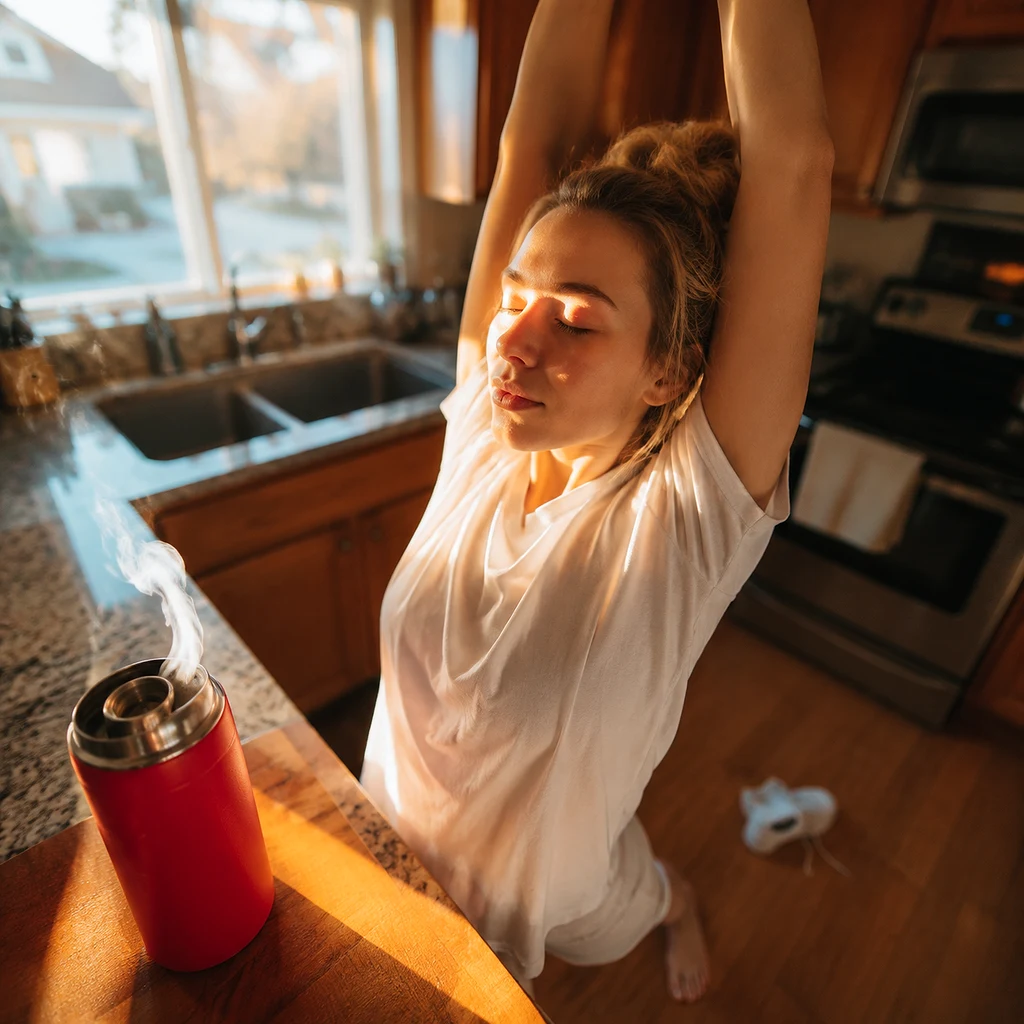
First, drinking hot water.
They buy a big cup.
They put hot water inside.
They drink it all day.
They bring it to the office.
They carry it on the subway.
They say: before, they drank cold water; now they drink hot water; the stomach feels better.
Chinese people will laugh: isn't that normal?
But for Americans, this is new.
They used to like cold cola.
Now they switched to hot water.
That's not a small change.
Second, wearing slippers at home.
Chinese people change shoes when they get home.
The outside shoes are dirty.
The slippers at home are clean.
This idea, in China, is common sense.
But in America, it's new.
Americans didn't used to do this.
They wore outside shoes at home too.
Some people didn't even take off their shoes.
Now many young people are starting to switch to slippers.
They say the home is cleaner.
The feet feel better too.
Third, doing Ba Duan Jin.
Ba Duan Jin is an old Chinese exercise.
It has hundreds of years of history.
It's not running, and it's not weightlifting.
It's just moving slowly.
There are eight movements in total.
The names are interesting too.
For example: "Two hands hold up the heavens to regulate the triple burner."
Many young Americans do Ba Duan Jin first thing in the morning.
They follow along on YouTube.
After doing it, the whole body is relaxed.
They say it feels great.
Better than going to the gym.
Fourth, sleeping early and rising early.
They used to sleep at one or two in the morning.
Some were still on their phone at three.
Now it's different.
They sleep at ten.
They get up at six.
They say their body feels much better.
Their head doesn't hurt anymore either.
Fifth, eating hotpot, eating Chinese food.
They think hotpot is the most fun way to eat.
A big group of friends sits together.
In the middle is a pot.
Everyone swirls food in the pot together, chatting together.
Some put in meat.
Some put in vegetables.
Some put in noodles.
They say this kind of eating isn't lonely.
Much better than eating a hamburger alone.
There's another thing they also like.
They gave it a name: "uncle style."
In English it's "uncle core."
What does that mean?
It means wearing tracksuits.
Squatting by the road drinking beer.
Chatting with old friends.
Not putting on airs, not faking.
They think this kind of life is comfortable.
And real.
The people pushing this trend are two famous figures.
The first is Sherry Zhu.
She is American.
But her parents are Chinese.
She makes videos on TikTok.
Starting in 2025, she taught people "how to become Chinese."
Her videos are half serious, half joking.
She'll say: today's first step, drink hot water.
And then hold up a thermos.
Everyone finds it interesting.
Her videos, all together, have millions of views.
The second is IShowSpeed.
He is an American gaming streamer.
He is extremely famous online.
In 2025, he went to China.
He livestreamed for many days.
He went to Beijing, Shanghai, Guangzhou.
He took the high-speed rail.
The high-speed rail is fast.
He said: too amazing.
He used his phone to pay.
He said: too convenient.
He walked alone on the street in the middle of the night.
He said: very safe.
He watched a drone show.
There were thousands of drones in the sky.
He said: insane.
His livestream had tens of millions of viewers.
Many young Americans only started paying attention to China after watching his livestream.
Then they thought: I also want to try Chinese life.
That's the start of Chinamaxxing.
But, we have to ask a question.
Why?
Why do they want to become Chinese?
Is it because China really is that good?
Not entirely.
The deeper reason, actually, is American life.
For young Americans, life right now is exhausting.
Let me say a few numbers.
You'll understand when you hear them.
College is expensive.
On average, they owe about $94,000 in student loans after graduating.
That's a huge sum.
It means in their first ten years of working, they're paying back school debt.
Seeing a doctor is expensive too.
About $5,000 per year on average.
Even if you don't get sick, you still spend money.
Housing is even more expensive.
They work a long time.
But about a third of their salary goes to rent.
Many people are thirty and still living with their parents.
They can't afford a house.
They feel they have no future.
They've already become very disappointed in life.
So when they see the Chinese videos, they think:
Those people over there seem to live a bit more easily.
Drinking hot water.
Wearing slippers.
Sleeping early and rising early.
Eating hotpot with friends.
Living slowly.
They think: this is the way a person should live.
Of course, people who know China will say:
Chinese young people are exhausted too.
China also has "996."
That's nine a.m. to nine p.m., six days a week.
Housing in China is expensive too.
China also has "neijuan."
"Neijuan" means everyone is racing, but no one really wins.
All of this is true.
So this thing doesn't mean Chinese life is necessarily better than American life.
It means young Americans are already unhappy with their own lives.
They're looking for another path.
They saw something in China.
What looks good, they take and use.
What doesn't fit, they put down.
They don't really want to become Chinese.
They want to become someone who can slow down.
They want to become someone who can eat well, sleep well.
There's another interesting angle.
In the past, it was Chinese people learning from Americans.
That was decades ago.
Chinese people wanted to study in America.
Wanted to work in America.
Chinese people wanted cola and hamburgers.
Wanted to celebrate Christmas.
That was that era's idea of "modern life."
Now it's flipped.
Young Americans want to learn from Chinese people.
They want to drink hot water.
Want to eat hotpot.
Want to wear slippers.
Want to do Ba Duan Jin.
The two sides seem to be swapping.
This shows that the world has changed.
We all used to look in one direction.
Now it's different.
When I saw this news, I had a very particular feeling.
We who learn Chinese are actually doing a kind of Chinamaxxing too.
We're also learning the Chinese way of life.
We also like Chinese things.
You listening to this show today are part of this thing too.
Finally, I want to ask you a question.
What about you?
After you started learning Chinese.
Are there things in your life that have quietly become "more Chinese"?
Maybe it's the food you eat.
Maybe it's the time you sleep.
Maybe it's the way you see the world.
Maybe it's a Chinese phrase you often say.
Think about it.
The "Chinese" part inside you — where does it come from?
Take your time, no rush.
Listen again
Try it without the transcript and notice what sounds clearer.
What vocabulary does this episode teach?
词汇HSK 3. Both noun and verb. 中国人的习惯 = Chinese habits / customs.
HSK 3 noun. Measure word: 个. 你今天来听这个节目 = you came to listen to this program today.
HSK 3. Both an adjective and a noun. Used in the script's discussion of why slow living feels better for the body.
HSK 2 connector. Used to introduce a specific example. Can also appear as 比如说.
HSK 3 verb/noun. 这是一个不小的变化 — uses a synonym 变化. 改变 carries the same meaning.
HSK 3 adjective/noun. From IShowSpeed's livestream comment: 半夜一个人在街上走,很安全 = walking alone in the middle of the night is safe.
Beyond HSK 1-3. Measure word: 双. 换拖鞋 = to change into slippers. Central concept in the episode.
Beyond HSK 1-3. Compound noun: 保温 (keep warm) + 杯 (cup). Sherry Zhu's signature prop in her videos.
Beyond HSK 1-3. Used throughout the script to describe what Americans are doing — imitating Chinese lifestyle habits.
Beyond HSK 1-3. Both noun and verb. 他直播了很多天 = he livestreamed for many days. The dominant content format in China.
Beyond HSK 1-3. A word Chinese young people coined to describe pointless intense competition where everyone races but no one really wins.
HSK 4, beyond the HSK 1-3 target. The standard word for any phone or computer application.
* beyond level超纲词
What grammar patterns appear in this episode?
语法Subject + 觉得 + Clause
Used to express opinion or feeling. Common spoken form. 觉得 is followed by a full clause.
我觉得挺有意思的。
他们觉得,这才是人应该过的生活。
他们觉得这样的生活很舒服。
因为... + 所以...
Cause-and-effect connector. Both clauses are kept. The 所以 part can sometimes be dropped in spoken Chinese but rarely the 因为 part.
因为他们买不起房子,所以他们觉得很累。
他们模仿喝热水,是因为他们怀念被照顾的感觉。
Subject + 比 + Comparison + Adjective
比 introduces what's being compared to. A 比 B + adjective = A is more [adj] than B.
比一个人吃汉堡好多了。
比去健身房还舒服。
他们的生活比以前更累。
Verb + 一下
一下 after a verb softens the action — 'do something for a moment / a bit'. Very common in spoken Chinese.
我们先说一下,他们做了什么。
他们想试试。
你想一想。
Indicates an increasing tendency: 'more and more...'. Often pairs with a comparative adjective.
现在不一样了。
他们越来越累。
不是... + 是...
Used to correct or clarify. 'It's not X, it's Y.' Very common spoken pattern for emphasis.
他们不是真的想变成中国人。
他们是想变成那个,可以慢一点的人。
这个不是说,他们要换国家。
Proper nouns
专有名词Free account
Keep learning from this story
Create a free account to keep saved words and your preferred level together.
- Keep words with their story context
- Remember your preferred level
- Build your vocabulary over time