
A Chinese podcast · Same story, 4 levels
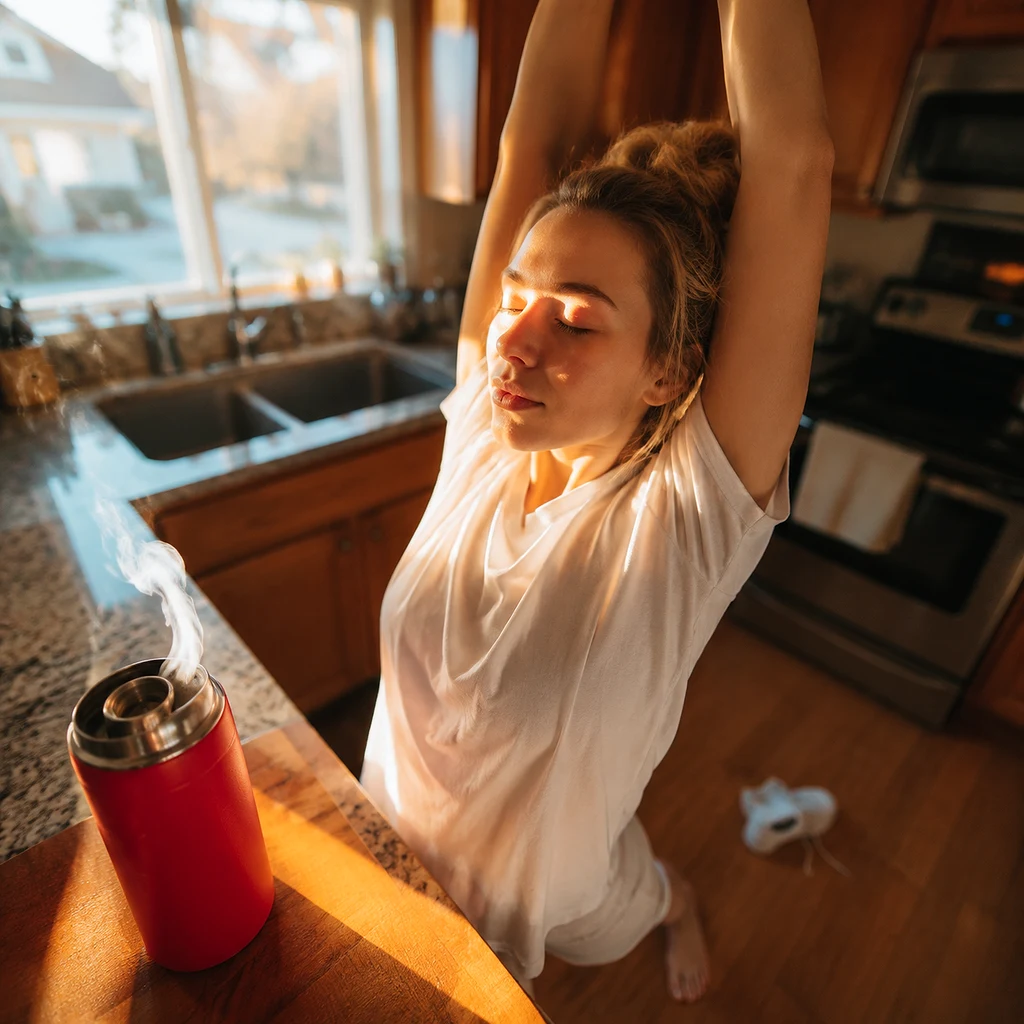
美国年轻人想"变成中国人"
Chinamaxxing Trend Spreads Across US TikTok
About this story
A look at the Chinamaxxing TikTok trend: young Americans drinking hot water, wearing slippers, doing Ba Duan Jin, and following creators like Sherry Zhu and IShowSpeed. HSK 2 Chinese listening practice.
This is an HSK 2 Chinese listening episode that runs about 6 minutes. The full Mandarin script is shown with tap-for-pinyin and a line-by-line English translation, so you can listen and read at once — comprehensible input in the sense of Stephen Krashen's i+1 theory. It teaches 12 key vocabulary words such as 喝、喜欢、一起 and walks through 6 grammar patterns, each explained in English with examples. The same news story is retold at 4 difficulty levels — use the level selector above to find the version that is challenging but still understandable for you.
Read at your level
原文Read the complete story in Chinese. Reveal pinyin and English only when you need them.
English transcript reference
Let me tell you a news story.
Right now in America, there's a new thing.
A lot of young people want to "become Chinese."
This doesn't mean they're changing countries.
It means they want to live like Chinese people.
This thing started from phone videos.
They watch videos.
They watch Chinese people's lives.
After watching, they think it looks good.
So they start doing it too.
Let's first say what they did.
First, they drink hot water.
Many Chinese people like hot water.
They don't like cold water.
They say hot water is good for the body.
Young Americans didn't used to be like this.
They used to drink cold water.
They also liked drinking cola.
Now it's different.
They bought a big cup.
There's hot water in the cup.
They drink it all day.
They say it makes the stomach feel a bit better.
Second, they wear slippers at home.
After Chinese people get home, they change shoes.
They put on slippers.
They say it's comfortable for the feet.
The home is also cleaner.
Young Americans used to wear outside shoes at home too.
Now they're learning too.
They bought slippers.
As soon as they get home, they change.
They say, it really is good.
Third, they exercise in the morning.
The exercise they do is called Ba Duan Jin.
Ba Duan Jin is an old Chinese exercise.
It's hundreds of years old.
It's not very tiring.
It's not running.
It's not weightlifting either.
It's just moving slowly.
There are eight movements.
They do it when they get up in the morning.
After doing it, they feel very comfortable.
Fourth, they sleep early at night.
They don't stay up late.
They used to sleep at one in the morning.
Now they sleep at ten.
They get up at six in the morning.
They say, sleeping early is good for the body.
Fifth, they also eat Chinese food.
They like eating hotpot.
There are lots of things in hotpot.
There's meat, vegetables, noodles.
Everyone eats together.
In the middle is a big pot.
They say it's lively that way.
And not lonely.
There's also a famous person.
Her name is Sherry Zhu.
She is American.
But her parents are Chinese.
She makes videos on TikTok.
She teaches people "how to become Chinese."
She says, first, drink hot water.
Second, wear slippers.
Third, sleep early.
Her videos are interesting.
She's also a little bit joking.
A lot of people watched and laughed.
Then they started learning too.
Her videos have been watched by millions.
There's another person, called IShowSpeed.
He is an American internet celebrity.
He's famous for playing games.
Last year he went to China.
He went to lots of places in China.
He went to Beijing.
He went to Shanghai.
He took the high-speed train.
The high-speed train is fast.
He used his phone to buy things.
He said: China is really convenient.
Walking alone at night is also safe.
He filmed a lot of videos.
A huge number of people watched his videos.
Tens of millions.
These videos made young Americans start thinking:
Oh, so this is what Chinese life is like.
I want to try it too.
You might ask: why?
Why do they want to "become Chinese"?
Because American life, for young people, is a bit hard.
Going to college is expensive.
A lot of young people have to pay back a lot of money after college.
Seeing a doctor is also expensive.
Housing is expensive too.
They work for many years and still can't afford a house.
So they feel very tired.
Then they see videos of China.
They see Chinese people walking slowly.
Eating slowly.
Drinking hot water.
Sleeping early.
They think: I also want this kind of life.
So they start learning.
Learning to drink hot water.
Learning to wear slippers.
Learning to sleep early and rise early.
There's one interesting thing.
In the past, a lot of Chinese people wanted to learn from Americans.
They wanted to go to America.
They wanted to drink cola and eat hamburgers.
Now it's the other way around.
Americans want to learn from Chinese people.
They want to drink hot water and eat hotpot.
The two sides seem to be swapping.
Of course, not all Americans are like this.
Some people don't like this thing.
They say: why are you doing this?
But the people doing it say:
We don't dislike America either.
We just think Chinese life has good parts.
We want to try.
What we learn, we use.
It's that simple.
This new thing, in English, is called Chinamaxxing.
In Chinese you can say "becoming Chinese."
This word is super hot online right now.
Finally, I want to ask you a question.
What about you?
In your life, is there anything you learned from another country?
Maybe it's food.
Maybe it's clothing.
Maybe it's a habit.
Do you think that thing made your life better?
Think about it slowly.
Listen again
Try it without the transcript and notice what sounds clearer.
What vocabulary does this episode teach?
词汇HSK 1 verb. Used throughout for 喝热水 (drink hot water) and 喝可乐 (drink cola).
HSK 1 verb. Followed by either a noun (喜欢热水) or a verb phrase (喜欢吃火锅).
HSK 2 adverb. Always before the verb: 大家一起吃 = everyone eats together.
HSK 2 verb. Used to express subjective opinion or feeling, followed by a clause.
HSK 2 verb. Often followed by another verb: 他们也开始学 = they also start learning.
HSK 2 conjunction. Often paired with 所以 (suǒyǐ) to form 'because... so...'. Introduces the reason clause.
Beyond HSK 1-2. Measure word: 双 (a pair) or 只 (a single one). 换拖鞋 = to change into slippers.
Beyond HSK 1-2. The iconic Chinese communal cooking dish — a shared pot of soup at the table where diners cook their own ingredients.
Beyond HSK 1-2. Short for 高速铁路 (high-speed railway). China has the world's largest high-speed rail network.
Beyond HSK 1-2. Combination of 网 (web) + 红 (red, popular). Refers to influencers and viral online personalities.
HSK 3, beyond the HSK 1-2 target. Both a noun and a verb: 我习惯了 = I'm used to it.
HSK 4, beyond the HSK 1-2 target. 手机软件 = phone app. Used in the script to describe Xiaohongshu.
* beyond level超纲词
What grammar patterns appear in this episode?
语法Subject + 喜欢 + Object / Verb-phrase
Use 喜欢 to express liking either a noun or an activity. The activity can be a full verb phrase.
他们喜欢吃火锅。
他们也喜欢喝可乐。
他们喜欢一起做。
因为... + 所以...
The most common 'because... so...' cause-and-effect structure in Chinese. Both clauses are kept, unlike English which usually drops one.
因为美国的生活有点难,所以他们觉得很累。
因为他们买不起房子,所以他们觉得没有未来。
比 + B + Adjective
Comparison structure: A 比 B + adjective = 'A is more [adj] than B'. Don't add 更 or 比较 inside the comparison.
这样很热闹,比一个人吃汉堡好多了。
高铁很快。
Subject + 觉得 + Clause
Use 觉得 to introduce an opinion or feeling. Followed by a complete clause, not just an adjective.
他们觉得很舒服。
他们觉得:这样的生活我也想要。
他们觉得,这样肚子舒服一点。
Subject + 开始 + Verb-phrase
开始 introduces the beginning of an action. Followed by another verb or verb phrase.
他们也开始学。
美国年轻人也开始学中国人。
他们开始关注中国。
Proper nouns
专有名词Free account
Keep learning from this story
Create a free account to keep saved words and your preferred level together.
- Keep words with their story context
- Remember your preferred level
- Build your vocabulary over time