
A Chinese podcast · Same story, 4 levels
Chinamaxxing:当西方年轻人想要"变成中国人"
Chinamaxxing Trend Spreads Across US TikTok
About this story
The Chinamaxxing trend on TikTok — Sherry Zhu's tutorials, IShowSpeed's China tour, and the deeper story: $94k student debt, 35% rent, and a generation that no longer believes in the American Dream. HSK 5-6 Chinese listening practice.
This is an HSK 5-6 Chinese listening episode that runs about 9 minutes. The full Mandarin script is shown with tap-for-pinyin and a line-by-line English translation, so you can listen and read at once — comprehensible input in the sense of Stephen Krashen's i+1 theory. It teaches 12 key vocabulary words such as 习惯、健康、节目 and walks through 7 grammar patterns, each explained in English with examples. The same news story is retold at 4 difficulty levels — use the level selector above to find the version that is challenging but still understandable for you.
Read at your level
原文Read the complete story in Chinese. Reveal pinyin and English only when you need them.
English transcript reference
Why is there a group of young Americans seriously trying to "become Chinese"?
That's one of the most interesting questions on the American internet in the spring of 2026.
Today we're going to talk about this.
The English name for it is Chinamaxxing.
Translated literally, it means "maxing yourself out as Chinese."
In the Chinese-speaking world, the more common phrase is "becoming Chinese."
Some people just use the English "becoming Chinese."
It's not about nationality.
It's about lifestyle.
A group of American Gen Z is starting to imitate the Chinese daily routine.
What are they doing?
Let me lay out a few of these things.
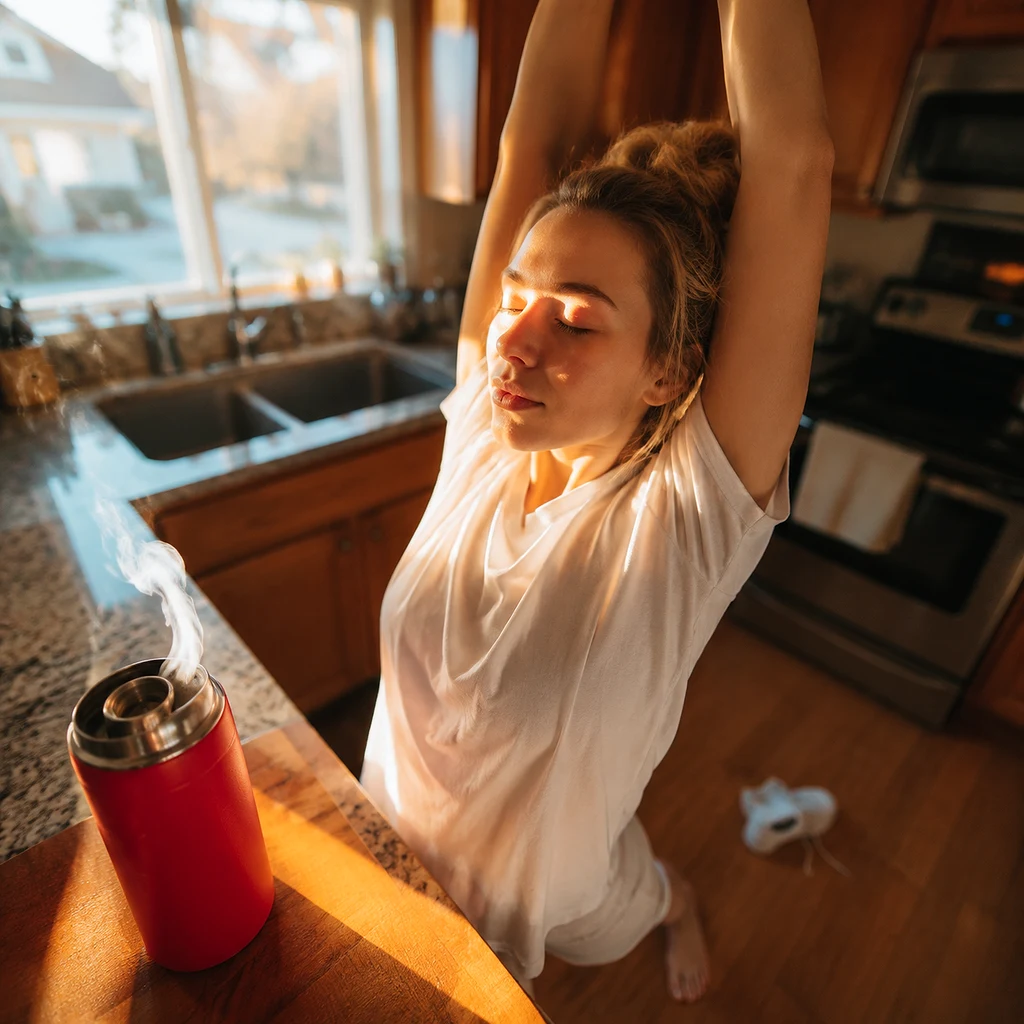
First, drinking hot water.
They've ditched ice water.
And they're not drinking iced cola every day anymore.
They buy a thermos.
They fill it with hot water.
They carry it at the office.
They carry it on the subway too.
They even bring it to friend gatherings.
Don't laugh — this really is a new thing.
Second, changing into slippers at the door.
The shoes from outside are dirty.
The home has to stay clean.
This idea is common sense in China.
In America, it's new.
They take off their shoes as soon as they get home.
Then they change into slippers.
They say the whole house feels different.
Third, doing Ba Duan Jin in the morning.
Not lifting weights at the gym.
Not running five kilometers.
Just slowly, leisurely.
Going through eight movements once.
With some soft music in the background.
They say after doing it the whole body is loose.
More comfortable than intense exercise.
Fourth, sleeping early and rising early.
They put down their phones.
In bed at ten.
Up at six.
No staying up late.
No scrolling videos at two or three in the morning.
Their sleep schedules have actually come back.
Fifth, eating Chinese food.
Especially hotpot.
They also drink Chinese-style soups.
They steep herbal tea.
They love a group of people circling a single pot.
Cooking slowly, chatting slowly.
Not rushing to finish.
Not rushing to leave.
There's another thing they've given a name to.
They call it "uncle style."
In English, "uncle core."
What does that mean?
It means wearing loose tracksuits.
Squatting by the road drinking beer.
Chatting casually with old friends.
Not putting on airs.
Not faking sophistication.
That relaxed atmosphere of life.
They find it especially healing.
There are two key figures pushing this trend.
Let me introduce them.
The first is Sherry Zhu.
She's an American-born Chinese.
She makes videos on TikTok.
Starting in 2025, she filmed a series of tutorials.
Called "how to become Chinese."
The style is half-serious, half-joking.
She'll say with a straight face: today's first step, drink hot water.
And then she lifts up a big thermos.
The audience finds it both funny and reasonable.
Her videos add up to millions of views.
The second is IShowSpeed.
He's a very famous American gaming streamer.
He usually streams games on YouTube.
In 2025, he flew to China.
He livestreamed a trip across China.
He took the high-speed rail.
He watched a drone show.
He tried QR-code payments.
He walked alone on the street in the middle of the night.
He kept saying to the camera: "This is insane."
That livestream had tens of millions of viewers.
These two accounts, taken together.
Made a lot of young Americans.
Look seriously, for the first time, at the everyday life in China.
Then they started imitating.
But this thing, on the surface, can't be understood.
We have to dig a layer deeper.
We have to ask a question.
Why now?
Why this generation of Americans?
Why not ten years ago?
The answer, actually, has little to do with China.
The deeper reason lies in America itself.
Let me give you a few numbers, and you'll feel it.
American college graduates carry, on average, $94,000 in student loans.
That's not a small amount.
It means in their first ten years of work, they might just be paying off school debt.
Healthcare is absurdly expensive too.
On average each person spends over $5,000 a year on medical care.
Even if you don't get sick.
Housing, even more so.
Their salaries — about 30 to 35 percent goes to the landlord.
Some people are thirty and still living with their parents.
So you see this picture.
A 20-something or early-30s young American.
Working hard every day.
But still feeling there's no future.
They no longer believe in their parents' generation's "American Dream."
And right at that moment, they swiped onto videos about China.
On screen was another way of life.
A thermos.
A pair of slippers.
A bowl of hot soup.
A few friends.
The pace a little slower.
The relationships a little tighter.
Their reaction was: oh, you can live like this.
So Chinamaxxing on the surface is imitating China.
Underneath, it's actually disappointment with their own country.
That's the first layer of this thing.
But there's a second layer, more worth talking about.
This trend doesn't mean Chinese life is more relaxed than American life.
Anyone who knows China understands.
Chinese young people are racing too.
"996" is still here.
Housing prices are still high.
"Neijuan" — that word was coined by Chinese young people themselves.
So strictly speaking.
These young Americans.
What they're imitating is an edited version of China.
A beautified version of China.
What they see is the most comfortable part of Chinese life.
And the most warm-hearted part.
They don't see the crowded subway.
They don't see the late-night overtime.
They don't see the anxiety of mortgage payments.
Does that mean this thing has no value?
No.
I think there's a sentence that's useful here.
When a person chooses what to imitate, they're reflecting what they lack.
They imitate drinking hot water because they miss the feeling of being cared for.
They imitate eating hotpot with a group because they're lonely.
They imitate sleeping early and rising early.
They imitate doing Ba Duan Jin.
Because their bodies have been chronically overdrawn.
The reason "uncle style" touches them.
Is that their own lives.
No longer have room for the word "relax."
So they don't really want to become Chinese.
They want to become someone who can drink hot water, wear slippers, and sleep well.
There's another interesting angle to this.
It used to be the other way around.
For the past forty years, it was Chinese people learning from America.
Drinking cola.
Eating hamburgers.
Celebrating Christmas.
Sending their kids to study in America.
That was one generation of Chinese people's idea of "modern life."
"Modern" equaled "American."
Now the wind has shifted.
It's young Americans.
Starting to treat the Chinese everyday.
As "another kind of modern life" to learn from.
The young people in the two countries.
Seem to be looking in each other's lifestyles.
For the parts they want for themselves.
When I look at this, I think of three larger trends.
The first trend.
The direction of "cultural longing" is starting to flow the other way for the first time.
In the old story, the arrow of longing almost always pointed at the West.
Now it's loosened.
That's a small but important inflection point.
The second trend.
When the younger generation chooses a lifestyle, they look less at passports and more at vibe.
What they want is slow.
Grounded.
The feeling of being connected.
Whoever can provide that vibe is who they'll learn from.
Whether you're Chinese, Japanese, or Italian.
The third trend, and the most interesting one.
This thing reminds us of something.
Each of our "cultures" is actually pieced together.
The language you use today.
The food you eat today.
The clothes you wear today.
The principles you believe today.
Behind each of them are many different countries.
What you think of as "American life."
Inside it there's Italy.
There's Japan.
There's Mexico.
What you think of as "Chinese life."
Inside it there's India too.
There's England.
There's Coca-Cola.
We are all cultural collages.
There's no "pure-blood" lifestyle.
Chinamaxxing makes this a little more visible.
And it lets us feel a little less anxious about the word "culture."
Finally, I'd like to leave two questions for you.
The first one is close.
After you started learning Chinese.
Are there things in your life that have quietly become "more Chinese"?
Maybe it's a cup.
A kind of meal.
A sleep schedule.
A catchphrase.
Can you count them?
The second one is further out.
If one day you had to leave the culture you were born into.
And pick a new lifestyle from scratch.
What are the few things you'd most want to take from other cultures?
And what are the few things you wouldn't want to take?
These two questions have no standard answer.
But they're worth thinking about slowly.
Listen again
Try it without the transcript and notice what sounds clearer.
What vocabulary does this episode teach?
词汇HSK 3 noun/verb. Used to describe the Chinese daily habits Americans are adopting.
HSK 3. The body-and-wellness frame that underlies many of the imitated habits.
HSK 3 noun. 你今天来听这个节目 = you came to listen to this program today.
HSK 3 noun/verb. The episode is about a generation's change in cultural direction.
HSK 3 noun. 节奏慢一点,关系紧一点 = pace a little slower, relationships a little tighter.
HSK 4 noun. Within the HSK 1-4 target for normal.
Beyond HSK 1-4. Sherry Zhu's signature prop. Compound: 保温 (keep warm) + 杯 (cup).
HSK 5+. Central verb of the episode — what Americans are doing to Chinese habits.
HSK 5+/coined. A modern Chinese internet word for racing where no one really wins. Coined by Chinese young people about their own lives.
HSK 5+. Used metaphorically in the script: 他们的身体已经在长期透支了 = their bodies have been chronically overdrawn.
HSK 5+. Used in the closing analysis: 这是一个微小但重要的拐点 = this is a small but important inflection point.
HSK 5+. Modern internet usage means 'soothing / emotionally restorative'. 这种放松的生活气息,他们觉得特别治愈.
* beyond level超纲词
What grammar patterns appear in this episode?
语法之所以... + 是因为...
Formal cause-effect structure. 'The reason X is because Y.' Inverts the standard 因为...所以... by putting the result first.
"叔叔风"之所以打动他们,是因为他们自己的生活,已经容不下"放松"两个字了。
并不 + Verb / Adjective
Emphatic negation, often correcting an assumption. Stronger than 不 alone. Frequently followed by 是.
这个流行,并不意味着中国的生活就比美国轻松。
他们不是真的想变成中国人。
对... + 来说
Topicalizer: 'as for...', 'from the perspective of...'. Marks who or what the following statement applies to.
但是对美国人来说,这是新的。
对美国年轻人来说,现在的生活很累。
对他们来说,没有未来。
把 + Object + Verb-phrase
The 把 construction: re-orders the object before the verb to emphasize what is done to it. Requires a result/disposal verb.
我先把这几件事摊开来说。
把八个动作做一遍。
美国年轻人,开始把中国的日常,当成"另一种现代生活"在学。
Verb + 起来 indicates the beginning of a state, or a sensory/experiential evaluation. Often translated 'looks / feels / sounds [adj]'.
他们一回家就脱鞋。
然后举起一个大保温杯。
他坐起来。
Indicates an ongoing tendency: 'more and more...'. Often pairs with an adjective or stative verb.
年轻一代选择生活方式的时候,越来越不看护照,看气质。
不是... + 而是 / 是...
Correction structure: 'not X, but Y'. Used to redirect or clarify what something actually is.
它说的不是国籍。是生活方式。
他们不是真的想变成中国人。
更深的原因,在美国自己。
Proper nouns
专有名词Free account
Keep learning from this story
Create a free account to keep saved words and your preferred level together.
- Keep words with their story context
- Remember your preferred level
- Build your vocabulary over time