
A Chinese podcast · Same story, 4 levels
至暗时刻的古巴:特朗普的石油封锁,与一座海岛的能源崩溃
Cuba Blackout Deepens Under Oil Blockade
About this story
Cuba Blackout Deepens Under Oil Blockade. HSK 5-6 Chinese listening practice.
This is an HSK 5-6 Chinese listening episode that runs about 5 minutes. The full Mandarin script is shown with tap-for-pinyin and a line-by-line English translation, so you can listen and read at once — comprehensible input in the sense of Stephen Krashen's i+1 theory. It teaches 12 key vocabulary words such as 医院、政府、经济 and walks through 3 grammar patterns, each explained in English with examples. The same news story is retold at 4 difficulty levels — use the level selector above to find the version that is challenging but still understandable for you.
Read at your level
原文Read the complete story in Chinese. Reveal pinyin and English only when you need them.
English transcript reference
Today I want to discuss a rather heavy topic — the Caribbean island nation of Cuba is mired in a rare energy crisis.
In a nutshell: the entire country keeps falling into island-wide blackouts.
This very July, within a single week, all of Cuba went dark twice; and counting from the start of the year, such nationwide blackouts have occurred four times.
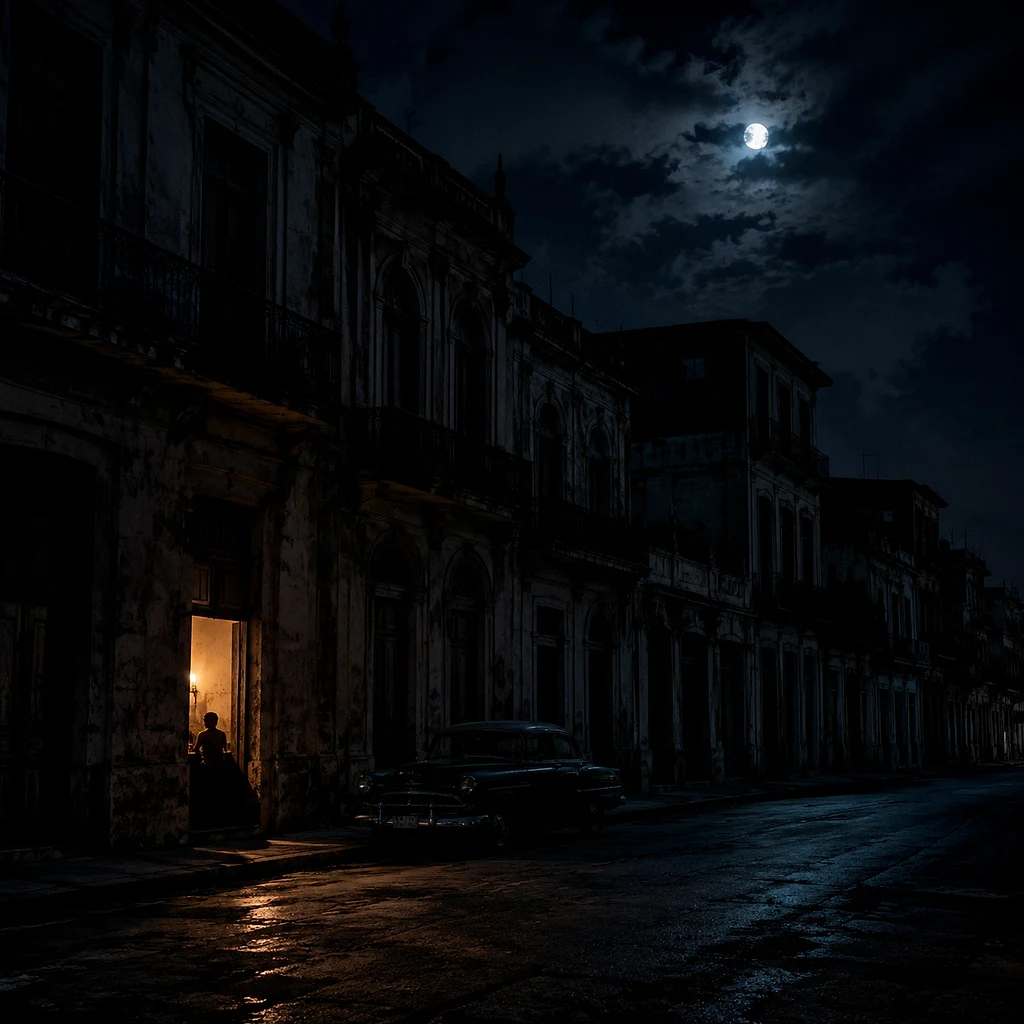
Each time the grid drops, the whole island sinks into total darkness at night.
How does a country fall to the point of being unable to even generate power?
Trace it to the source, and the problem lies with oil.
Cuba's power generation relies overwhelmingly on burning oil, yet its own output covers only around 40%; the larger remainder has long depended on imports.
And it is precisely this import lifeline that has been forcibly severed from outside.
The one who did it is the US and the Trump administration.
Early this year, Trump signed an executive order branding Cuba an "unusual and extraordinary threat" — effectively a de facto "oil blockade."
He issued a stark warning: any country that dares supply Cuba with oil, the US will hit with hefty tariffs.
Under such threats, nations weighed the stakes and, unwilling to offend the US over Cuba, halted supplies one after another.
In the past, the one that long propped up Cuba was fellow-leftist Venezuela.
But later, Trump moved on Venezuela as well, ousting its leader through military action.
Venezuela, unable even to save itself, then cut off its oil and financial support to Cuba.
With these lifelines severed together, Cuba's oil reserves ran dry at a visible pace.
Since the start of the year, only one Russian tanker delivered it a single shipload of oil, back in March.
To make matters worse, Cuba's grid was already beyond repair — most of its infrastructure stuck in the Cold War era, long decrepit and constantly failing.
An aging grid plus a fuel cutoff has pushed the country to the brink of collapse.
Yet what truly wrenches the heart is never these cold numbers, but the individual Cubans behind them.
On this perennially hot island, with no power, not even a fan will turn at home, and the heat is stifling.
After dark, the whole city is pitch black — even the traffic lights are out — and getting around becomes perilous; many can only light candles, and with no gas to cook, they retreat to the courtyard to burn firewood.
And of all the hardships, the deadliest is at the hospitals.
The blackouts disable refrigerators, spoiling vast quantities of medicine, and all the power-dependent equipment simply stops working.
A senior UN official issued a grave warning over this: for lack of essential medicine, some children are dying.
The cold data bears it out too — in recent months, Cuba's infant mortality has nearly doubled.
So why is Trump so intent on driving Cuba into such a desperate corner?
Ultimately, it's a campaign of maximum pressure: by making life in Cuba utterly unbearable, he aims to topple a government that has held on for decades and install a pro-US regime.
After all, the feud between the US and Cuba has festered for a full sixty-plus years; this is merely its most intense act yet.
Back in the last century, Cuba took a socialist road utterly different from America's, and ever since, Washington's blockade has scarcely truly eased.
Over more than half a century, Cubans have grown used to shortages of all kinds, yet even so, this energy collapse is the most dire in decades.
For that very reason, the UN and many rights groups have spoken out, condemning the approach — because those it truly punishes are innocent civilians, not the powerful in charge.
Facing this desperate strait, Cuba is not sitting still to await its fate.
It has launched its boldest set of economic reforms in decades, while speeding up solar-equipment imports from China, pinning its power-generation hopes on the sun overhead.
But renewables currently make up less than a fifth of its consumption; truly filling the gap is no overnight feat.
Tellingly, as the US presses harder and old partners bow out, the hand reaching out to Cuba is, increasingly, China's.
From solar panels to all manner of infrastructure, China's presence across Latin America is growing ever clearer.
This game of chess is no longer just about the fortunes of Cuba alone.
Through these seemingly endless days, ordinary Cubans can only grit their teeth and endure, day after day, in darkness and heat.
On one side, the cool maneuvering on a great-power chessboard; on the other, ordinary households for whom a single lamp or fan has become a luxury.
The vast gulf between them is what, in this story, leaves one most silent.
Okay, that's where we'll leave this somewhat heavy story today; see you next time.
Listen again
Try it without the transcript and notice what sounds clearer.
What vocabulary does this episode teach?
词汇Hospital. 最致命的,是医院 = the deadliest hit is the hospitals.
A government. 迫使这个政府垮台 = force this government to collapse.
Economy. 最大胆的经济改革 = the boldest economic reforms.
Data. 冰冷的数据 = the cold, hard data.
A city. 整座城市漆黑一片 = the whole city is pitch black.
A problem. 问题出在石油上 = the problem lies with oil.
Oil. 大部分依赖燃烧石油 = it relies mostly on burning oil.
A blackout. 一次又一次地陷入全岛大停电 = falls again and again into island-wide blackouts.
A blockade. 事实上的石油封锁令 = a de facto oil-blockade order.
Venezuela — the leftist ally that long supplied Cuba.
The power grid. 古巴那套电网本就积重难返 = Cuba’s grid was already beyond repair.
An infant. 婴儿死亡率几乎翻了一倍 = infant mortality has nearly doubled.
* beyond level超纲词
What grammar patterns appear in this episode?
语法把 A 定性为 B
"To designate / classify A as B."
把古巴定性为“异常且重大的威胁”。
一边...另一边...
"On one side... on the other..." — frames a stark contrast.
一边是大国棋盘上冷静的博弈;另一边是奢望一盏灯的寻常人家。
即便如此...依旧...
"Even so... still..." — the result holds despite the concession.
古巴人早已习惯短缺,可即便如此,这次的崩溃依旧是几十年来最凶险的一回。
Proper nouns
专有名词Free account
Keep learning from this story
Create a free account to keep saved words and your preferred level together.
- Keep words with their story context
- Remember your preferred level
- Build your vocabulary over time