
A Chinese podcast · Same story, 4 levels
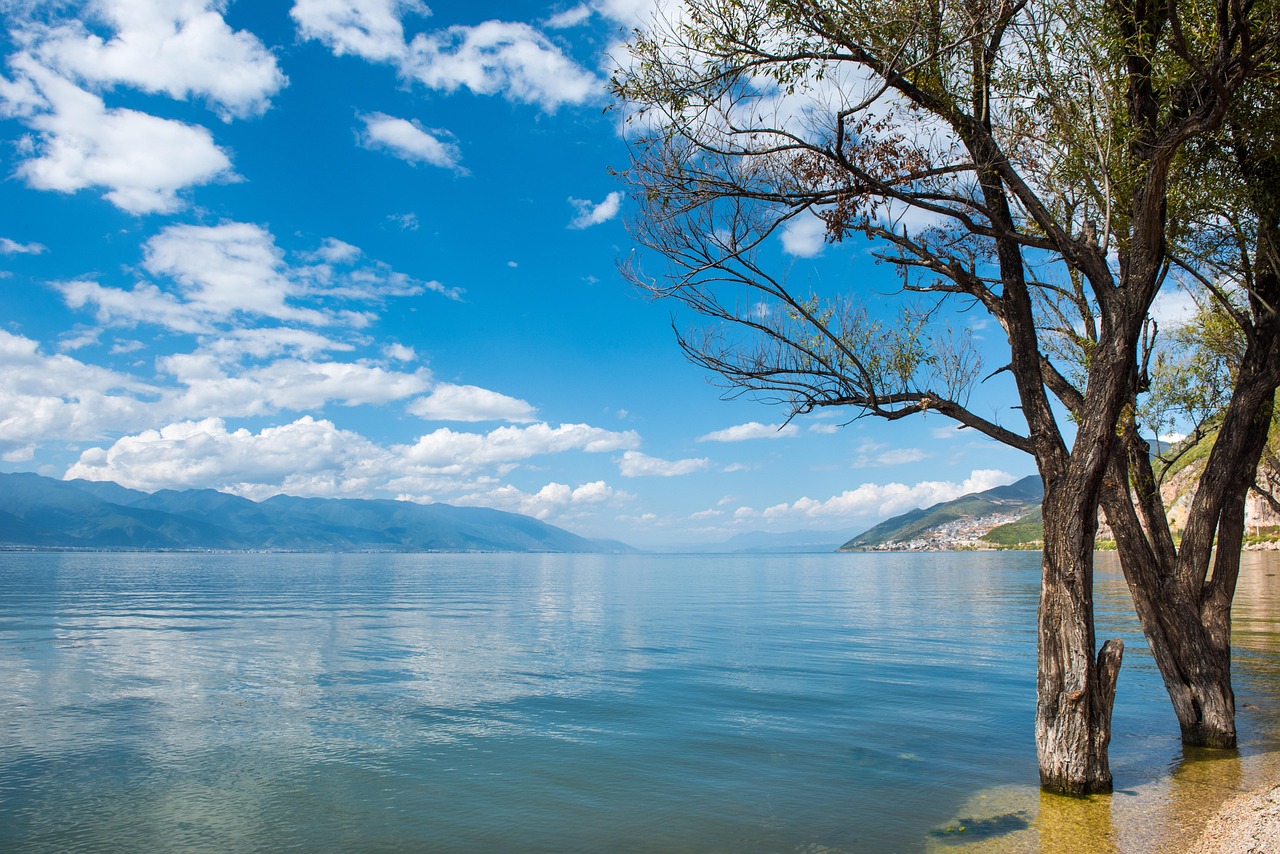
大理:水变好要很多年
Dali: A Thousand-Year Tea and Ten Days' Notice
About this story
Cangshan, Erhai and the strip between them; three-course tea recorded in the Tang dynasty; and the 2017 clean-up that shut a thousand businesses. HSK 3 Chinese listening practice.
This is an HSK 3-4 Chinese listening episode that runs about 5 minutes. The full Mandarin script is shown with tap-for-pinyin and a line-by-line English translation, so you can listen and read at once — comprehensible input in the sense of Stephen Krashen's i+1 theory. It teaches 12 key vocabulary words such as 坝子、回味、水质 and walks through 3 grammar patterns, each explained in English with examples. The same news story is retold at 4 difficulty levels — use the level selector above to find the version that is challenging but still understandable for you.
Read at your level
原文Read the complete story in Chinese. Reveal pinyin and English only when you need them.
English transcript reference
Dali's terrain is easy to understand.
To the west is Cangshan, nineteen peaks forming a screen.
To the east is Erhai, about two hundred and fifty square kilometres, China's second largest highland lake.
The old town and a great many villages are packed onto a narrow strip of flat land between them.
That structure determined how local people lived for over a thousand years: water and timber from the mountain, crops on the flat, fish from the lake.
Today it also determines something else — where visitors can go, and who is allowed to live by the water.
The owner of my guesthouse isn't local.
He used to work in Shanghai, more than twelve hours a day.
One year he came to Dali for a week off, and after going back he kept thinking about Cangshan.
The next year he moved here.
There are a lot of people like this in Dali; locals call them new Dali people.
Most come from big cities like Beijing and Shanghai.
They've brought new businesses, and they've also brought rising rents.
The owner admits this himself.
He said: we made the old town better-looking, and we also made it more expensive.
Dali prefecture has over three point six million people, most of them Bai.
Tourism accounts for roughly a quarter of local income.
That proportion matters — it explains what happened next.
The next day I cycled around Erhai, and in one village I was invited into a courtyard for tea.
Bai hospitality uses three courses of tea.
The first is roasted tea leaf, and it tastes bitter.
The second has brown sugar and walnut added, and it tastes sweet.
The third has Sichuan pepper, fresh ginger, cassia bark and honey — a complicated taste.
The old man summed it up in six characters: one bitter, two sweet, three aftertaste.
Bitter-then-sweet is a common idea; the third course is the one that matters.
Aftertaste supplies no conclusion.
It assumes you have already tasted the bitter and the sweet, and leaves the judgement to you.
This tea isn't a new invention.
The Tang-dynasty writer Fan Chuo, in his Book of the Southern Barbarians, records that people here "boiled it together with pepper, ginger and cassia".
Which means that back in the eighth century, in the Nanzhao period, people here were already putting Sichuan pepper and ginger in their tea.
In November 2014, Bai three-course tea was listed as national-level intangible cultural heritage.
In 2022 it entered UNESCO's Representative List of the Intangible Cultural Heritage of Humanity.
After the tea, the old man pointed at the lake and raised something else.
Over the past decade or so, more and more guesthouses opened around the lake.
Household waste water went straight into Erhai and the water quality clearly declined.
On 31 March 2017, the local government announced a comprehensive clean-up of lakeside restaurants and accommodation.
Over a thousand guesthouses, restaurants and bars were ordered to stop trading within ten days.
Operators had ten days to cancel bookings and wind up their businesses.
After that, the busiest stretch of shoreline became an empty street.
I asked him what he thought.
His answer was very practical.
The closures did cost a lot of people their income; that's true.
But when he was small you could drink the water of Erhai directly, and later you couldn't, and now it's clearer again.
He said: water takes many years to get better, and only a few years to get worse.
That sentence states a complicated policy problem very clearly.
The cost of environmental clean-up lands on specific people, while the benefit is shared by everyone, including people who come later.
The lake was quiet that afternoon; you could see the villages and the mountain on the far shore.
At dusk I went back to the old town, and the streets were full of people.
The bustle of the old town and the quiet of the lakeside switch over within a single day.
A lot of people criticize the old town for being too commercial.
The criticism has a point, but the income from that commerce supports many local families.
The real question is who gets to decide what this place becomes.
On the morning I left, I looked at Cangshan again.
The clouds were in a completely different place than on my first day.
Nineteen peaks, a lake of two hundred and fifty square kilometres, a tea over a thousand years old, and ten days in 2017.
All of it sits on the same strip of flat ground.
If you could move somewhere like Dali for a year, would you go?
Listen again
Try it without the transcript and notice what sounds clearer.
What vocabulary does this episode teach?
词汇HSK 4. A quarter of the prefecture's, from tourism.
HSK 5. The problem the old man states in one line.
HSK 3. Geography decides who can live by the water.
HSK 2. Whose life the layout has shaped for a thousand years.
The narrow strip everything is squeezed onto.
The third cup supplies no conclusion.
What declined as the shore built up.
A thousand businesses, ten days.
The action announced on 31 March 2017.
The tea was listed nationally in 2014.
What went straight into the lake.
Dispersed to everyone, while the cost concentrates.
* beyond level超纲词
What grammar patterns appear in this episode?
语法决定了 + clause
Names what a condition determines.
今天它还决定另一件事,就是游客能去哪里、谁能住在水边。
A 落在 …,B 却 …
Contrasts where cost lands with where benefit goes.
环境治理的成本落在具体的人身上,收益却分给所有人和以后的人。
Proper nouns
专有名词Free account
Keep learning from this story
Create a free account to keep saved words and your preferred level together.
- Keep words with their story context
- Remember your preferred level
- Build your vocabulary over time