
A Chinese podcast · Same story, 4 levels
大理:成本集中,收益分散
Dali: A Thousand-Year Tea and Ten Days' Notice
About this story
A tea recognized by UNESCO in 2022, an 8th-century record of it, and the ten-day order that reveals who pays for a clean lake. HSK 5-6 Chinese listening practice.
This is an HSK 5-6 Chinese listening episode that runs about 6 minutes. The full Mandarin script is shown with tap-for-pinyin and a line-by-line English translation, so you can listen and read at once — comprehensible input in the sense of Stephen Krashen's i+1 theory. It teaches 12 key vocabulary words such as 茶俗、回味、乳扇 and walks through 3 grammar patterns, each explained in English with examples. The same news story is retold at 4 difficulty levels — use the level selector above to find the version that is challenging but still understandable for you.
Read at your level
原文Read the complete story in Chinese. Reveal pinyin and English only when you need them.
English transcript reference
Dali's geography is almost textbook in its clarity.
To the west is Cangshan, nineteen peaks forming a screen; to the east is Erhai, roughly two hundred and fifty square kilometres, China's second largest highland lake.
The old town and a great many villages are packed onto the narrow strip of level ground between them.
That layout determined the local means of production for more than a thousand years: water and timber from the mountain, farming on the flat, fishing in the lake.
It continues to determine something else today — where visitors can go, and who is allowed to live by the water.
Dali Bai Autonomous Prefecture has a resident population of about three point six million, a large share of it Bai, and tourism accounts for roughly a quarter of local income.
Hold onto that quarter; it is the entire background to what follows.
The owner of my guesthouse came from Shanghai.
He used to work in finance, routinely more than twelve hours a day.
One year he took a week off in Dali, and afterwards kept returning to the image of clouds on Cangshan.
The next year he resigned and moved; that was six years ago.
There are a considerable number of such people in Dali, and locals call them new Dali people.
Most come from first-tier cities to open guesthouses, make crafts, run bookshops, or simply work remotely.
They have brought capital, a particular aesthetic and another rhythm of living, along with rising rents and increasingly interchangeable shops.
The owner doesn't dodge this.
He said: we made the old town better-looking, and we made it more expensive.
The honesty in that sentence is worth more than most of the marketing about slow living.
The old town and its surroundings are the traditional heartland of the Bai.
The Bai have lived around Erhai for over a thousand years, with their own language, architectural tradition and festival calendar.
The most visible marker is the housing: white walls, grey tiles, painted panels and inscriptions on the spirit wall and gate tower.
The next day I cycled around Erhai, and in one village I was brought into a courtyard for tea.
Bai hospitality uses three courses of tea, and the structure is very precise.
The first uses roasted leaves and tastes bitter.
The second adds brown sugar, sesame, walnut kernel and toasted rushan cheese flakes, and tastes sweet.
The third holds Sichuan pepper, ground fresh ginger, ground cassia bark and honey, and the flavour opens in layers.
The old man summed it up in six characters: one bitter, two sweet, three aftertaste.
Bitter-before-sweet is a familiar idea; the interesting one is the third.
Aftertaste offers no conclusion.
It assumes you have already tasted the bitter and the sweet, and leaves the remaining judgement to you.
The custom is older than most people assume.
Fan Chuo's Book of the Southern Barbarians, written in the Tang dynasty, already records that people here "boiled it together with pepper, ginger and cassia".
Which is to say that as early as the eighth century, in the Nanzhao period, Sichuan pepper and ginger had already entered the tea bowls here.
In November 2014, Bai three-course tea was inscribed on China's national list of intangible cultural heritage.
In 2022 it entered UNESCO's Representative List of the Intangible Cultural Heritage of Humanity.
A procedure for receiving a guest, formally recognized as heritage worth protecting.
After the tea, the old man pointed at the lake and raised something else.
Over the past decade or so, lakeside guesthouses expanded rapidly, household waste water entered Erhai in volume, and water quality fell steadily.
On 31 March 2017, the local government announced a comprehensive rectification of lakeside catering and accommodation.
More than a thousand guesthouses, restaurants and bars were required to cease trading within ten days.
Operators had ten days to cancel bookings, let staff go, and wind up their businesses.
A month later, the busiest stretch of shoreline had become an empty street.
It was an action of extraordinary force, and considerable controversy.
I asked how he assessed it.
He didn't offer a tidy answer.
The closures genuinely cost many people their income, including two of his nephews.
But when he was small you could scoop water out of Erhai and drink it; later you couldn't; and in the last few years it has cleared somewhat.
He said: water takes many years to improve, and only a few to spoil.
That sentence states the hardest part of environmental governance precisely.
The cost of remediation is concentrated on a small number of identifiable people, while the benefit is dispersed across everyone, including those not yet born.
Any account that emphasizes only one side of that is simplifying the problem.
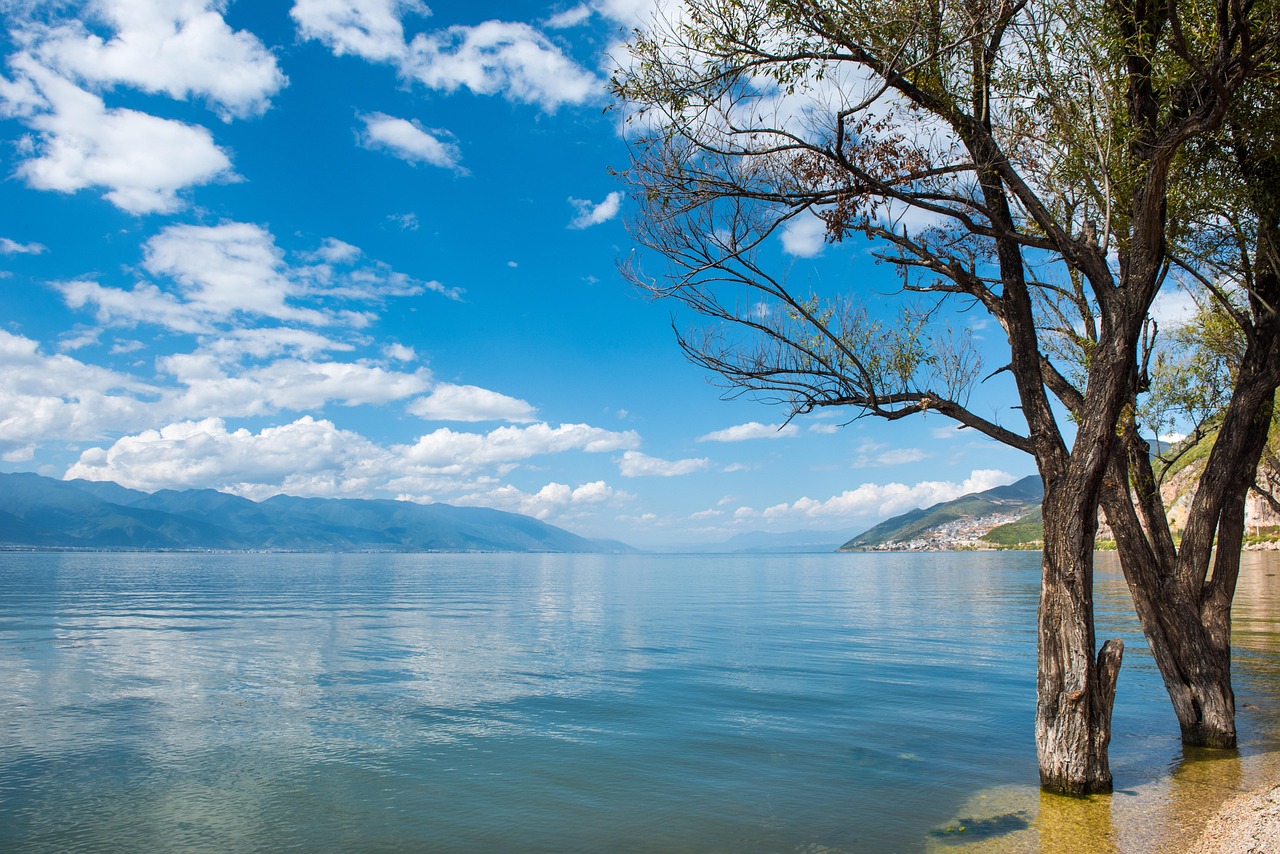
The lake was quiet that afternoon, and you could clearly make out the villages and the ridgeline opposite.
Back in the old town at dusk the situation was entirely reversed: the streets dense with people, bar speakers turned up loud.
Within a single day you can switch back and forth between two versions of Dali.
Criticizing the old town for over-commercialization is easy, and the criticism does have grounds.
But the income that commerce generates supports a large number of local families, and dismissing it outright isn't fair.
The better question concerns who decides: who determines what this place becomes, and how much weight local residents carry in that.
On the morning I left I looked at Cangshan once more, and the clouds sat in a completely different position from the day I arrived.
Nineteen peaks, a lake of two hundred and fifty square kilometres, a tea that existed in the eighth century, and those ten days in 2017.
All of it presses onto the same strip of flat ground, and none of it sits comfortably together.
If you had the chance to live somewhere like Dali for a year, would you go — or would you worry that you'd only be continuing your old life against different scenery?
Listen again
Try it without the transcript and notice what sounds clearer.
What vocabulary does this episode teach?
词汇HSK 5. A quarter of local income is tourism.
HSK 4. What the closures cost, concretely.
HSK 3. What UNESCO recognition is meant to secure.
HSK 5. How much weight they carry in the decision.
A procedure for receiving a guest, recognized as heritage.
Leaves the remaining judgement to you.
Toasted and flaked into the second cup.
Where a Bai household states itself in public.
The 31 March 2017 order.
Ten days to do it in.
Cost concentrates; benefit disperses.
Any one-sided one is simplifying.
* beyond level超纲词
What grammar patterns appear in this episode?
语法任何 … 都 …
A universal claim.
任何只强调其中一面的叙述,都是在简化问题。
早在 …,就已经 …
Pushes a date earlier than expected.
也就是说,早在八世纪的南诏时期,花椒与姜就已经进入这里的茶碗。
更值得追问的是 …
Redirects to the better question.
更值得追问的是决定权:谁在决定这个地方变成什么样子,本地居民在其中占多大比重。
Proper nouns
专有名词Free account
Keep learning from this story
Create a free account to keep saved words and your preferred level together.
- Keep words with their story context
- Remember your preferred level
- Build your vocabulary over time