
A Chinese podcast · Same story, 4 levels
端午节:一个诗人的故事,和我们吃的粽子
Duanwu Festival Marks 2,000 Years of Tradition
About this story
The Dragon Boat Festival (Duanwu): its three famous customs — zongzi, dragon-boat racing, hanging mugwort — and the story of the patriotic poet Qu Yuan that ties them all together. HSK 2 Chinese listening practice.
This is an HSK 2 Chinese listening episode that runs about 4 minutes. The full Mandarin script is shown with tap-for-pinyin and a line-by-line English translation, so you can listen and read at once — comprehensible input in the sense of Stephen Krashen's i+1 theory. It teaches 14 key vocabulary words such as 热闹、为什么、节日 and walks through 7 grammar patterns, each explained in English with examples. The same news story is retold at 4 difficulty levels — use the level selector above to find the version that is challenging but still understandable for you.
Read at your level
原文Read the complete story in Chinese. Reveal pinyin and English only when you need them.
English transcript reference
Today,
we'll talk about
a Chinese festival.
This festival
is called the Dragon Boat Festival.
You may
never have heard this name.
But
it is extremely ancient.
How ancient?
It is already
over two thousand years old.
The Dragon Boat Festival
falls each year on
the fifth day of the fifth lunar month.
This year,
that was in June.
This day
is, in China,
a public holiday.
Many people
get to rest.
So,
on this day, what do people
do?
The most famous customs —
there are three.
The first
is eating zongzi.
Zongzi
is a kind of food.
On the outside,
with green leaves,
it is wrapped.
Inside,
is glutinous rice.
Some zongzi are sweet,
some are savory.
Over sweet versus savory,
southerners and northerners
every year
have a little 'argument'.
The second
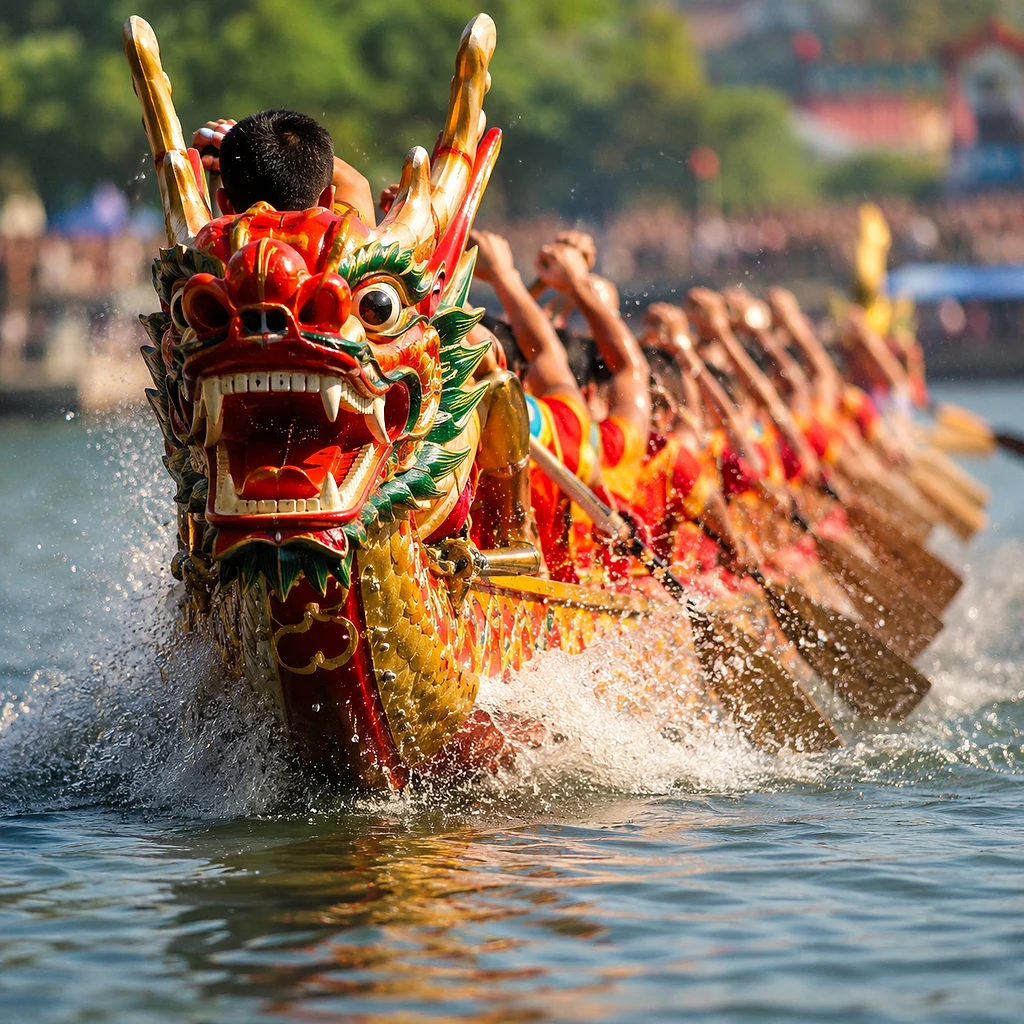
is dragon-boat racing.
A dragon boat
is a very long boat.
Many people sit in it,
all rowing together.
On the bank,
there are people
cheering them on.
It's very lively.
The third
is, on the door,
hanging a plant
called mugwort.
People believe
it can
bring health.
But
have you ever wondered:
why
do people do these things?
For that, we must speak of
one man.
His name
was Qu Yuan.
Qu Yuan
was, over two thousand years ago,
a great poet.
He was also a good official.
He loved his country deeply.
He wished, with all his heart,
to make the country stronger.
But
the king wouldn't listen to him,
and even drove him away.
Later,
his country
was defeated by another country.
Qu Yuan,
hearing this news,
had his heart break.
He was simply too grief-stricken, too despairing.
In the end,
holding a great stone,
he jumped into a great river,
and ended his own life.
That day
was exactly the fifth of the fifth month.
The common people
all loved and revered Qu Yuan.
They rowed boats
on the river,
searching everywhere for him.
They also took rice
and threw it into the river.
Because they thought:
let the fish in the river
eat the rice,
so they won't
harm Qu Yuan.
You see,
rowing boats to look for him
later
became dragon-boat racing.
Throwing rice into the river
later
became eating zongzi.
And so,
one poet's story
became
a festival over two thousand years old.
Finally,
I'd like to talk with you.
The Dragon Boat Festival
is delicious,
is lively.
But behind it
is the Chinese people's
long memory
of a good man.
So,
I want to ask you:
in your heart,
is there a person
you
wish always
to remember?
Listen again
Try it without the transcript and notice what sounds clearer.
What vocabulary does this episode teach?
词汇HSK 3 考纲词. 岸边有人加油,非常热闹 = people cheer on the bank — very lively.
HSK 1-2. why.
HSK 1-2. festival / holiday.
HSK 1-2. believe.
HSK 1-2. to rest.
HSK 1-2. but; however.
HSK 1-2. because.
它叫端午节,在农历五月初五 = the Dragon Boat Festival, on the 5th day of the 5th lunar month.
它非常古老…有两千多年了 = it is extremely ancient, over 2,000 years old.
农历五月初五 = the 5th day of the 5th month of the lunar calendar.
是中国的一个公共假期 = it's a public holiday in China.
用绿色的叶子包起来,里面是糯米 = wrapped in green leaves, filled with glutinous rice.
粽子里面,是糯米 = inside the zongzi is glutinous rice.
一种很长的船,船上坐着很多人,大家一起划 = a long boat that many people row together.
* beyond level超纲词
What grammar patterns appear in this episode?
语法古老到什么程度呢?(to what degree...?)
Rhetorical question emphasizing extent.
古老到什么程度呢?它已经,有两千多年了。
被 + Agent + Verb (passive)
Marks the subject as the receiver of the action.
他的国家,被别的国家打败了。
把 + Object + Verb 进/到 ... (disposal + direction)
Foregrounds the object and where it goes.
他抱着一块大石头,跳进了一条大江。
他们还把米饭,扔进江里。
为了 + Goal (in order to)
States purpose.
为了甜的还是咸的,南方人和北方人,每年都要吵一次。
X 后来就成了 Y (X later became Y)
Describes how a practice turned into a custom.
划船去找他,后来,就成了赛龙舟。
不但没 ... ,反而 ... (not only not ..., but instead ...)
Contrary-to-expectation pattern.
实在太难过、太失望了。
有没有一个人,是你 ...的?(is there a person you...?)
A reflective yes-no question for the close.
在你的心里,有没有一个人,是你,很想一直,记住的?
Proper Nouns
专有名词Free account
Keep learning from this story
Create a free account to keep saved words and your preferred level together.
- Keep words with their story context
- Remember your preferred level
- Build your vocabulary over time