
A Chinese podcast · Same story, 4 levels
一条江,一个诗人,两千年:端午节为什么是中国人最深的乡愁
Duanwu Festival Marks 2,000 Years of Tradition
About this story
Advanced Chinese listening practice. The deeper meaning of the Dragon Boat Festival: Qu Yuan, China's first great named poet and author of 'Li Sao'; his integrity, exile, and death in the Miluo River in 278 BC; how zongzi, dragon boats and the 'poison month' health customs merged into Duanwu; and a meditation on cultural memory and 家国情怀. HSK 5-6 Chinese listening practice.
This is an HSK 5-6 Chinese listening episode that runs about 5 minutes. The full Mandarin script is shown with tap-for-pinyin and a line-by-line English translation, so you can listen and read at once — comprehensible input in the sense of Stephen Krashen's i+1 theory. It teaches 14 key vocabulary words such as 标准、伟大、城市 and walks through 7 grammar patterns, each explained in English with examples. The same news story is retold at 4 difficulty levels — use the level selector above to find the version that is challenging but still understandable for you.
Read at your level
原文Read the complete story in Chinese. Reveal pinyin and English only when you need them.
English transcript reference
Today,
we'll talk about
a festival almost every Chinese person
has celebrated since childhood,
yet may never truly have understood — the Dragon Boat Festival.
Every year, on the fifth day of the fifth lunar month,
the scent of zongzi leaves drifts in the air,
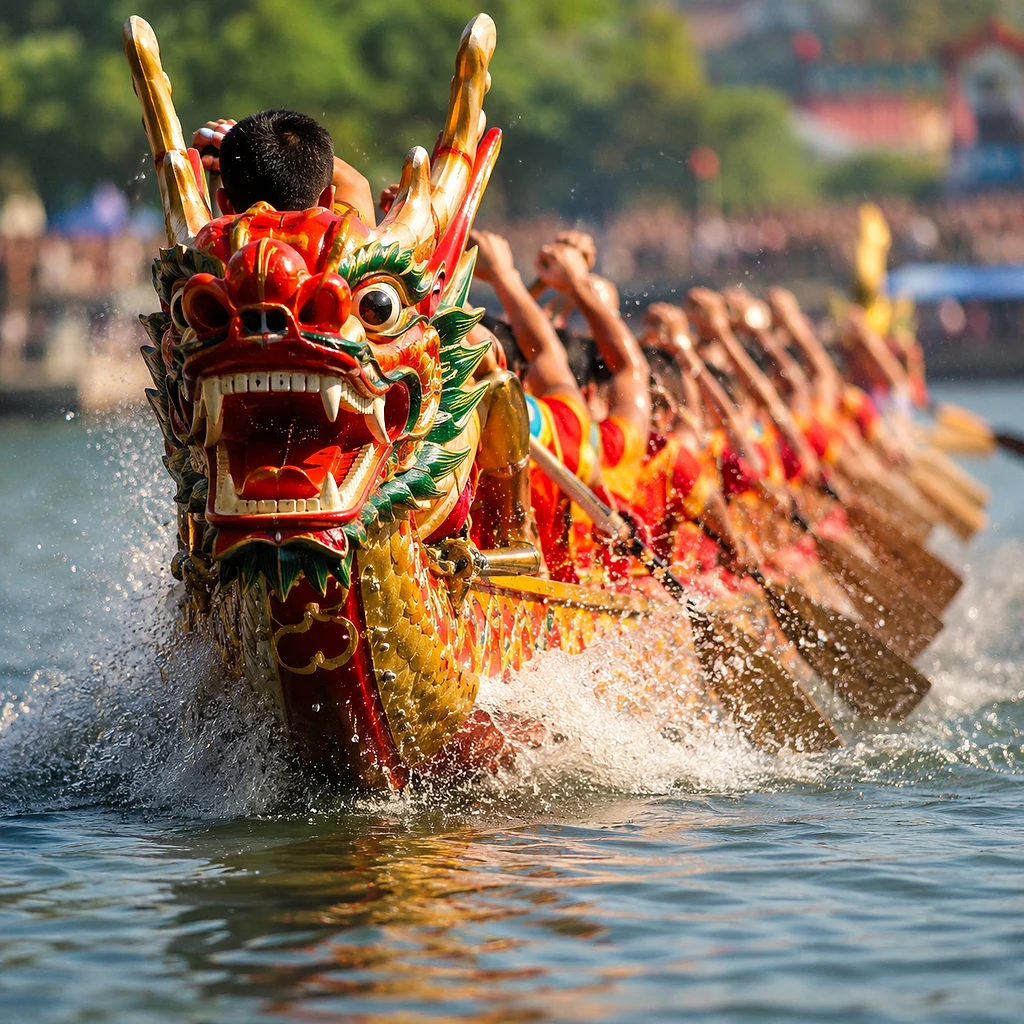
and dragon boats race across the water.
For us today,
Duanwu
is perhaps just a three-day holiday,
a seasonal meal of zongzi.
But if you are willing
to walk a few steps deeper
into this festival,
you will find
that at its very end
stands a man,
and a river
that has flowed for over two thousand years.
This man
is called Qu Yuan.
To explain him clearly,
we must first go back
more than two thousand three hundred years.
China then
was not yet unified,
dotted with rival lords,
war raging year after year.
Qu Yuan
was a noble and minister of the southern state of Chu,
and, in Chinese history,
the first
great poet
to leave behind his name.
His poem 'Li Sao',
to this day,
is still, by countless people,
recited again and again.
And yet,
more moving than his talent
was his integrity.
All his life, Qu Yuan
was loyal to one thing only —
his homeland, Chu.
He longed for Chu to be strong,
longed for it to be able
to withstand the northern power
that watched it like a hungry tiger — the state of Qin.
Again and again he offered counsel,
and again and again
was squeezed out and framed by the petty men around him,
until, at last,
he was, time after time,
exiled to remote places.
He could only, from afar,
watch helplessly
as the country he loved so deeply
slid, step by step, into decline.
In 278 BC,
the scene he least wished to see
came to pass after all:
Chu's capital
fell to Qin.
His country broken,
his home destroyed.
For Qu Yuan,
the last light
in his life
went out.
On that fifth of the fifth month,
he came to the bank of the Miluo River,
embraced a great stone,
and leapt,
giving himself,
forever,
to that river.
Legend says
the people along the river,
hearing the dreadful news,
were overcome with grief.
They vied to row out,
onto the river to search for him —
and this
is the origin of dragon-boat racing.
They cast rice balls
into the river,
only so the fish and shrimp
would not harm
the poet's body —
and this
is the origin of zongzi.
Of course,
as a festival of long history,
Duanwu's meaning
is far more than one man's story.
Before Qu Yuan,
the ancients already saw the fifth lunar month
as an 'evil month', a 'poison month'.
At this time the summer heat rises,
snakes and insects breed,
and plagues easily spread.
And so,
the mugwort and calamus hung at the door,
the scented sachets worn on the body,
the five-color threads tied on children's wrists —
all carry
the ancients' simple wish
to ward off evil and illness and pray for peace and health —
a humble wish.
And so,
the heartfelt remembrance of a patriotic poet,
and a people's
ancient wisdom of seeking fortune and avoiding harm,
over long ages,
merged and settled,
and finally crystallized into
the Duanwu we know today.
Speaking of this,
I want, with you,
to talk about a deeper layer.
Don't you find
this an almost unbelievable thing?
A man
has been gone
for over two thousand three hundred years.
And yet,
to this day,
every fifth of the fifth month,
from cities to villages,
from home to overseas,
hundreds of millions of Chinese
will still, because of him,
eat the same food,
and row the same kind of boat.
What we commemorate —
is it really only Qu Yuan,
this one particular man?
Perhaps
what we truly cannot let go of
is, in him,
that 'though I die nine times, I would not regret it' resolve,
that
devotion that binds
the self and the homeland
tightly together —
that deep feeling.
It is a kind
of spiritual ground-color carved
into the deepest part of our culture.
At the end of the show,
I want to leave you
with two questions.
First,
this year's Duanwu —
how did you spend it?
While eating zongzi and watching the dragon boats,
did you,
even for a single moment,
think of Qu Yuan?
Second,
for over two thousand years,
we have used a festival
to remember one man.
So,
how do you hope
the people of the future
will,
remember us,
and the things
we hold dear?
These two questions
have no standard answer.
But they
are worth your
thinking about slowly.
Listen again
Try it without the transcript and notice what sounds clearer.
What vocabulary does this episode teach?
词汇HSK 1-4. standard.
HSK 1-4. great.
HSK 1-4. city.
HSK 1-4. country.
HSK 1-4. purpose / aim.
HSK 1-4. program / show.
HSK 1-4. to discover / to find.
龙舟竞渡 = dragon boats racing across the water.
诸侯林立,战火连年 = rival lords everywhere, war year after year.
他写下的《离骚》,直到今天依然被无数人反复诵读 = his Li Sao is still recited today.
比他的才华更动人的,是他的风骨 = more moving than his talent was his integrity.
那个虎视眈眈的秦国 = the state of Qin, eyeing Chu like a hungry tiger.
他屡屡进谏,却屡屡被排挤 = again and again he counseled the king, and was pushed out.
被一次次地,流放到偏远之地 = exiled, time after time, to remote places.
* beyond level超纲词
What grammar patterns appear in this episode?
语法却未必真正 ... (yet not necessarily truly...)
Qualifies a claim, hinting at a gap between habit and understanding.
从小过到大,却未必真正读懂的节日。
如果你愿意 ... ,你会发现 ... (if you are willing to..., you will find...)
Invites the listener to look deeper.
但如果你愿意,往这个节日的深处,再走几步,你会发现,它的尽头,站着一个人。
比 X 更 + Adj 的,是 Y (more Adj than X is Y)
Ranks one thing above another.
比他的才华更动人的,是他的风骨。
只为 + Goal (only so that...)
States a sole, often selfless, purpose.
他们把米团,投入江中,只为让鱼虾,不要伤害,诗人的身体。
远不止 ... (far more than...)
Asserts something exceeds a stated scope.
端午的内涵,远不止一个人的故事。
我们 ... 的,真的只是 ... 吗?(is what we ... really only ...?)
A rhetorical question that reframes the subject.
我们纪念的,真的只是屈原,这个具体的人吗?
这两个问题,没有标准答案。但是它们,值得你慢慢地想。
The channel's signature normal-level close.
这两个问题,没有标准答案。但是它们,值得你,慢慢地想。
Proper Nouns
专有名词Free account
Keep learning from this story
Create a free account to keep saved words and your preferred level together.
- Keep words with their story context
- Remember your preferred level
- Build your vocabulary over time