
A Chinese podcast · Same story, 4 levels
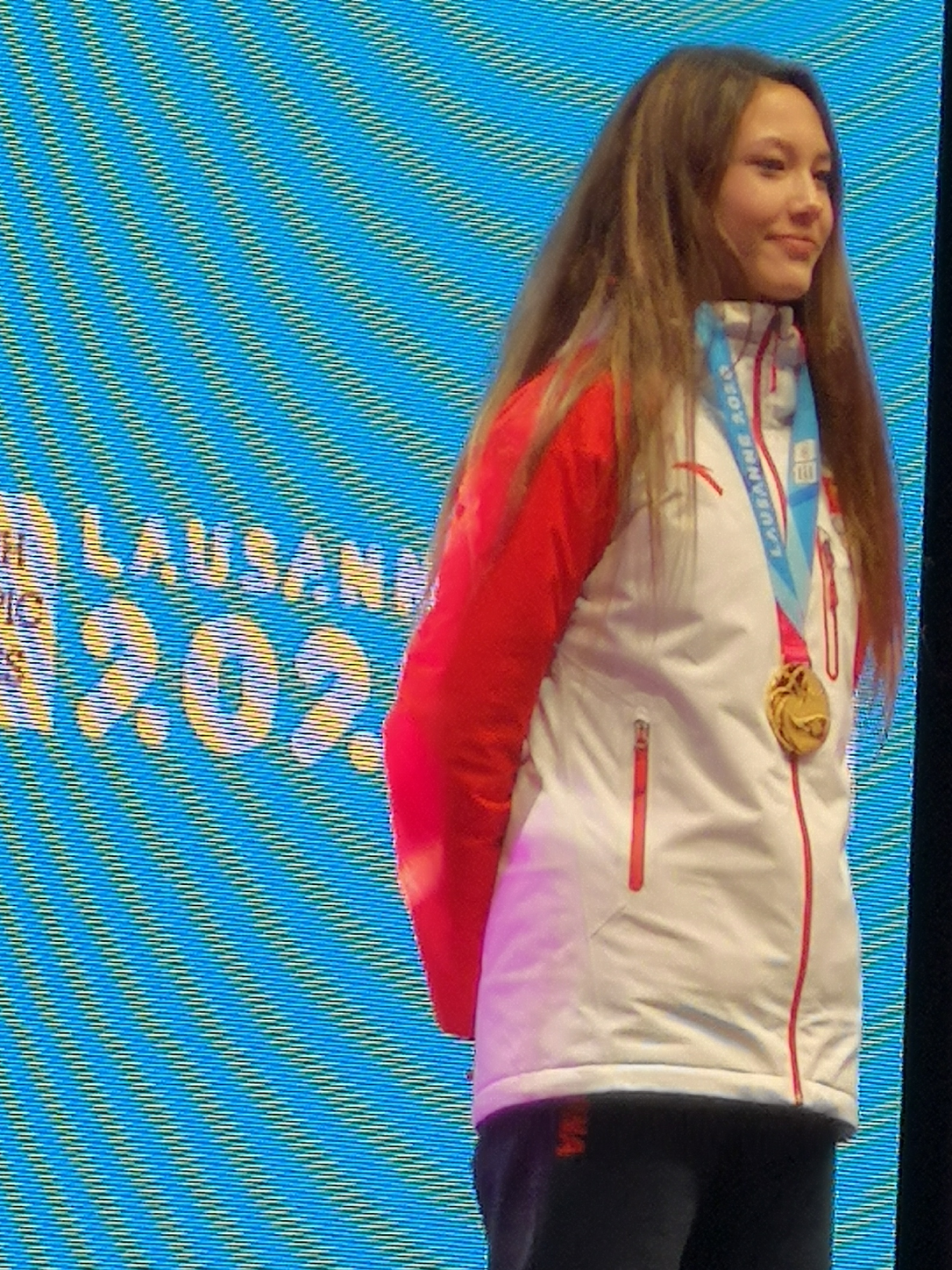
Photo: Christophe95 · CC BY-SA 4.0
谷爱凌:冰雪之上的双重奏与文化符号的诞生
Eileen Gu Heads to Milan Olympics
About this story
Eileen Gu, the San Francisco-born Stanford skier, returns as China's bicultural symbol heading into Milan Cortina 2026. HSK 5-6 Chinese listening practice.
This is an HSK 5-6 Chinese listening episode that runs about 8 minutes. The full Mandarin script is shown with tap-for-pinyin and a line-by-line English translation, so you can listen and read at once — comprehensible input in the sense of Stephen Krashen's i+1 theory. It teaches 15 key vocabulary words such as 关注、适应、背景 and walks through 4 grammar patterns, each explained in English with examples. The same news story is retold at 4 difficulty levels — use the level selector above to find the version that is challenging but still understandable for you.
Read at your level
原文Read the complete story in Chinese. Reveal pinyin and English only when you need them.
English transcript reference
Speaking of the most eye-catching face at the 2026 Winter Olympics, Eileen Gu's name still occupies the center of the media storm — not only because of her performance on the competition field, but because of the complex and fascinating cultural metaphor she embodies.
If you've paid even the slightest attention to winter sports in recent years, it's impossible to avoid this name — one could even say she has become a social phenomenon that transcends sports itself.
For those listeners who may still be stuck on the basic question of "who is Eileen Gu," we perhaps need to re-examine the growth trajectory of this young athlete, because her story is precisely the most vivid footnote of the era of globalization.
Born in San Francisco, with an American father and a mother who was a Chinese immigrant from Beijing, this typical Chinese-American mixed family background meant she was destined from the start to possess a dual cultural perspective.
Unlike many children who grow up in a single cultural context, Eileen Gu didn't struggle in the cracks of identity — instead, she displayed an astonishing adaptability, navigating with ease between two vastly different cultural systems.
Every summer she would return to Beijing, immersing herself in the hutongs and everyday life of that ancient city — her fluent Beijing dialect even makes many native Beijingers feel a sense of familiarity.
This dual background is viewed by many as her "superpower," enabling her to seamlessly bridge the subtlety of the East and the expressiveness of the West, finding her place in two entirely different systems of evaluation.
As early as age three, when most children were still learning to walk, she had already begun her ice and snow journey at ski resorts near Lake Tahoe.
The word "talent" seems somewhat inadequate when applied to her, because beyond her remarkable athletic ability, she also possesses an enviable academic mind.
Gaining admission to Stanford University with near-perfect SAT scores, while holding a modeling contract with IMG and being named to Forbes' "30 Under 30" list — these labels stacked together
paint the picture of a nearly perfect "slash-career" young achiever.
However, when we focus on this 2026 Winter Olympics, you'll find that, having shed the rawness of her early debut, the 22-year-old Eileen Gu displays a more mature and profound competitive state.
She didn't simply "show up" on the competition field — she took over the event with the bearing of a champion.
In the final of the freestyle skiing slopestyle event, she captured a precious silver medal — the value of this medal is actually no less than her previous gold medals.
You have to understand that to prepare for this Winter Olympics, she specifically took time away from her demanding studies at Stanford — this ability to switch roles between an elite university and an elite competition is itself a feat that's extremely difficult to replicate.
This silver medal was not only an affirmation of her technical consistency but also an enormous test of her mental fortitude.
After all, in the world of competitive sports, defending a legacy is often harder than building one — and maintaining such a high level of performance under the nearly exacting gaze of public expectations is itself proof of her inner strength.
Recalling 2022, when she became the first woman in the world to land a double cork 1440 in competition, that earth-shattering impact still remains vivid in memory.
At that time, her fashion spreads in GQ magazine complemented her soaring figure on the slopes, forming a powerfully dynamic visual symbol.
By 2026, this dynamism hasn't diminished — if anything, it has become more substantial with the passage of time.
Industry discussions about Eileen Gu have long transcended the realm of athletic competition — she has become a unique cultural specimen for exploring how individuals can bridge geopolitical divides against the backdrop of retreating globalization.
Of course, the controversies surrounding her have never fully subsided — regarding nationality, regarding her choice of team — the waves of opinion on social media rise and fall endlessly.
But what's undeniable is that she has handled these complex social sentiments in a very smart and graceful manner.
She represents not just an athlete, but an emerging cultural force — a possibility of refusing to be defined by a single label.
In this era full of uncertainty, Eileen Gu's very existence is an inspiration — she tells the younger generation that whether it's racing on a snowboard through clouds and peaks, or burying oneself in studying at an Ivy League library, these two things are not contradictory.
She's not just breaking records in sports — she's breaking stereotypes about what "success" means.
The spirit that RADII champions — bold, boundary-breaking, and full of freshness — finds its most thorough expression in Eileen Gu.
This influence is subtle and pervasive — it's reflected not only in the luxury brands and commercial advertisements she endorses, but more importantly in the countless young people inspired by her to take up winter sports or bravely pursue their dreams.
When we delve into her technical movements, you'll find that freestyle skiing as a sport is itself full of philosophical meaning.
It requires athletes to find that fleeting point of balance at extremely high speeds and in highly unstable conditions — which is also a kind of metaphor for Eileen Gu's life situation.
In slopestyle competitions, every feature and every jump is full of variables — athletes need to make judgments and adjustments within milliseconds.
The reason Eileen Gu stands out, beyond physical ability, lies in her profound understanding of "finding control within chaos."
At 22, she's in the prime of her athletic career and also at a critical stage of mental maturity — her performance at the 2026 Winter Olympics can be seen as an important step in her transformation from "prodigy" to "sports legend."
This transformation doesn't happen overnight — behind it are countless times of getting back up after falling, and the extreme push-and-pull between late-night studying at Stanford and early-morning training on the slopes.
We often say "sports and academics go hand in hand," but in practice, those who can push both to the extreme are exceedingly rare — and Eileen Gu has broken through this barrier.
Her success has also prompted people to reflect on traditional education models and talent development paths — what kind of environment can nurture such well-rounded individuals with both international vision and solid skills.
From San Francisco's Bay Area to Beijing's Shougang Big Air venue, these two geographic coordinates intertwine in her life, weaving a unique map of growth.
On this map, there is no either-or opposition — only the tolerance and integration of embracing both.
Perhaps this is what makes Eileen Gu most appealing — she doesn't belong to any fixed framework; she is always in motion, always growing.
In that breathtaking slopestyle final, when she landed solidly, the cheers that erupted from the crowd were not just for a silver medalist — they were for this young woman who found her balance point amid the collision of Eastern and Western cultures.
Her every leap into the air is like a declaration to the world that boundaries exist to be broken.
Whether for Chinese audiences or American audiences, Eileen Gu is an undeniable presence — she connects two seemingly distant worlds in her own way.
In this winter of 2026, snowflakes continue to fall, and the story of Eileen Gu is clearly still being written — every chapter is full of unknown wonders and challenges.
This is not just a story about skiing — it's a story about how a person establishes their identity and engages in dialogue with the world in this rapidly changing era.
When we see her confident smile on the podium, we might realize that the true winners are never just medal holders — they are those who dare to define the rules of their own lives.
Listen again
Try it without the transcript and notice what sounds clearer.
What vocabulary does this episode teach?
词汇A common verb used when talking about following news, sports, or trends.
Used to describe adjusting to new environments or conditions.
Can refer to a physical background or a person's family/cultural background.
Can be a noun or a verb.
In this text, it is used as a noun meaning 'affirmation' or 'recognition'.
HSK 1-4. society.
HSK 1-4. politics.
HSK 1-4. international.
A literary term referring to a figure of speech or a symbolic representation.
An idiom (chengyu) describing someone who is very skilled and can handle a task effortlessly.
An idiom used to describe a baby learning to walk, or metaphorically the early stages of a venture.
A modern term for young people who have multiple careers or identities (e.g., Lawyer/Writer/Photographer).
An idiom describing someone young and inexperienced who has just entered society or a profession.
Literally 'gold content', used metaphorically to describe the true value or quality of something (like a medal or degree).
An idiom used to describe something or someone that is extremely rare and precious.
* beyond level超纲词
What grammar patterns appear in this episode?
语法不仅……更……
Not only... but even more... (Used to emphasize the second clause as being more important or significant than the first).
这不仅是因为她在赛场上的表现,更因为她身上所承载的复杂而迷人的文化隐喻。
她代表的不仅仅是一个运动员,更是一种新兴的文化力量。
并非……而是……
Not... but rather... (Used to negate one statement and affirm the contrary).
她并非只是简单地“出现”在赛场上,而是以一种王者的姿态接管了比赛。
这种蜕变并非一蹴而就,背后是无数次摔倒后的重新站起。
之所以……(是)因为/在于……
The reason why... is because/lies in... (A formal structure for explaining causes).
谷爱凌之所以能够脱颖而出,除了身体素质,更在于她对于这种“失控中寻找控制”的深刻理解。
无论……还是……
No matter if A or B... (Used to indicate that the result or conclusion is the same regardless of the options).
告诉年轻一代,无论是脚踏滑雪板在雪岭云端飞驰,还是在常春藤盟校的图书馆里埋头苦读,这两者并不矛盾。
无论是对于中国观众还是美国观众,谷爱凌都是一个无法被忽视的存在。
Proper nouns
专有名词Sources
来源Free account
Keep learning from this story
Create a free account to keep saved words and your preferred level together.
- Keep words with their story context
- Remember your preferred level
- Build your vocabulary over time