
A Chinese podcast · Same story, 4 levels
英国第一位国王,为什么没人记得?
England's First King Æthelstan: 1,100 Years of Near-Forgetting
About this story
England's first king Æthelstan united the country in 927, but plans for a 1,100-year anniversary in 2027 struggle — only 31 petition signatures and a rejected statue. HSK 4 Chinese listening practice.
This is an HSK 4 Chinese listening episode that runs about 3 minutes. The full Mandarin script is shown with tap-for-pinyin and a line-by-line English translation, so you can listen and read at once — comprehensible input in the sense of Stephen Krashen's i+1 theory. It teaches 12 key vocabulary words such as 历史、统一、记得 and walks through 6 grammar patterns, each explained in English with examples. The same news story is retold at 4 difficulty levels — use the level selector above to find the version that is challenging but still understandable for you.
Read at your level
原文Read the complete story in Chinese. Reveal pinyin and English only when you need them.
English transcript reference
When Britons pick the best monarch in history, the shortlist doesn't include the man who first unified England.
His name is Æthelstan; he was crowned 1,100 years ago, and today almost no one in his own country remembers him.
America has Washington, Germany has Bismarck, but England's story has to start with a forgotten king.
William the Conqueror and his grandfather Alfred the Great are names Britons grow up hearing.
In 927, Æthelstan rode north and took York.
That was the last Viking kingdom left on the island.
That same year, the leaders of the various kingdoms recognized him at a meeting as King of the English.
Historians see that year as England's unification, and he became the first King of England.
By 2027, this will be exactly 1,100 years ago.
Derek Hilling, who launched the Birth of England Project, wants to turn the anniversary into a big event.
He has prepared commemorative coins, stamps and downloadable celebration packs, and even wants a national holiday.
He petitioned Parliament for an England Day, and so far it has only 31 signatures.
Another petition to put up a statue of him outside Parliament was rejected.
In Malmesbury, someone applied to erect an 11-foot bronze statue of him.
Local residents worried the statue would damage the roots of three silver birches, and the application was ultimately not approved.
The trouble is that 2027 is also the European Year of the Normans, marking 1,000 years since William the Conqueror's birth.
In 1066, the Normans crossed the sea and killed the English king, then massacred locals in the north.
Hilling's view is straightforward: if the Norman celebrations also cover that part, then fine.
Historian Tom Holland admires him greatly and finds the story both heroic and inspiring.
He says it's hard to imagine an American or French national story beginning with a crushing defeat.
He really could fight, too — he defeated a Scottish and Viking alliance at the Battle of Brunanburh.
He also established a relatively centralized rule, wanting the whole kingdom to use a single coin.
He is buried in Malmesbury, where commemorative walks and lectures have been held for him.
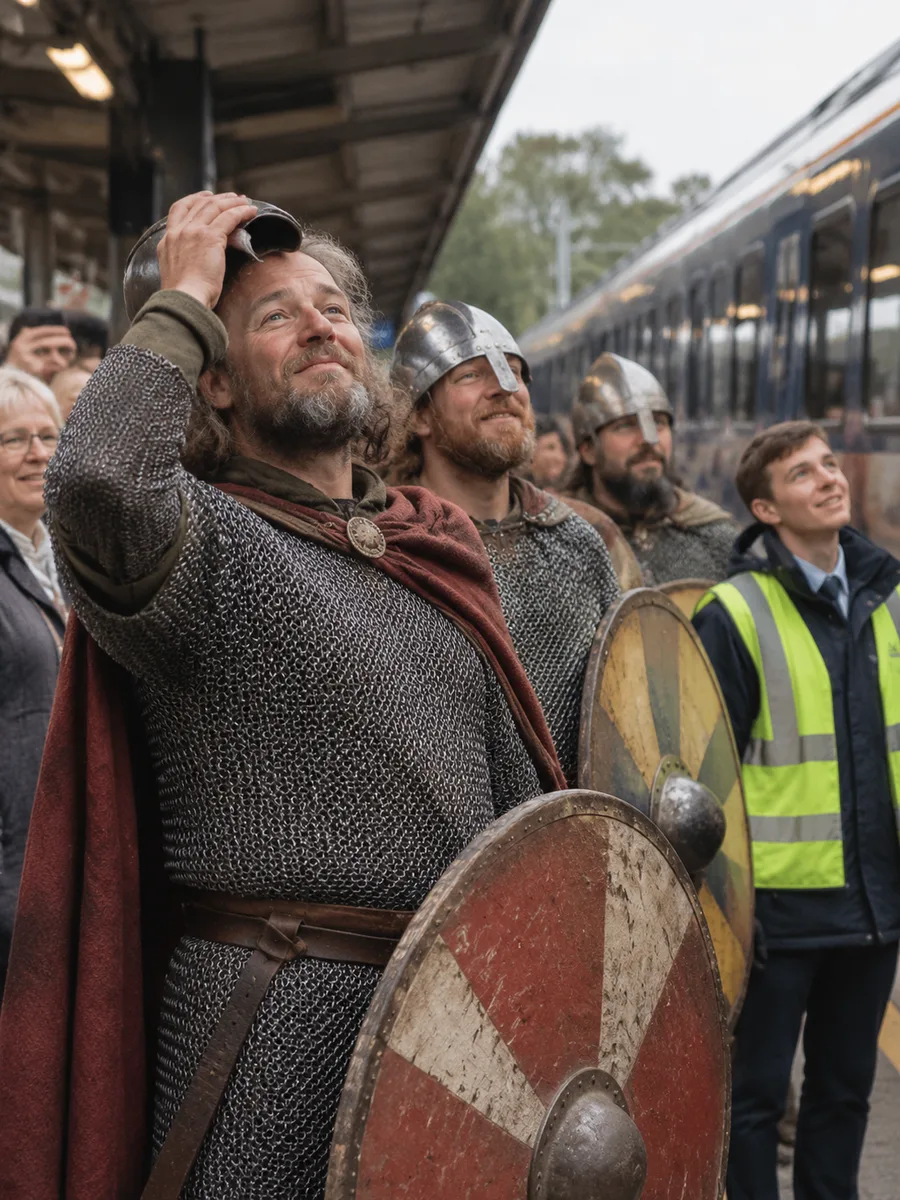
Not long ago, Kingston station in London named a train King Æthelstan, and Holland says the buzz later slowly faded.
In Eamont Bridge, Cumbria, locals are embroidering a tapestry.
That is exactly where the kingdoms recognized him as king back then.
An organization called E927 wants to hold festivals and public art there, and has received a grant from the local council to build a website.
Cambridge scholar David Woodman wrote a biography of him titled The First King of England.
The celebrations are set for 2027, and Hilling says this must be done on a big scale.
Woodman's explanation is simple: poor Æthelstan — no one in his own time promoted him properly.
Listen again
Try it without the transcript and notice what sounds clearer.
What vocabulary does this episode teach?
词汇HSK 3. 历史上 = "in history"; 历史学家 = historian.
HSK 3. Used as verb and noun: 统一英格兰 = unify England.
HSK 3. 没人记得 = nobody remembers; contrast 忘记 (forget).
HSK 3. 承认他是王 = recognize him as king.
HSK 3. 纪念币 = commemorative coin; 纪念活动 = commemorative events.
HSK 2. 他准备纪念币 = he prepared commemorative coins.
HSK 3. 申请立铜像 = apply to erect a statue.
HSK 3. 没有通过 = was not approved; 被驳回 is a stronger synonym.
HSK 3. 英格兰国王 = King of England; 君主 is a more formal synonym.
Beyond HSK 3. 候选名单 = shortlist of candidates.
Beyond HSK 3. Formal word for king/queen; 君主制 = monarchy.
Beyond HSK 3. 向议会请愿 = petition Parliament.
* beyond level超纲词
What grammar patterns appear in this episode?
语法却 (contrast adverb)
Marks a sharp contrast with what came before, like "yet/however" placed after the subject.
候选名单里却没有第一个统一英格兰的人。
英格兰却要从一个被忘掉的国王讲起。
被 + Verb (+ 了)
Passive marker: the subject receives the action. Often used for negative outcomes.
另一份请愿想在议会外面给他立雕像,被驳回了。
这份申请最后没有通过。
是…的 (emphasis)
Highlights a fact or circumstance, often with 正是 for "exactly".
那里正是当年各邦承认他为王的地方。
如果…那(就)…
Conditional: "if… then…".
如果诺曼人的庆祝也讲这一段,那没问题。
从…到… / 从…讲起
Expresses a range or starting point: "from… to…", "start from…".
英国人从小听到大。
英格兰却要从一个被忘掉的国王讲起。
为 + Person + Verb
Marks the beneficiary: "for someone".
那里为他办过纪念步行和讲座。
Proper nouns
专有名词Sources
来源Free account
Keep learning from this story
Create a free account to keep saved words and your preferred level together.
- Keep words with their story context
- Remember your preferred level
- Build your vocabulary over time