
A Chinese podcast · Same story, 4 levels
英国第一位国王,为什么没人记得?
England's First King Æthelstan: 1,100 Years of Near-Forgetting
About this story
HSK 1: England plans to celebrate 1,100 years since King Æthelstan united the country in 927, but most people don't know who he is.
This is an HSK 2 Chinese listening episode that runs about 2 minutes. The full Mandarin script is shown with tap-for-pinyin and a line-by-line English translation, so you can listen and read at once — comprehensible input in the sense of Stephen Krashen's i+1 theory. It teaches 12 key vocabulary words such as 国家、常常、打 and walks through 7 grammar patterns, each explained in English with examples. The same news story is retold at 4 difficulty levels — use the level selector above to find the version that is challenging but still understandable for you.
Read at your level
原文Read the complete story in Chinese. Reveal pinyin and English only when you need them.
English transcript reference
There was a king in England named Æthelstan.
He was the first king of England.
Before him, there were many small kingdoms in England that often fought each other.
In 927, he rode north to York.
At that time, York was not his.
He took York.
That year, many kings came to see him.
They said to him: You are our king.
From that year on, England became one country.
Many people say that England started from here.
By 2027, 1,100 years will have passed since this event.
There is an Englishman who wants to hold a big event in 2027.
He wants to make a new kind of money.
He also wants one day when everyone in the country does not work.
He wrote a piece of paper saying England should have an England Day.
Only 31 people signed the paper.
Some people also want to put a very large stone figure in London.
This stone figure looks like this king.
However, London does not have this stone figure.
In another city, people also want to make a stone figure.
This stone figure is very tall.
But there are three trees there.
People living nearby said: The stone figure will damage the roots of the trees.
So this stone figure was not made either.
In 2027, Europe will also hold an event.
The people in this event come from France.
Almost 1,000 years ago, these people came to England by boat and killed the king of England.
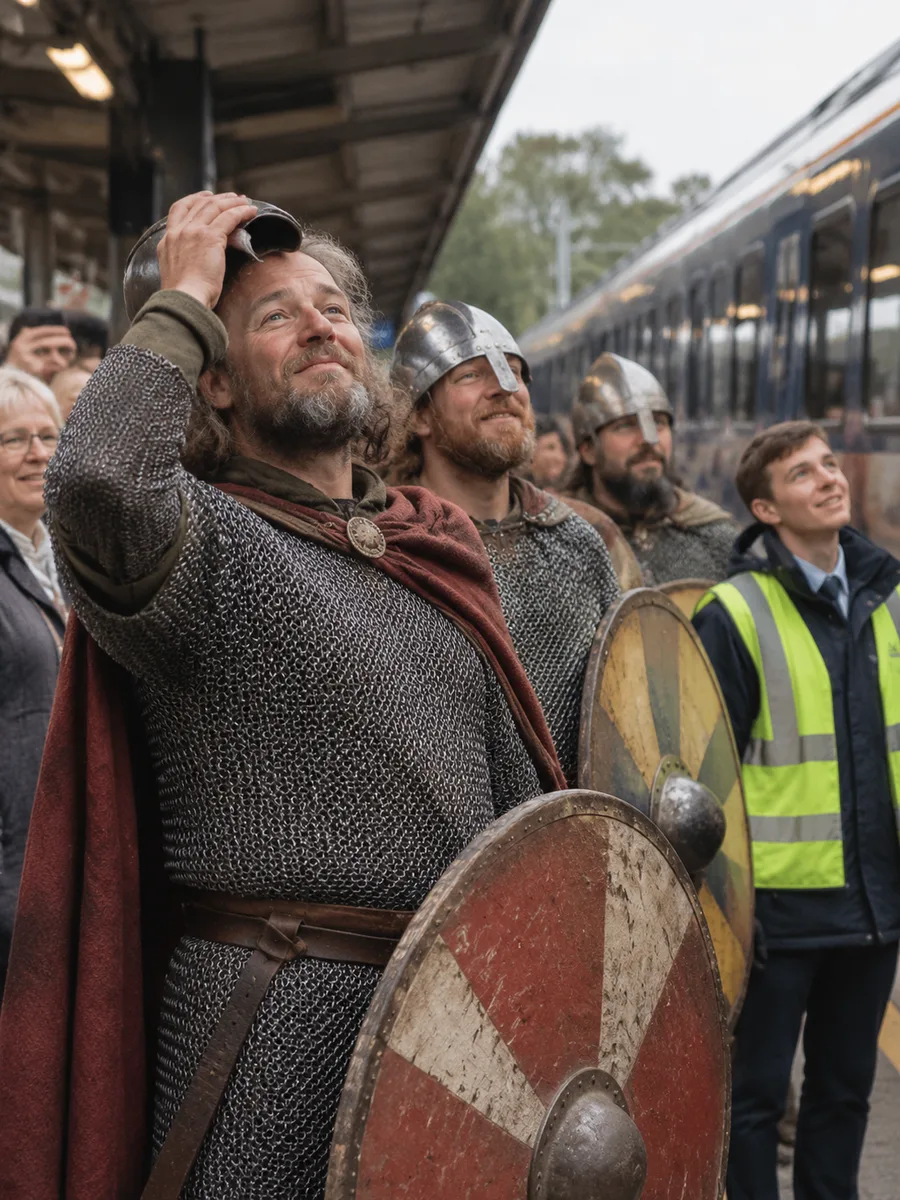
Last year, a train in London used this king's name.
That Englishman said: In 2027, we must make it big.
Listen again
Try it without the transcript and notice what sounds clearer.
What vocabulary does this episode teach?
词汇HSK 1. Used in the script to describe England becoming one country.
HSK 1. Indicates frequency; appears in the script as '常常打来打去' (often fought each other).
HSK 1. In the script, used in '打来打去' meaning to fight back and forth.
HSK 1. Common verb of movement; used in '他骑马去了北边的约克' (he rode a horse to York in the north).
HSK 1. Used in '来见他' (come to see him) and '坐船来了英国' (came to England by boat).
HSK 1. Appears in '来见他' (come to see him).
HSK 1. Used in '他们对他说' (they said to him) and '很多人说' (many people say).
HSK 1. Used in dates like '九百二十七年' (927) and '二零二七年' (2027).
HSK 1. Common noun for a male monarch.
HSK 1. Often used before nouns to indicate a large quantity.
Beyond HSK 1. Used in '他拿下了约克' (he took York).
Beyond HSK 1. Compound of 石头 (stone) and 人 (person).
* beyond level超纲词
What grammar patterns appear in this episode?
语法有 + Noun + 叫 + Name
Used to introduce someone or something by name.
英国有一个国王,叫埃塞尔斯坦。
从 + Time + 起
Means 'starting from (a time)'.
从这一年起,英国成了一个国家。
对 + Person + 说
Means 'say to (someone)'.
他们对他说:你是我们的国王。
想 + Verb Phrase
Expresses desire or intention: 'want to do something'.
他想在二零二七年做很大的活动。
他还想有一天,全国的人都不工作。
可是
Conjunction meaning 'but; however', indicating contrast.
可是,伦敦没有这个石头人。
可是那里有三棵树。
所以
Conjunction meaning 'so; therefore', indicating result.
所以这个石头人也没有做成。
Proper nouns
专有名词Sources
来源Free account
Keep learning from this story
Create a free account to keep saved words and your preferred level together.
- Keep words with their story context
- Remember your preferred level
- Build your vocabulary over time