
A Chinese podcast · Same story, 4 levels
英国第一位国王,为什么没人记得?
England's First King Æthelstan: 1,100 Years of Near-Forgetting
About this story
England's first king Æthelstan united the country in 927, but few remember him. As the 1,100th anniversary nears, a small group campaigns to celebrate. HSK 5+ Chinese listening practice.
This is an HSK 5+ Chinese listening episode that runs about 3 minutes. The full Mandarin script is shown with tap-for-pinyin and a line-by-line English translation, so you can listen and read at once — comprehensible input in the sense of Stephen Krashen's i+1 theory. It teaches 12 key vocabulary words such as 征服、承认、纪念 and walks through 4 grammar patterns, each explained in English with examples. The same news story is retold at 4 difficulty levels — use the level selector above to find the version that is challenging but still understandable for you.
Read at your level
原文Read the complete story in Chinese. Reveal pinyin and English only when you need them.
English transcript reference
America's founding father is Washington, Germany recognizes Bismarck, but England's founding king is almost unknown in his own country.
In a recent poll to choose Britain's best monarch, his name wasn't even on the candidate list.
The attention went to William the Conqueror and his own grandfather, Alfred the Great.
His name is Æthelstan, a tenth-century Anglo-Saxon king and the first king in English history.
In 927, he led his army north to York and conquered the last remaining Viking kingdom in Britain.
In the same year, the leaders of Britain's kingdoms acknowledged him as 'King of the English' at a meeting.
Later historians regard this meeting as the starting point of England as a nation.
By 2027, this event will be exactly 1,100 years old.
Derek Hilling, founder of the 'Birth of England Project,' is already preparing commemorative sets, coins, and stamps.
He is also campaigning for one thing: to establish a nationwide 'England Day.'
To this end, he submitted a petition to Parliament; so far, it has only 31 signatures.
Another petition to erect a statue of Æthelstan outside Parliament has been rejected.
In Malmesbury, a plan for an 11-foot-tall statue has also stalled.
Local residents opposed it, citing the risk of damage to the roots of three nearby silver birch trees.
And 2027 also happens to be the 'European Year of the Normans,' marking 1,000 years since William the Conqueror's birth.
This Duke of Normandy was born in 1027 and crossed the sea to invade England in 1066.
Hilling reminds us that after killing the English king, the Normans carried out a bloody massacre across the north.
His exact words were that if the commemorations could also reflect that side, then fine.
Historian and podcast host Tom Holland, however, believes Æthelstan's story is heroic and inspiring.
He says he cannot imagine America or France beginning their national story with a massive defeat.
In 937, Æthelstan defeated an invading Scottish-Norse alliance at the Battle of Brunanburh.
He is also credited with establishing a relatively centralized rule, aiming for the whole kingdom to use a single coinage.
He is buried in Malmesbury; in 2024, the town held walking events and lectures for him.
Records about him are very scattered; his exact age, cause of death, and why he never married are all lost.
In the 1920s, the 1,000th anniversary of his achievements was completely ignored.
Five years ago, a history podcast held an online vote called the 'Kings and Queens World Cup.'
He fought his way to the final and ultimately defeated Elizabeth I to win the championship.
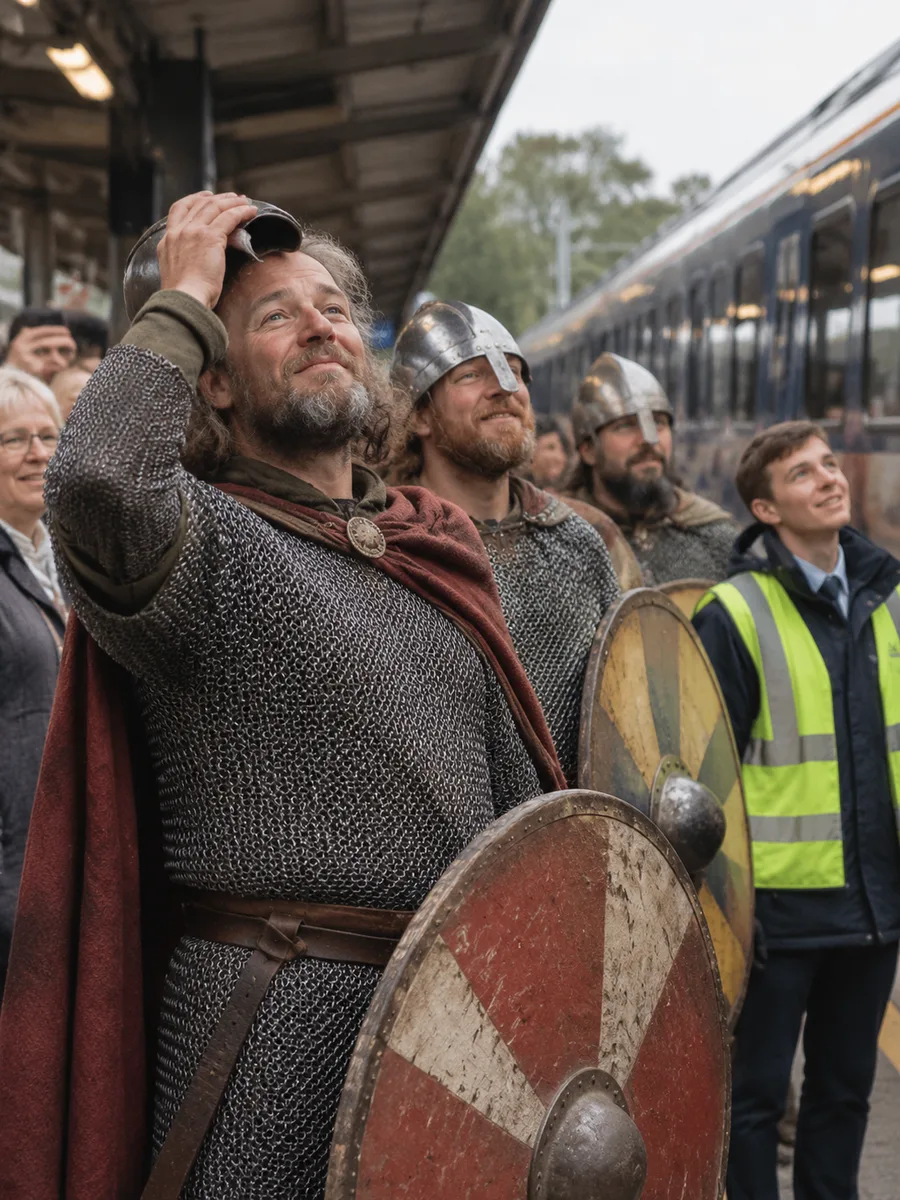
In 2025, the station in Kingston upon Thames named a train 'King Æthelstan.'
But Holland says that momentum later 'just fizzled out.'
In Embleton Bridge, Cumbria—the place where he was recognized as king in 927—locals are embroidering a tapestry.
A community interest company named after that year plans to hold festivals and create public artworks there.
The company received a £6,000 grant from the local council to develop a website.
One of its directors is local councillor Adrian Waite.
The celebrations are all set for 2027; Hilling says this event 'must be done on a grand scale.'
Cambridge scholar David Woodman has written a book titled 'The First King of England.'
His explanation is more direct: poor Æthelstan simply didn't have a contemporary who wrote about him properly.
In 2027, Europe commemorates the Normans; Hilling and his companions hope the English will remember Æthelstan.
Listen again
Try it without the transcript and notice what sounds clearer.
What vocabulary does this episode teach?
词汇HSK 5. Used in names like 征服者威廉 (William the Conqueror).
HSK 4. Here means to acknowledge someone's status, e.g., 承认他为国王.
HSK 4. Common in 纪念活动 (commemorative event) and 纪念币 (commemorative coin).
HSK 4. Refers to local residents, e.g., 当地居民反对.
HSK 4. Often followed by a reason: 反对,理由是……
HSK 4. Common verb for founding a system or organization, e.g., 建立统治.
HSK 5. Written records, e.g., 关于他的记载散失.
HSK 5. Refers to a nation's founding figure, e.g., 美国国父华盛顿.
HSK 5. A king or queen; 最佳君主 means 'best monarch'.
HSK 5. Often used in 候选人 (candidate) or 候选名单 (shortlist).
HSK 5. Often used as 递交请愿 (submit a petition).
HSK 5. Used for rejecting a request or appeal, e.g., 请愿被驳回.
* beyond level超纲词
What grammar patterns appear in this episode?
语法被 + Verb + 了
Passive voice marker. Indicates that the subject is acted upon.
已经被驳回。
纪念却被彻底忽略了。
The 把 construction emphasizes the object and the result of an action.
把这次会盟看作英格兰作为一个国家的起点。
Emphasizes a fact or detail, often used in definitions or explanations.
他的解释更直接:可怜的埃塞尔斯坦,只是没赶上同时代有人替他好好写。
以……为……
Means 'take ... as ...' or 'regard ... as ...'.
以一场惨败作为自己民族故事的开篇。
Proper nouns
专有名词Sources
来源Free account
Keep learning from this story
Create a free account to keep saved words and your preferred level together.
- Keep words with their story context
- Remember your preferred level
- Build your vocabulary over time