
A Chinese podcast · Same story, 4 levels
教皇利奥十四世访问阿根廷,与“电锯总统”米莱谈穷人与经济
Pope Leo XIV Visits Argentina, Meets 'Chainsaw President' Milei to Discuss the Poor and the Economy
About this story
Pope Leo XIV arrives in Buenos Aires, meets President Javier Milei, and calls for an economy that serves people, not the other way around, amid austerity protests. HSK 5+ Chinese listening practice.
This is an HSK 5+ Chinese listening episode that runs about 2 minutes. The full Mandarin script is shown with tap-for-pinyin and a line-by-line English translation, so you can listen and read at once — comprehensible input in the sense of Stephen Krashen's i+1 theory. It teaches 12 key vocabulary words such as 公路、总统、握手 and walks through 7 grammar patterns, each explained in English with examples. The same news story is retold at 4 difficulty levels — use the level selector above to find the version that is challenging but still understandable for you.
Read at your level
原文Read the complete story in Chinese. Reveal pinyin and English only when you need them.
English transcript reference
During his twenty years in Peru, he often rode horseback for most of a day just to say Mass in a village not even connected by road.
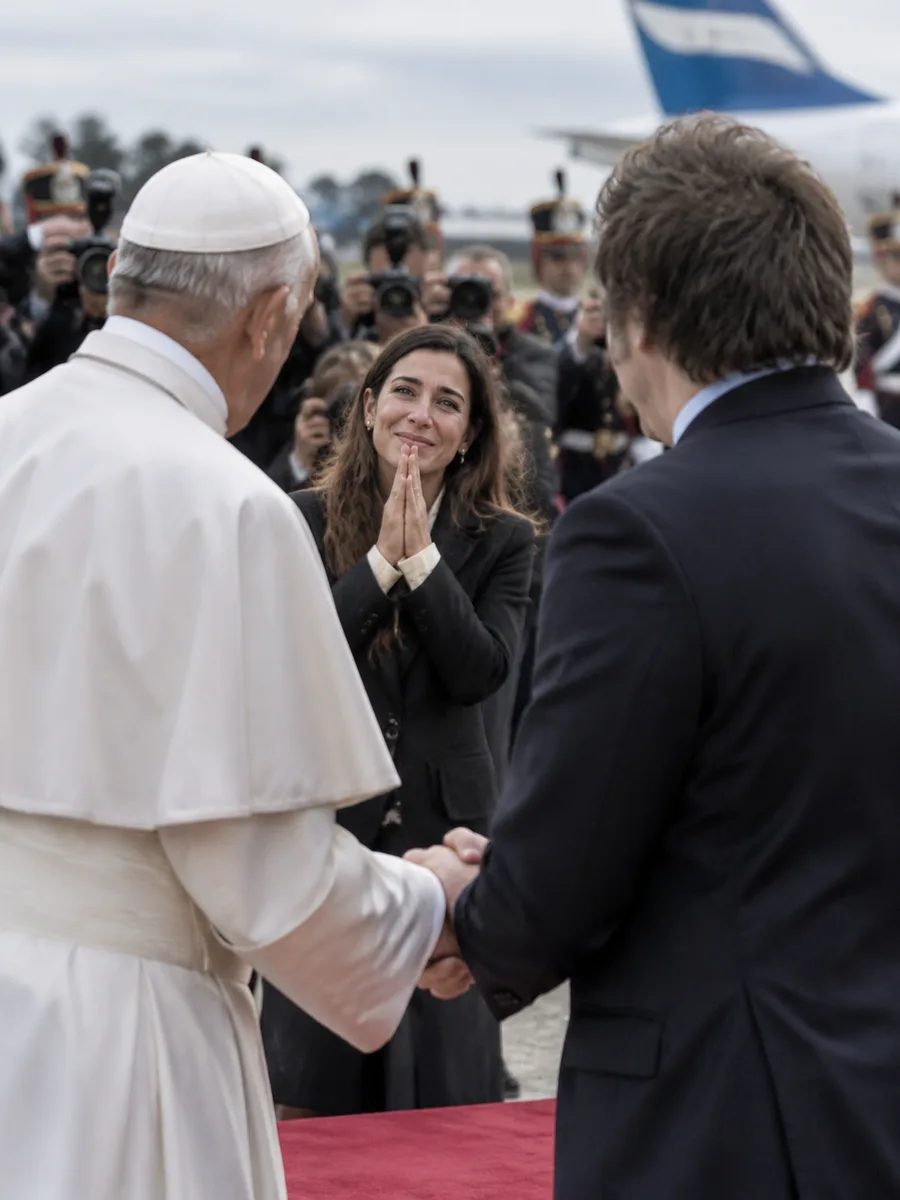
Now he is Pope Leo XIV, born in Chicago; his plane landed in Buenos Aires, with a red carpet laid out at the foot of the stairs.
Coming forward to greet him was Argentine President Javier Milei, and the two shook hands at the airport.
The last time a Roman pope set foot on Argentine soil was John Paul II in 1987, nearly forty years ago.
This South American trip lasts twelve days and covers three countries; Argentina is one stop.
Milei is a libertarian economist; austerity is the hallmark of his government, and its most iconic image is a chainsaw.
He calls social welfare an aberration and keeps slashing state spending.
The pope and he held closed-door talks at the presidential palace for half an hour.
Afterwards the two went together to the Palacio Libertad, a cultural center, where they shared a stage and each gave a speech.
Milei spoke first, with the pope sitting on the stage behind him: "Your Holiness, thank you for coming. I ask you to pray for Argentina."
Then it was the pope's turn; he said the economy should serve people, not make people serve the economy.
This line drew warm applause from the whole hall.
He did not name names, but he asked those in politics to choose their words carefully, so as to safeguard democracy.
Milei himself is known for his sharp tongue; he once called the previous pope, Francis, "the representative of evil on earth."
At the same event, he said Francis was the most important figure in Argentine history, and that "his humanity inspired all of us."
Earlier this year, Cardinal Rossi, Archbishop of Córdoba, said at Mass that there exists "a certain cruelty at the level of the state and institutions."
In Argentina's Catholic Church, Rossi's standing is second only to the pope himself.
In the Plaza de Mayo, clergy took to the streets, joining protests against cuts to pensions and disability benefits.
Argentina's poverty rate has already fallen from over forty percent when Milei took office to around thirty percent.
But figures from the polling firm Aurelio show that nearly seventy percent of Argentines see the economic situation as negative.
In a slum beside the railway in Buenos Aires, Father Toto's parish runs eight soup kitchens, where about two hundred people come to eat every day.
He says the number of people coming is still growing.
"If inflation has been stopped and poverty has fallen somewhat, here you simply can't see it—quite the opposite."
In the coming days, the pope will visit a center for the disabled and also meet with trade unionists.
Listen again
Try it without the transcript and notice what sounds clearer.
What vocabulary does this episode teach?
词汇HSK 4. 公路都不通 = not even connected by road.
HSK 4. Used for 阿根廷总统哈维尔·米莱.
HSK 4. Verb-object compound; 两人在机场握手.
HSK 4. 踏上阿根廷的土地 = set foot on Argentine soil.
HSK 3. 三个国家 = three countries.
HSK 4. Central theme: 经济应当为人服务.
HSK 4. 这届政府 = this administration.
HSK 4. 社会福利 = social welfare.
HSK 4. 骑 (ride) + 马 (horse). Appears in 骑马走上大半天.
HSK 3. Common noun; measure word 个.
HSK 4. 热烈的掌声 = warm applause.
HSK 5. 守住民主 = safeguard democracy.
* beyond level超纲词
What grammar patterns appear in this episode?
语法为了 + Verb Phrase
Expresses purpose: 'in order to'. Often shortened to 为 in formal writing.
只为到一个连公路都不通的村子做一场弥撒。
连 + Noun + 都/也 + Verb
Emphasizes an extreme case: 'not even...'. Here 连公路都不通 = not even connected by road.
只为到一个连公路都不通的村子做一场弥撒。
是 + Noun Phrase
Simple identification/definition sentence, common in news writing.
阿根廷是其中一站。
把 + Object + Verb Phrase
The 把 construction moves the object before the verb to show disposal or result.
把国家开支一削再削。
从 + A + 到 + B
Expresses a range from A to B.
阿根廷的贫困人口已经从米莱上任时的四成以上降到三成左右。
应当 + Verb + 而不是 + Verb
Expresses what should be done versus what should not: 'should..., not...'.
经济应当为人服务,而不是让人去为经济服务。
从 + Time + 起 + 到 + Time
Expresses a time span from one point to another.
从米莱上任时的四成以上降到三成左右。
Proper nouns
专有名词Sources
来源Free account
Keep learning from this story
Create a free account to keep saved words and your preferred level together.
- Keep words with their story context
- Remember your preferred level
- Build your vocabulary over time