
A Chinese podcast · Same story, 4 levels
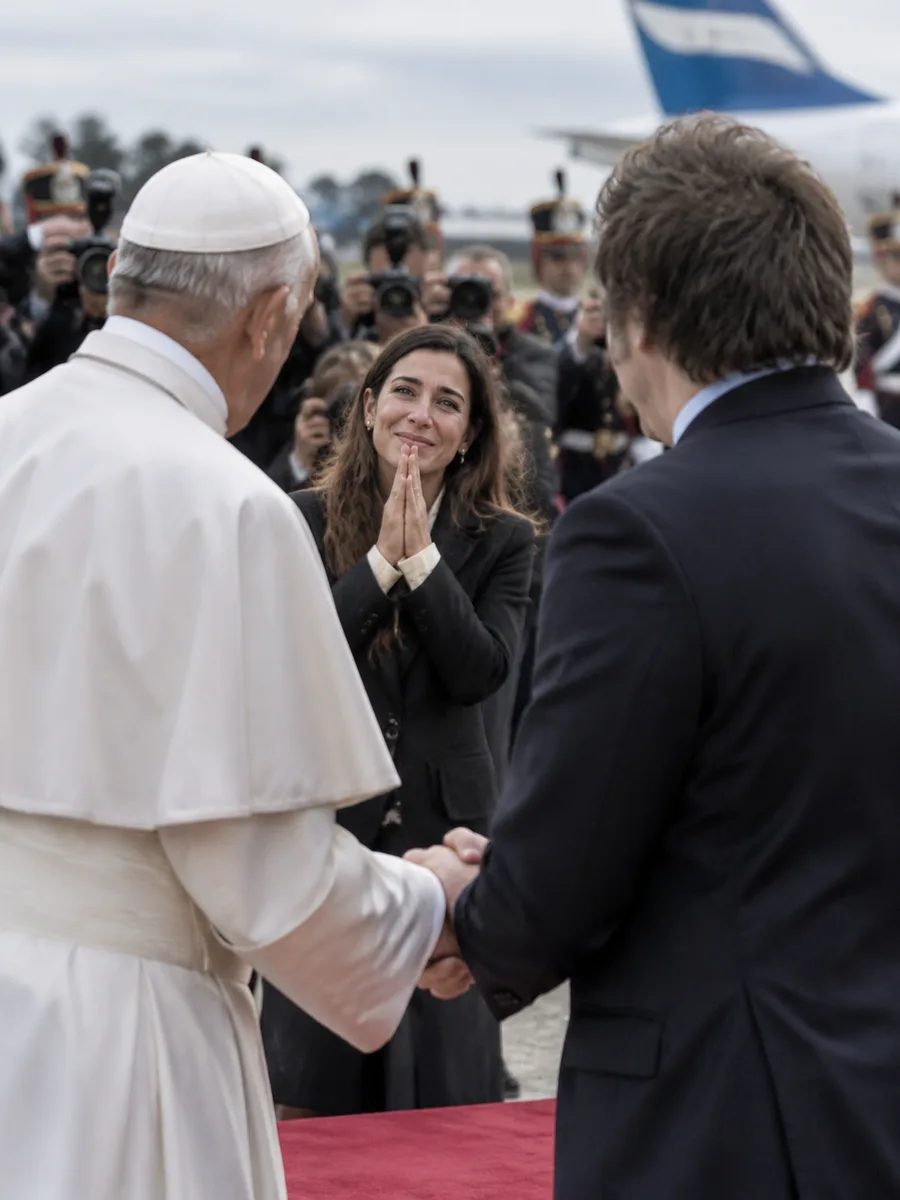
教皇利奥十四世访问阿根廷,与“电锯总统”米莱谈穷人与经济
Pope Leo XIV Visits Argentina, Meets 'Chainsaw President' Milei to Discuss the Poor and the Economy
About this story
Pope Leo XIV meets Argentina's President Javier Milei in Buenos Aires, urging that the economy serve people, not the other way around. HSK 3 Chinese listening practice.
This is an HSK 3 Chinese listening episode that runs about 3 minutes. The full Mandarin script is shown with tap-for-pinyin and a line-by-line English translation, so you can listen and read at once — comprehensible input in the sense of Stephen Krashen's i+1 theory. It teaches 12 key vocabulary words such as 首都、机场、出生 and walks through 6 grammar patterns, each explained in English with examples. The same news story is retold at 4 difficulty levels — use the level selector above to find the version that is challenging but still understandable for you.
Read at your level
原文Read the complete story in Chinese. Reveal pinyin and English only when you need them.
English transcript reference
The Pope arrived in the capital of this country.
The Pope is the highest leader of Catholicism.
President Milei went to the airport to meet him, with a red carpet laid on the ground.
The two shook hands and also smiled and said a few words.
This is his first visit to this country since becoming Pope.
The last Pope visited here almost forty years ago.
The Pope was born in the United States.
He worked in the countryside of Peru for twenty years.
Some villages cannot be reached by car, so he rode a horse to see the poor.
The President studied economics, and his approach is to make the government spend less money.
He has been continuously reducing government spending.
He has said that it is wrong for the government to use money to help the poor.
The two first talked alone for a while.
They talked for half an hour at the place where the President works.
After talking, they went together to a cultural center.
Both of them spoke there.
When the President was speaking, the Pope sat behind him.
He said, Pope, thank you for coming to this country.
He also asked the Pope to pray to God for this country.
The Pope said that the economy should serve people.
People should not live for the economy.
After this sentence, many people applauded vigorously.
The Pope also said that those who manage politics should protect democracy.
Democracy is letting the people be able to speak.
Those who manage politics should also be careful with their words.
The President often speaks very bluntly.
The President also praised the previous Pope, saying he is the most important person in this country.
But previously, the President said that the previous Pope was very bad.
Earlier this year, a Catholic leader spoke.
He said that the government sometimes treats people very badly.
Many people stood in the Plaza de Mayo, saying they disagree with the government's actions.
The government cut money, and the elderly and sick are most affected.
The government says that the number of poor people is now lower than before.
Out of ten people, about three are poor.
Before, out of ten people, there were more than four.
On the edge of the city, there is a very poor place.
There is a railway there, and many houses are built right next to the railway.
Toto works in this place, and his church has opened eight soup kitchens.
The poor do not pay for meals, and more than two hundred people come to eat every day.
Toto says that more and more people are coming to eat.
He says that if prices really stabilize, the poor here should also decrease.
But here, you can't see it at all; the situation is exactly the opposite.
In the next few days, the Pope will also visit people who are in poor health.
He will also meet some workers.
Listen again
Try it without the transcript and notice what sounds clearer.
What vocabulary does this episode teach?
词汇HSK 2. Common noun for a country's capital.
HSK 2. Common place noun.
HSK 2. Used as 出生在美国 (born in the US).
HSK 1. Both verb and noun.
HSK 2. Common in news contexts.
HSK 2. Used in 文化中心 (cultural center).
HSK 2. Common verb.
HSK 2. Often used as 受影响 (be affected).
HSK 2. Used for a country's president.
HSK 1. Ordinal prefix 第 + number + measure word.
HSK 2. Common political term.
HSK 2. 穷 (poor) + 人 (person).
* beyond level超纲词
What grammar patterns appear in this episode?
语法是...的 (emphasis construction)
Used to emphasize a fact or situation, often with a time or place.
这是他当教皇以后第一次来这个国家。
上一个教皇来这里,是快四十年以前的事了。
把 + object + verb phrase (disposal construction)
Indicates how something is handled or affected.
他一直把政府的开支往下减。
政府把钱减了,老人和病人受影响最大。
如果...就... (conditional)
Expresses a condition and its result.
如果物价真的稳住了,这里的穷人也该少了。
越来越 + adjective/verb
Indicates a gradual increase or change.
来吃饭的人越来越多。
为了 + noun/verb phrase
Expresses purpose or reason.
人不应该为了经济活着。
应该 + verb
Expresses obligation or expectation.
经济应该为人服务。
管政治的人应该保护民主。
Proper nouns
专有名词Sources
来源Free account
Keep learning from this story
Create a free account to keep saved words and your preferred level together.
- Keep words with their story context
- Remember your preferred level
- Build your vocabulary over time