
A Chinese podcast · Same story, 4 levels
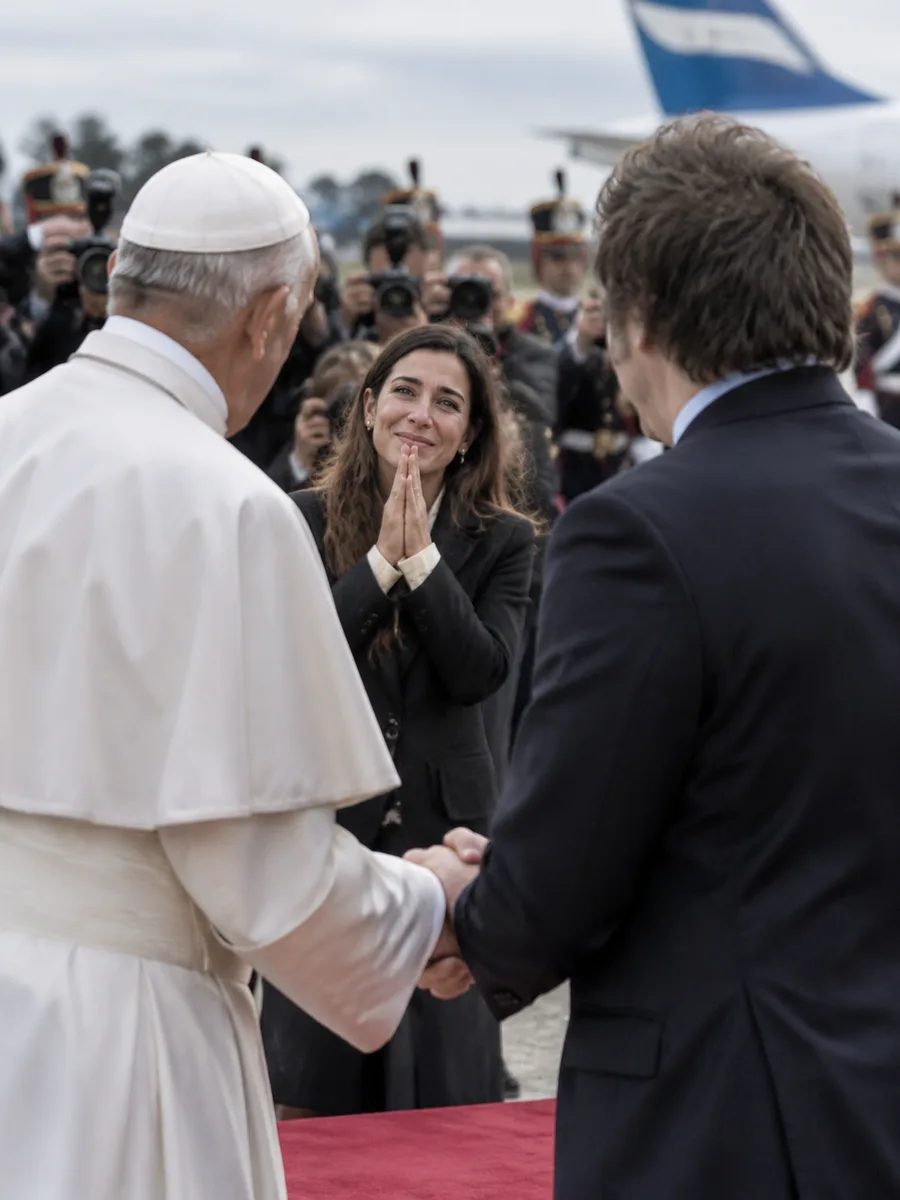
教皇利奥十四世访问阿根廷,与“电锯总统”米莱谈穷人与经济
Pope Leo XIV Visits Argentina, Meets 'Chainsaw President' Milei to Discuss the Poor and the Economy
About this story
HSK 3: Pope Leo XIV visits Argentina, where his message for the poor clashes with President Javier Milei's chainsaw austerity and welfare cuts.
This is an HSK 4 Chinese listening episode that runs about 3 minutes. The full Mandarin script is shown with tap-for-pinyin and a line-by-line English translation, so you can listen and read at once — comprehensible input in the sense of Stephen Krashen's i+1 theory. It teaches 12 key vocabulary words such as 总统、访问、机场 and walks through 8 grammar patterns, each explained in English with examples. The same news story is retold at 4 difficulty levels — use the level selector above to find the version that is challenging but still understandable for you.
Read at your level
原文Read the complete story in Chinese. Reveal pinyin and English only when you need them.
English transcript reference
The pope sat on the stage, and President Milei turned around and asked him to pray for his country.
This is Pope Leo XIV's first visit to Argentina.
The last time a pope came here was nearly forty years ago.
Milei rolled out a red carpet at the airport; the two shook hands and then went together to the presidential palace.
Leo XIV was born in Chicago but spent twenty years doing missionary work in Peru.
He often rode horseback to remote villages to visit the poor there.
This experience gave him a very direct understanding of poverty.
Milei is a libertarian economist, famous for sharply cutting government spending.
He called social welfare an aberration, and when cutting the budget he even raised a chainsaw.
The two men's ideas are very far apart, so this visit drew attention from the very start.
At the presidential palace they held private talks, then went together to the Palace of Liberty.
On the stage at the Palace of Liberty, Milei spoke first, thanking the pope for coming to Argentina.
He said, I would like to ask you to pray for Argentina, with the pope sitting right behind him.
The pope then spoke, saying the economy should serve people, not the other way around.
This sentence drew warm applause from the whole hall and also pointed to the two men's real disagreement.
These remarks were also seen as a response to Milei's austerity policies.
He also talked about democracy, asking politicians to use their words carefully.
He did not name names, but Milei has long been known for his fierce rhetoric.
This time Milei also called Pope Francis the most important person in Argentina's history.
He said Francis's character inspired everyone.
But a few years ago, he had called Francis 'the representative of evil on earth.'
Tension between the church and the government does not appear only in this one speech.
Archbishop Rossi of Córdoba said there is a kind of institutional cruelty here.
Because the budget was cut, benefits for retirees and disabled people have been affected.
Some clergy walked onto the Plaza de Mayo and stood with the protesters.
On the edge of Buenos Aires, Father Toto's view is more direct.
His parish runs eight soup kitchens, serving about two hundred people every day.
He said more and more people are coming, and the need is still rising.
Argentina's poverty rate has already dropped from over forty percent to around thirty percent.
But he said that even if inflation has stopped and poverty has fallen, the situation here is exactly the opposite.
This South America trip includes three countries, and Argentina is only one stop.
In Argentina, he also plans to visit disabled people and meet with union members.
Listen again
Try it without the transcript and notice what sounds clearer.
What vocabulary does this episode teach?
词汇HSK 3. 总统米莱 — President Milei.
HSK 3. 访问阿根廷 — visit Argentina; formal word for an official visit.
HSK 3. 在机场铺了红毯 — rolled out a red carpet at the airport.
HSK 3. 两人握手 — the two shook hands.
HSK 3. 削减政府支出 — cut government spending.
HSK 3. 经济学家 — economist; 经济应当为人服务 — the economy should serve people.
HSK 3. 社会福利 — social welfare.
HSK 3. 退休人员 — retirees.
HSK 3. 削预算 — cut the budget; 预算被削减 — the budget was cut.
HSK 3. 他还谈到民主 — he also talked about democracy.
HSK 3. 要求政治家谨慎地使用自己的语言 — asked politicians to use their words carefully.
HSK 3. 贫困人口 — the poor population; 对贫困有很直接的了解 — a direct understanding of poverty.
* beyond level超纲词
What grammar patterns appear in this episode?
语法是……的第一次
Used to emphasize that something is the first time an action or event has happened.
这是教皇利奥十四世第一次访问阿根廷。
还是……的事
A pattern meaning 'was still a matter of...', used to refer to a past time or event.
上一次教皇来到这里,还是将近四十年前的事。
靠 + Noun/Verb + 出名
Means 'to be famous for' something, often a skill or action.
米莱是自由主义经济学家,靠大幅削减政府开支出名。
把 + Object + 称作 + Noun
The 把 construction with the verb 称作 ('to call') to say what someone calls something.
他曾经把方济各叫作“地球上邪恶的代表”。
应当 + Verb + 而不是 + Verb
Expresses what should happen as opposed to what should not; 'should... rather than...'.
经济应当为人服务,而不是相反。
Passive voice marker; the subject receives the action.
由于预算被削减,退休人员和残疾人的补助受到影响。
这番话,也被看作是对米莱紧缩政策的一种回应。
就算……也……
Concessive pattern meaning 'even if..., still...'.
就算通胀停了、贫困降了,这里的情况恰恰相反。
Proper nouns
专有名词Sources
来源Free account
Keep learning from this story
Create a free account to keep saved words and your preferred level together.
- Keep words with their story context
- Remember your preferred level
- Build your vocabulary over time