
A Chinese podcast · Same story, 4 levels
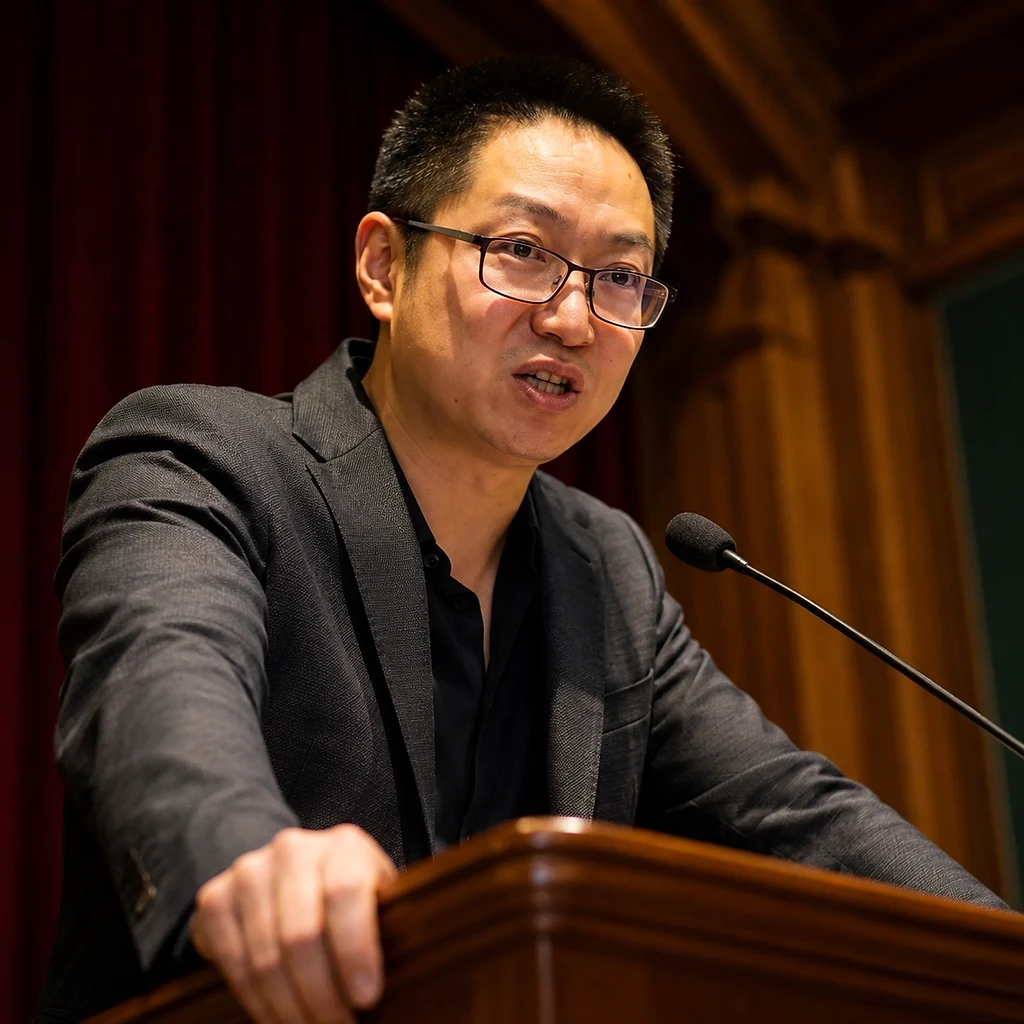
粉笔老板张小龙,骂了大学生
Fenbi's Boss Zhang Xiaolong Insulted College Students
About this story
The Fenbi CEO Zhang Xiaolong incident at Renmin University — a civil-service-exam-prep CEO insulting the very students who are his customers, and what it says about China's civil service exam fever. HSK 1 Chinese listening practice.
This is an HSK 1 Chinese listening episode that runs about 8 minutes. The full Mandarin script is shown with tap-for-pinyin and a line-by-line English translation, so you can listen and read at once — comprehensible input in the sense of Stephen Krashen's i+1 theory. It teaches 12 key vocabulary words such as 学校、学生、工作 and walks through 6 grammar patterns, each explained in English with examples. The same news story is retold at 4 difficulty levels — use the level selector above to find the version that is challenging but still understandable for you.
Read at your level
原文Read the complete story in Chinese. Reveal pinyin and English only when you need them.
English transcript reference
Today let's talk about something that happened.
A man insulted some students.
This man is the boss of a big company.
The students he insulted were from a very famous university.
This event is being talked about all over China.
Let's go through it slowly.
First, let's talk about the company.
This company is called Fenbi.
What is "fenbi"?
"Fenbi" is the thing teachers use to write on the board at school.
Whatever fenbi writes comes out white.
But the "fenbi" we're talking about here isn't the chalk for writing.
It's the name of a company.
This company is a very big company.
It's a big company in China.
What does this company do?
This company teaches students how to take exams.
What exams?
The civil service exam.
What is a civil servant?
A civil servant is a kind of job.
People who are civil servants do work for the government.
People who are civil servants don't make a lot of money.
But this kind of job is very stable.
What does "stable" mean?
"Stable" means: you won't suddenly have no job.
This year you have work.
Next year you also have work.
The job stays.
So lots of Chinese university students want to be civil servants.
They feel that this kind of job is very good.
But to be a civil servant, you have to take a test.
What is a test?
A test is using a pen to write words on paper.
If you answer correctly, your score is high.
If your score is high, you can be a civil servant.
If your score isn't high, you can't.
So students need to take classes.
Taking classes means going to learn how to take the test.
This company called Fenbi teaches exactly this.
They teach with phones, and with computers.
The classes aren't very expensive.
So lots of students use this company's classes.
The boss of this company is named Zhang Xiaolong.
He's in his forties this year.
Before, he himself was also a civil-service-exam teacher.
Later he started this company on his own.
He made a lot of money.
Now let's talk about what happened yesterday.
Yesterday, Zhang Xiaolong went to a university.
This university is called Renmin University.
Where is Renmin University?
Renmin University is in Beijing.
Renmin University is one of the top three universities in China.
Very famous.
What did he go there to do?
He went to give a lecture.
What is a lecture?
A lecture means: one person stands at the front and speaks.
Students sit below and listen.
What was the lecture supposed to be about?
It was supposed to be about the civil service exam.
Zhang Xiaolong knows that subject best.
But when the lecture was about to start.
He suddenly changed the topic.
He didn't want to talk about the civil service exam anymore.
He wanted to talk about something new.
He wanted to talk about AI and work.
He said: AI is here.
How should young people find jobs?
He said he was going to explain.
The students sat and listened.
After listening for a while.
The students had no reaction.
What does "no reaction" mean?
It means: no one laughed.
And no one asked questions.
The students just sat quietly.
And listened quietly.
Zhang Xiaolong saw this and was unhappy.
He got angry.
He started cursing the students.
What is "cursing"?
"Cursing" means: saying bad things.
Saying things that hurt people.
He cursed for a long time.
What did he say?
He said: "It's right that you can't find jobs."
What does "it's right" mean?
It means: this is your own problem.
He also said: "Other than taking the civil service exam, you don't know anything."
He also said: "Taking the civil service exam is just 'eating and waiting to die.'"
What does "eating and waiting to die" mean?
"Eating and waiting to die" means: someone does nothing.
They just eat.
They just wait to die.
It's a very nasty thing to say.
The students listened and didn't say anything.
Some students quietly took out their phones.
They quietly filmed a video.
Zhang Xiaolong finished cursing.
He didn't finish the lecture.
He left on his own.
He didn't come back.
That night.
The students put the video online.
People all over China saw the video.
Everyone was very angry.
Everyone said: this boss went too far with his words.
And, people noticed something very strange.
What is strange?
Zhang Xiaolong's company teaches students how to take the civil service exam.
Why do students use this company's classes?
It's because they want to be civil servants.
Students buy classes and give this company money.
This company makes money.
Zhang Xiaolong also makes money.
But what did Zhang Xiaolong say at the university?
He said: being a civil servant is eating and waiting to die.
The people he was cursing are the very people who give him money.
The thing he was cursing is the very thing his company teaches.
Isn't this strange?
There's an old saying in China.
The saying is: after eating someone else's food, then cursing the cook.
This saying means: a person has forgotten that their money came from someone else.
A lot of people are saying Zhang Xiaolong is exactly like this.
This morning.
Zhang Xiaolong wrote a letter.
This letter is called an "apology letter."
What is an apology letter?
An apology letter is: a person writes a letter.
In the letter they say "I'm sorry."
What did Zhang Xiaolong say in the letter?
He said: "I was wrong."
He said: "What I said wasn't right."
He said: "The whole thing is my problem."
But some students said: writing a letter is no use.
Words once spoken can't be taken back.
We want to know: what are you going to do next?
Finally, I want to ask you a question.
In your country.
Is there a job like the civil service exam in China?
Meaning: a kind of job that lots and lots of young people want to do.
Everyone wants to go in.
Lots of people, few jobs.
Why does everyone want to do this kind of job?
Is it because the money is good?
Is it because the work is stable?
Or is it for some other reason?
Do you yourself want to do this kind of job?
Why?
Listen again
Try it without the transcript and notice what sounds clearer.
What vocabulary does this episode teach?
词汇HSK 1 noun. 人民大学是北京一所很有名的学校 = Renmin University is a very famous school in Beijing.
HSK 1 noun. 大学的学生 = university students. Used repeatedly throughout the episode.
HSK 1. Both verb and noun. 找工作 = look for a job.
HSK 1 verb. Used throughout for both 'think' and 'want to do something'.
HSK 1 verb. 学生坐在下面听 = students sit below and listen. Used many times across the lecture scene.
HSK 1 noun. 赚钱 = make money. 他赚了很多钱 = he made a lot of money.
Beyond HSK 1. 粉 (powder) + 笔 (pen). Originally means chalkboard chalk; here it's the company name. The episode glosses it inline.
Beyond HSK 1. The central topic noun. The episode glosses: 公务员就是为国家工作的人.
HSK 3, beyond the HSK 1 target. The episode glosses: 道歉,就是说对不起.
Beyond HSK 1. The episode glosses: 讲座,就是站在那里说话给学生听.
HSK 2, beyond the HSK 1 target. 一个公司 = a company. 公司很大 = the company is big.
Beyond HSK 1. The central verb of the episode. 他开始骂人 = he started cursing people.
* beyond level超纲词
What grammar patterns appear in this episode?
语法Basic identity sentence — 是 links the subject to a noun.
公司的老板叫张小龙。
他自己以前也是老师。
粉笔,就是老师在学校用的那个白白的东西。
Subject + 不 + Verb / Adjective
Negate verbs and adjectives with 不 placed directly before them.
他不高兴。
学生不说话。
他自己以前也害怕。
Use 很 before adjectives to form a basic descriptive sentence.
公司很大。
学生很生气。
工作稳定。
Subject + 也 + Verb
也 means 'also'. It goes between subject and verb, never at the start of the sentence.
他自己以前也是老师。
他自己也是学哲学的人。
他自己以前也害怕。
了 after a verb marks a completed action — often translates as past tense in English.
他突然生气了。
他开了公司。
全中国的人都看见了。
Subject + 想 + Verb-phrase
想 + verb means 'want to do something'. Use 想 before another verb.
很多大学生想做公务员。
他们想做公务员。
你自己想做这个工作吗?
Proper nouns
专有名词Free account
Keep learning from this story
Create a free account to keep saved words and your preferred level together.
- Keep words with their story context
- Remember your preferred level
- Build your vocabulary over time