
A Chinese podcast · Same story, 4 levels
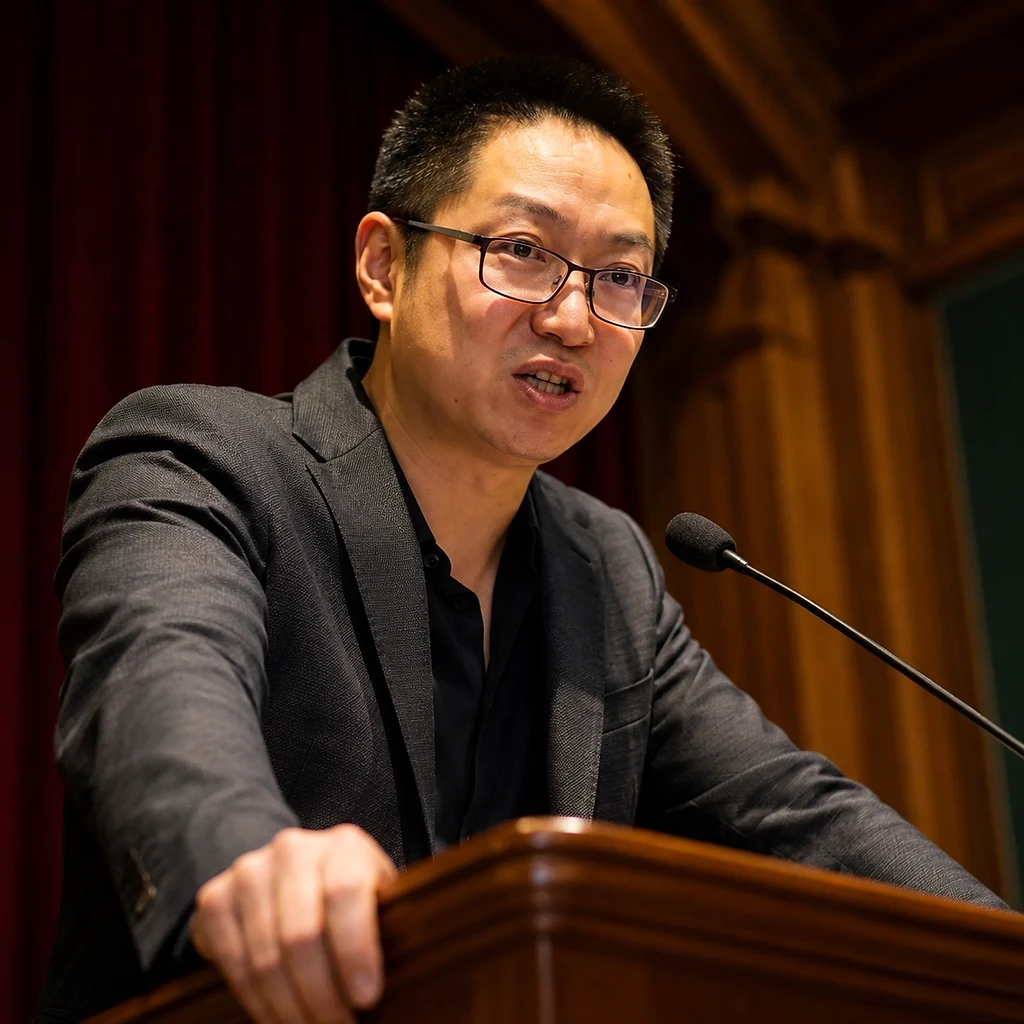
粉笔 CEO 张小龙在人大开骂——一个人的失态,背后是一代人的焦虑
Fenbi CEO Apologizes After RUC Outburst
About this story
A deeper read of the Zhang Xiaolong incident: the irony of cursing your own customers, three layers of analysis on personal fragility, generational anxiety, and how successful people see those who didn't get out. HSK 5-6 Chinese listening practice.
This is an HSK 5-6 Chinese listening episode that runs about 10 minutes. The full Mandarin script is shown with tap-for-pinyin and a line-by-line English translation, so you can listen and read at once — comprehensible input in the sense of Stephen Krashen's i+1 theory. It teaches 12 key vocabulary words such as 责任、经济、社会 and walks through 7 grammar patterns, each explained in English with examples. The same news story is retold at 4 difficulty levels — use the level selector above to find the version that is challenging but still understandable for you.
Read at your level
原文Read the complete story in Chinese. Reveal pinyin and English only when you need them.
English transcript reference
Why would a CEO of a publicly listed company.
Stand on the podium of one of China's best universities.
In front of philosophy school students.
And curse them for over ten minutes.
Saying they "deserve not being able to find jobs"?
And his own company.
Earns its money from those very students.
Today let's talk about this.
The event happened on the night of June 3, 2026.
Location: Beijing.
The philosophy school of Renmin University of China.
The lecturer.
Was Zhang Xiaolong, CEO of Fenbi Technology.
Fenbi — you've probably heard of it.
It's China's largest civil-service-exam prep company.
What is "gongkao peixun"?
It's teaching students how to take the civil service exam.
In 2023, Fenbi listed on the Hong Kong stock exchange.
Since then, the company has been publicly traded.
Zhang Xiaolong is Fenbi's founder.
In his forties.
He studied philosophy as an undergraduate.
For his master's at Sun Yat-sen University, also philosophy.
Even while in grad school, he was already teaching civil service prep part-time.
Later he gave up on his PhD.
In 2013 he ran to Beijing.
And started Fenbi.
He caught the mobile internet wave and the civil-service-exam boom.
The company grew large.
This lecture was originally going to be on his most familiar territory.
The civil-service-prep industry.
But before the lecture started.
He changed the topic at the last minute.
The new topic was: "Career planning in the AI era."
Meaning: AI is here, how should young people find jobs.
He first shared some of his own views.
He said the best job in the future is trading stocks.
His exact words were: "Best to trade tech stocks."
"Even better, trade US stocks."
"And best of all, get the whole family to trade stocks together."
You can imagine — standing on a university stage giving that advice.
The atmosphere was a little strange.
The students in the audience were mostly philosophy undergrads and grads.
They had no reaction to this advice.
No one laughed.
No one asked questions.
They just sat quietly.
It was this "silence" that made Zhang Xiaolong lose control.
He'd probably expected applause after he finished.
Or at least someone to agree.
But there was nothing.
He started cursing on the stage.
He cursed continuously for several minutes.
Some students secretly recorded videos.
So later all of this got out.
The key sentences were these:
"You have no awareness of the changes new things bring to society."
"You are utterly oblivious."
"So it's only right that you can't find jobs."
"Other than getting into the system."
"Working as civil servants, eating and waiting to die."
"You have no abilities at all."
"Hun chi deng si" — "eating and waiting to die" —
You might need to gloss those four characters separately.
It means: doing nothing, just eating, waiting for death.
It's a very heavy thing to say.
A public figure.
On a university stage.
Saying this kind of thing to students.
Is very unusual.
After cursing, Zhang Xiaolong didn't wait for the lecture to end.
He left directly.
Leaving a roomful of stunned students.
That night.
The videos and audio recordings were uploaded online.
Weibo, Xiaohongshu, Zhihu all exploded.
The next day, the morning of June 4.
Fenbi Technology issued an apology letter.
Zhang Xiaolong wrote in the letter:
"The responsibility for this incident is entirely mine."
"I deeply reflect."
"For the negative impact on Renmin University and the philosophy school, I deeply apologize."
"I am willing to take on corresponding responsibility."
The apology was issued.
But netizens weren't buying it.
The most common line in the comments was this:
"Pick up the bowl to eat, put down the bowl to curse mom."
Meaning: eating someone's food, then cursing the person who cooked it.
The logic is simple.
What Fenbi sells is civil-service-exam prep.
The students who buy his courses almost all want to become civil servants.
Their money feeds Fenbi, feeds Zhang Xiaolong.
You're now standing on a stage cursing their civil-service path as "eating and waiting to die."
Then where did your money come from?
It came from those very "eating and waiting to die" people.
This is "pick up the bowl to eat."
"Put down the bowl, curse mom."
That's the first layer of this thing.
But there are deeper layers to this.
When I looked at it myself.
I had three feelings.
The first feeling.
Is on the level of personal loss of composure.
As a CEO of a publicly listed company.
Standing on a university stage cursing.
Regardless of what the students did.
You shouldn't.
Emotional control is a basic skill.
Zhang Xiaolong failed at it.
And he failed in a particularly embarrassing way.
The audience didn't applaud, so he cursed them.
That's an extremely fragile reaction.
Fragile to a degree that doesn't fit a CEO in his forties.
More like a young person who feels ignored.
The second feeling.
More complicated.
It's that: the phenomenon he was cursing is real.
There really are millions of young people.
Who treat civil service as the only path out.
There really are more and more people.
With no interest in private companies, in startups, in new industries.
They only want to get into the system.
They only want an iron rice bowl.
Why?
It's not because they're lazy.
It's because what they see is this:
Private companies are unstable.
Internet companies are laying people off.
Real estate has collapsed.
Doing business gets harder.
So the system has become "the only safe place."
The students aren't being lazy.
The students are doing risk assessment.
Their judgment makes sense.
Zhang Xiaolong's mistake.
Wasn't cursing the wrong audience.
It was getting the cause wrong.
He treated the consequence as the cause.
The students want civil service.
Not because they have no abilities.
It's because society has left them no other good options.
The third feeling.
Is the most interesting layer.
It's that: what he was cursing was himself from a decade ago.
I mentioned this earlier.
Zhang Xiaolong studied philosophy in college.
His high school teacher told him at the time: "If you study philosophy, you won't easily find a job."
He knows what that judgment feels like.
Later he chose the civil-service-prep lane.
Maybe because he didn't want to "eat and wait to die."
He took one step out of the traditional "get into the system" path.
And he bet right.
The company listed, made a lot of money.
Now he returns to a philosophy school's stage.
And sees himself from a decade ago.
By rights he should understand them.
But he didn't.
He cursed them.
Psychology has a saying.
What a person hates most is "the unfinished version of themselves" they still carry.
Zhang Xiaolong cursing students may not just be because the students' reaction was flat.
It may be because he saw an "if I hadn't bet right back then, I'd be like this" version of himself.
What he was cursing was the self that "almost became them."
This explanation doesn't excuse him.
But it helps us understand the psychology behind the loss of composure.
Back to the impact of this thing.
Fenbi's stock has dropped 67% in the past six months.
On June 3, the stock was at 0.67 Hong Kong dollars.
A big drop from the IPO price.
After this incident.
The company's image takes another hit.
But where the stock actually goes — we'll have to see.
The apology letter has one key sentence.
"I am willing to take on corresponding responsibility."
"Corresponding responsibility" —
This is standard PR phrasing.
With no specifics.
Should he resign?
Should he pay compensation?
Should he refund tuition?
None of it has been said.
The real test is still ahead.
About this whole thing.
I want to tell you about three larger trends.
The first trend.
The civil service exam in China is no longer just an employment choice.
It's the mental state of a generation.
When millions of people put their only sense of security on "getting into the system."
It means no one believes in the other lanes anymore.
That's a signal worth the whole society reflecting on.
Cursing students won't solve it.
The second trend.
Is the question of CEO speech authority.
Over the past decade or so.
In the internet startup wave.
Many CEOs got used to being adored.
Whatever they said, someone wrote it down.
They slowly lost their judgment about the occasion.
Zhang Xiaolong isn't the first.
And won't be the last.
This is a collective loss of composure.
The third trend.
And the most important one.
Is the question of "how successful people see young people."
A person who bet right.
Looking back at those still standing where they started.
He can choose empathy.
Or he can choose contempt.
Zhang Xiaolong chose contempt.
Which is basically saying: "I did it, you can't, so you're not good enough."
But the economy is different now.
The era is different.
The path he walked back then.
Today's young people may not be able to walk it.
This isn't a moral question.
It's a factual question.
A truly smart successful person.
Should see this fact.
And then help young people.
Not curse them.
Finally.
I want to leave two questions with you.
The first is more concrete.
In your country or culture.
Is there a "hot lane" like China's "civil service exam"?
A single path that masses of young people.
All push to try to enter?
What is it?
Why are they all pushing toward it?
What do you yourself think of that path?
The second question.
Think a bit bigger.
If one day.
You bet right.
And you stood at a position much higher than your peers at the time.
Looking back at those who didn't bet right.
How would you treat them?
Would you feel they "deserve to be useless"?
Or feel "they just didn't catch the wave"?
How do you know which one is real?
These two questions have no standard answer.
But they're worth thinking about slowly.
Listen again
Try it without the transcript and notice what sounds clearer.
What vocabulary does this episode teach?
词汇HSK 4. 承担相应的责任 = take on corresponding responsibility — directly from Zhang's apology letter.
HSK 4. 但是经济不一样了 = but the economy is different now.
HSK 4. 一个新鲜事物给社会带来的改变 = the changes a new thing brings to society.
HSK 4. 心理学上有个说法 = there's a saying in psychology.
HSK 3 noun/verb. 公司形象进一步受伤 — influence/impact on company image.
HSK 4. Within the HSK 1-4 target for normal. Implied throughout the stock-trading-advice discussion.
Beyond HSK 1-4. 失 (lose) + 态 (manner). A common modern Chinese word for public meltdowns. The episode's title itself uses it.
Beyond HSK 1-4. 一代人的焦虑 = a generation's anxiety. Central concept of the episode's second-layer analysis.
Beyond HSK 1-4. 进体制 = get into the system (i.e. become a civil servant or state-enterprise employee).
Beyond HSK 1-4. The opposite of 共情 (empathy). Zhang Xiaolong 选了鄙视 = chose contempt.
Beyond HSK 1-4. 公关常用的话术 = standard PR phrasing. A word with a slightly cynical connotation.
Beyond HSK 1-4. 赛 (race) + 道 (road). Originally a racing-track word, now used in business / careers to mean a career path or industry niche.
* beyond level超纲词
What grammar patterns appear in this episode?
语法Subject + 之所以... + 是因为...
Formal cause-effect structure with result first, then reason. More emphatic than 因为...所以....
他骂他们,其实是在骂那个'差点成为他们'的自己。
对... + 来说
Topicalizer: 'as for / from the perspective of'.
对中国人民大学和哲学院造成的负面影响,我深深致歉。
学生不是在懒。学生在做风险评估。
Subject + 把 + Object + Verb-phrase
把 construction re-orders the object before the verb, emphasizing disposal or result.
他把结果当成了原因。
把考公务员当成唯一的出路。
几百万人都把唯一的安全感寄托在'考编'上。
不是 + Reason1 + 是 + Reason2
Correction: 'not because X, but because Y'.
不是因为他们懒。是因为他们看到的现实是这样的。
不是骂错了对象。是搞错了原因。
Subject + 越来越 + Adjective / Verb
越来越 = 'more and more'. Marks an ongoing tendency.
做生意越来越难。
真的有越来越多人。
Verb / Adjective + 起来
Verb/Adj + 起来 introduces evaluation or starts an action.
评论里最多的一句话是这样的。
他在讲台上越说越激动。
回头看那些还在原地的人。
Subject + 当成 + Noun
把 X 当成 Y / 把 X 当 Y = 'treat X as Y'.
把考公务员当成唯一的出路。
他把结果当成了原因。
Proper Nouns
专有名词Free account
Keep learning from this story
Create a free account to keep saved words and your preferred level together.
- Keep words with their story context
- Remember your preferred level
- Build your vocabulary over time