
A Chinese podcast · Same story, 4 levels
车顶上的鳄鱼、白布下的荒诞、和"佛罗里达男子"的文化密码
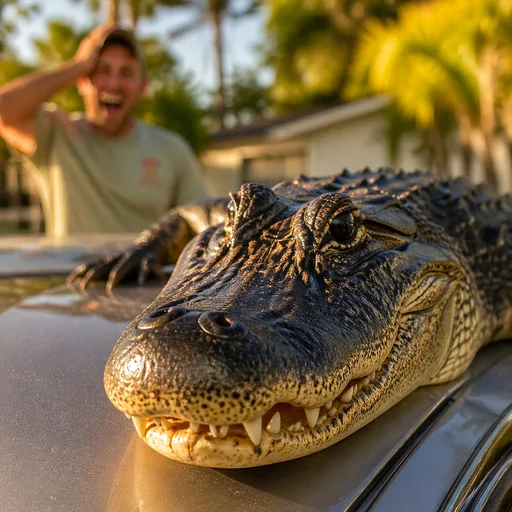
Florida Man Straps Live Alligator to Car Roof
About this story
Anthony Buhl and March Chadwick drove a live alligator across three Florida counties on their car roof — Florida Man strikes again. HSK 5-6 Chinese listening practice.
This is an HSK 5-6 Chinese listening episode that runs about 7 minutes. The full Mandarin script is shown with tap-for-pinyin and a line-by-line English translation, so you can listen and read at once — comprehensible input in the sense of Stephen Krashen's i+1 theory. It teaches 12 key vocabulary words such as 系统、自动、生态 and walks through 3 grammar patterns, each explained in English with examples. The same news story is retold at 4 difficulty levels — use the level selector above to find the version that is challenging but still understandable for you.
Read at your level
原文Read the complete story in Chinese. Reveal pinyin and English only when you need them.
English transcript reference
Speaking of a unique presence in American news ecology, that would be "Florida Man."
These words have become a cultural symbol in America.
Representing a specific type of absurd crime news.
Usually involving animals, alcohol, terrible judgment, and baffling behavioral logic.
Another "Florida Man" level news story dropped this week.
Two tourists strapped a dead alligator to the roof of their sedan.
Drove through three counties in central Florida.
Passed by the Disney World Resort.
After being told it was illegal, covered the alligator with a white sheet.
Then kept driving.
And were finally arrested over a hundred kilometers away.
Every detail of this story is worth examining.
First, the main characters.
Anthony Buhl, fifty-six, New Yorker.
March Chadwick, fifty-seven, from Tennessee.
Two middle-aged men vacationing in Florida.
One day while driving they saw a dead alligator on the roadside.
Very likely the product of a traffic accident.
This is extremely common in Florida.
The state has about 1.3 million wild American alligators.
They're distributed across virtually every freshwater body.
Occasionally appearing in swimming pools, golf courses, even supermarket entrances.
Alligators getting hit while crossing roads happens every other day.
Locals who see it don't even slow down.
But Buhl and Chadwick aren't locals.
Their first reaction upon seeing a dead alligator was: "This thing could be taxidermied."
Taxidermy has a certain tradition in American Southern culture.
Hunters mount deer antlers, fish, even entire bears as specimens on their walls.
This is a "trophy" culture.
But alligators are different.
Florida state law explicitly prohibits.
Any person from hunting, capturing, or possessing American alligators.
Whether alive or dead.
Even roadside carcasses are off limits.
Because the American alligator was once on the brink of extinction.
Although the population has recovered now.
Legal protection remains in effect.
These two men either didn't know this law.
Or knew but thought "nobody cares about a dead one."
Regardless of which.
They loaded the alligator onto their car roof.
Secured it with rope.
And drove onto Florida's highways.
An ordinary sedan.
With a big alligator strapped to the roof.
Driving under Florida's sunshine.
Someone first spotted them near the Disney World Resort.
Just outside Orlando.
The place that receives tens of millions of tourists annually.
Imagine you're taking your kids to see Mickey Mouse.
A car passes by.
With a dead alligator strapped to the roof.
Your kid asks: "Mommy what's that?"
You say: "That's Florida."
Someone took photos.
Someone called police.
The Florida Fish and Wildlife Conservation Commission began tracking the vehicle.
Highway license plate recognition systems made tracking easy.
But these two kept driving.
From Orlando all the way to Melbourne.
Melbourne is on Florida's east coast.
About an hour and a half from Orlando.
Crossing at least three counties.
But the most brilliant detail of the whole story isn't any of this.
It's something that happened in between.
Someone on the road told them.
"You can't take alligators. It's illegal."
The court document's original text reads as follows.
"After being warned by multiple parties that possession of the alligator is illegal, the defendants covered the alligator with a white sheet."
They didn't put the alligator back on the roadside.
They took out a white sheet.
And covered the alligator.
Like putting a bedsheet over it.
As if what you can't see doesn't exist.
This behavior in legal terms is called "attempting to conceal evidence of a crime."
But in cultural terms it's called "burying one's head in the sand."
If you were to describe it with a Chinese idiom.
It would probably be "no silver three hundred taels buried here."
A raised alligator-shaped lump on the car roof.
Covered with a white sheet.
Anyone with eyesight can tell it's an alligator.
Police finally stopped them in Melbourne.
Both admitted they knew it was illegal.
They said they just wanted to have it taxidermied.
Both were charged with illegal killing, possession, or capture of American alligators.
This is a third-degree felony in Florida.
Each posted five thousand dollars bail.
Arraignment scheduled for April 28th.
Now pulling back from the news level to look at this.
Why has "Florida Man" become a cultural phenomenon?
There's a structural reason.
Florida has a public records law called the "Sunshine Law."
It's the most transparent in all of America.
All arrest records, police reports, and court documents are public.
Any reporter, or even any ordinary person, can access them.
This means every absurd arrest in Florida.
Can be quickly discovered and reported.
What about other states?
Equally absurd things are happening.
You just can't see them.
Because those states' records aren't public.
So "Florida Man" isn't because Floridians are crazier.
It's because Florida's law lets you see all the craziness.
This is a story about information transparency.
But most people don't think about this layer.
They just see a dead alligator on a car roof.
Then covered with a white sheet.
Then two middle-aged tourists being walked out of a police station in handcuffs.
Then they laugh.
That's enough.
Sometimes news doesn't need to change the world.
It just needs to make you, at the end of a day.
Laugh once.
And think: "At least I didn't do anything that stupid today."
This is the purpose of "Florida Man" news.
But if you're willing to think one step further.
This story has a deeper level.
The behavior of "covering the problem with a white sheet."
In legal terms it's called attempting to conceal criminal evidence.
But in psychology it describes a very common human behavior pattern.
When we face a problem we don't want to deal with.
Many people's first reaction isn't to solve it.
But to pretend it doesn't exist.
Cover it up.
Hide it.
Then keep walking forward.
Until someone stops you and says "sir there's an alligator on your roof."
This isn't a trait unique to Floridians.
This is a human trait.
We all have our own "car roof alligators."
We all have our own "white sheets."
The only difference is some people's alligators are smaller.
Less easy to spot.
While some people's alligators are strapped to the roof.
Passing Disney.
Getting caught by police license plate scanners.
So the reason this story is funny.
Isn't just because it's absurd.
It's because we see ourselves in the absurdity.
That person trying to cover a problem with a sheet and pretend everything's normal.
We've all more or less done the same thing.
Our "alligator" just might not be an actual alligator.
It might be an unanswered email.
A bill we don't want to face.
A relationship we're afraid to end.
We're all driving.
There's something on the roof.
We're all driving.
There's something on the roof.
Then we covered it with a sheet.
Keep driving.
Until someone stops us.
Florida Man just does it more literally.
Listen again
Try it without the transcript and notice what sounds clearer.
What vocabulary does this episode teach?
词汇HSK 1-4. system.
HSK 1-4. automatic.
HSK 1-4. ecosystem.
HSK 1-4. tradition.
HSK 1-4. speed.
HSK 1-4. phenomenon.
A large reptile with big jaws living in water.
A US state known for heat, tourism, and bizarre news.
The top surface of a car.
A preserved dead animal made to look alive.
To do something illegal.
Legally guarded from harm.
* beyond level超纲词
What grammar patterns appear in this episode?
语法Proper nouns
专有名词Sources
来源Free account
Keep learning from this story
Create a free account to keep saved words and your preferred level together.
- Keep words with their story context
- Remember your preferred level
- Build your vocabulary over time