
A Chinese podcast · Same story, 4 levels
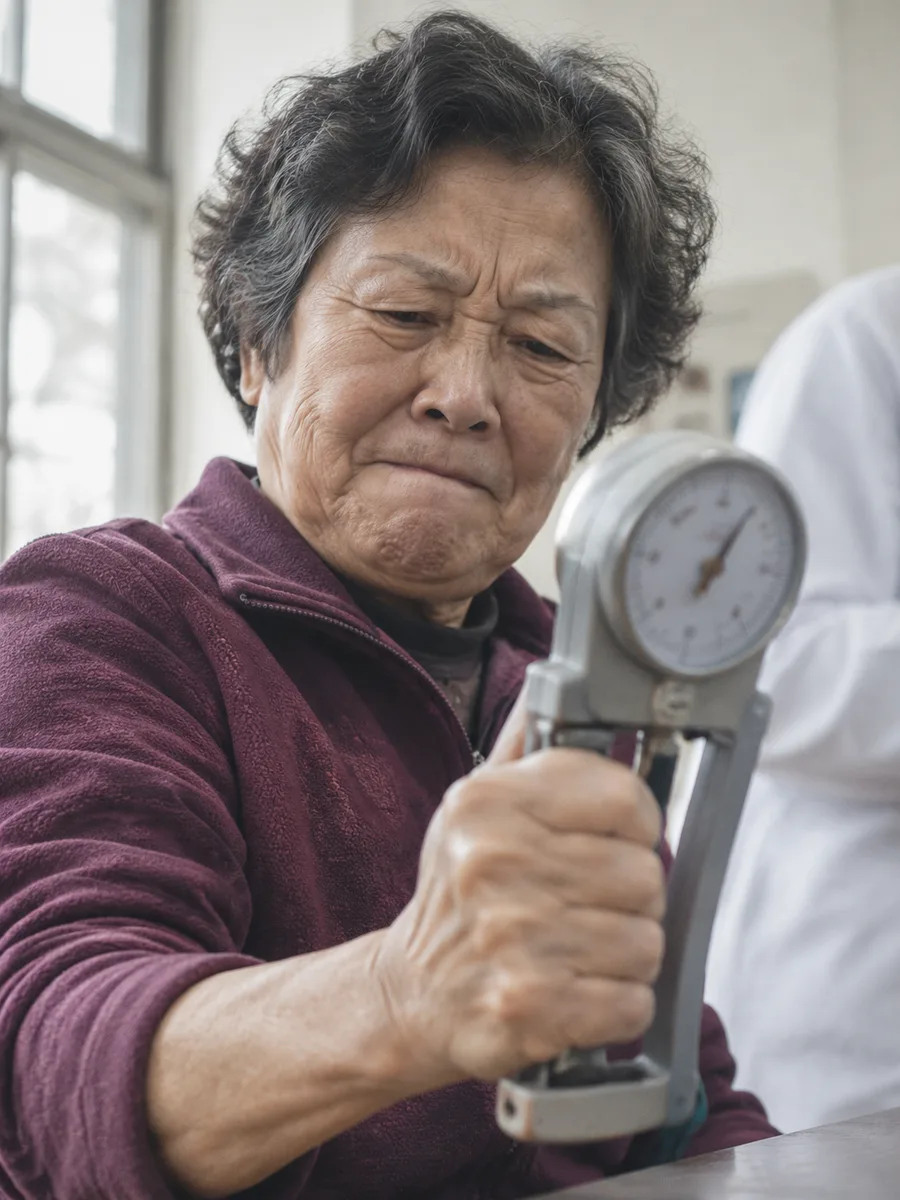
《柳叶刀》研究:握力是健康的信号
Grip Strength and Health: Lancet Study Links Weak Grip to Higher Death Risk and Cognitive Decline
About this story
Easy Chinese listening: a Lancet study of 140,000 people links weak grip to higher death risk and cognitive decline. Learn why grip strength signals brain health. HSK 3 Chinese listening practice.
This is an HSK 3 Chinese listening episode that runs about 3 minutes. The full Mandarin script is shown with tap-for-pinyin and a line-by-line English translation, so you can listen and read at once — comprehensible input in the sense of Stephen Krashen's i+1 theory. It teaches 12 key vocabulary words such as 身体、国家、风险 and walks through 7 grammar patterns, each explained in English with examples. The same news story is retold at 4 difficulty levels — use the level selector above to find the version that is challenging but still understandable for you.
Read at your level
原文Read the complete story in Chinese. Reveal pinyin and English only when you need them.
English transcript reference
The little bit of strength with which the hand grabs something is grip strength.
People with weak grip strength often have poorer health.
More than ten years ago, a very large study looked at 140,000 people.
These 140,000 people lived in many countries, and the researchers followed them for several years.
The study calculated a number: for every 5-kilogram decrease in grip strength, the risk of death is 16% higher.
There were also somewhat more people who died from heart and blood vessel diseases.
The study also said that grip strength can reveal these things better than blood pressure.
Blood pressure is the number doctors look at when they measure your arm; grip strength is more accurate than it.
Just training the strength of the hands cannot make your life longer.
But grip strength is a signal that can help people see the overall condition of the body.
The hand can tell about the whole body because the hand does not move by itself.
At Ohio University in the United States there is a physiologist named Brian Clark.
He studies how the body works, and he says muscles are like puppets.
A puppet only moves when someone pulls strings above it.
Clark says the strings are in the brain, and muscles stand at the end of a chain of command.
The brain gives the order, and only then can the hand grip tightly.
Each time the hand grips, the brain must manage 39 muscles in the hand and wrist.
When the five fingers exert force together, the total force is less than what they produce separately added up.
So whether the strength of the hand is great also depends on whether the brain is good.
There was a small experiment that found old people to test hand strength.
Old people who did poorly on brain tests also had more weakness in hand strength.
There is also a researcher on aging named Ivan Bautmans.
He says that a gradual decrease in grip strength may be a signal that the brain is having problems first.
Testing hand strength this way is very cheap and very simple, and can remind people early.
The two hands being different is also interesting.
The strength of the commonly used hand is a little greater than the other, which is very common.
If the difference is too great, it is worth paying attention to.
Because one hand is mainly controlled by one side of the brain.
When the brain has a problem, often one side is damaged first while the other side is still fine.
Bautmans says that if one hand is so weak that it is only half of the other hand, you should be careful.
Weak hand strength, or a big difference between the two hands, is not a disease.
It is just a reminder that one should go to the hospital for a check-up.
Later, someone put many studies together to look at, and the number of people looked at was very large.
The result is still the same: people with stronger grip strength later had fewer brain problems.
Now some doctors have old people train the strength of the whole body, not just the hands.
What is trained is the whole body, and what is thought about is the brain.
Listen again
Try it without the transcript and notice what sounds clearer.
What vocabulary does this episode teach?
词汇HSK 2. Can mean physical health: 身体好 (in good health).
HSK 2. Measure word 个: 一个国家.
HSK 2. Common in health/economic contexts: 死亡的风险 (risk of death).
HSK 2. 去医院看医生 = go to the hospital to see a doctor.
HSK 2. 发出信号 = send a signal; 信号不好 = poor signal.
HSK 2. 五根手指 = five fingers.
HSK 2. 做实验 = do an experiment.
HSK 2. 很简单 = very simple.
HSK 2. Physical strength; often used with 有/没有: 很有力气 (very strong).
HSK 2. Used as noun and verb: 一项研究 (a study), 研究者 (researcher).
HSK 2. 心脏病 = heart disease.
HSK 2. 量血压 = to measure blood pressure.
* beyond level超纲词
What grammar patterns appear in this episode?
语法每 + Verb/Measure + Number + Noun, 就 + Result
Expresses a proportional relationship: 'for every X, then Y'.
握力每小五公斤,死亡的风险就高百分之十六。
比 + Noun + 更/还 + Adjective
Comparison: 'more ... than ...'.
研究还说,握力比血压更能看出这些事。
血压是医生量胳膊时看的那个数,握力比它准。
是……的 + Noun
Emphatic construction identifying or describing something.
手抓住东西的那点力气,就是握力。
可是握力是个信号,能帮人看身体的整体情况。
因为……,所以……
Cause and effect: 'because..., therefore...'.
因为心脏和血管的病死去的人,也多一些。
因为一只手主要由脑子的一边管。
越……越……
Correlative: 'the more..., the more...'.
差得太多,就值得注意了。
让 + Person + Verb Phrase
Causative: 'make/let someone do something'.
光练手上的力气,不能让命变长。
现在有医生让老人练全身的力气,不只是练手。
比 + Noun + Adjective + 一点/得多
Comparison with degree: 'a little more ... than', 'much more ... than'.
常用那只手的力气,比另一只大一点,这很常见。
脑子题做得差的老人,手上的力气也差得更多。
Proper nouns
专有名词Sources
来源Free account
Keep learning from this story
Create a free account to keep saved words and your preferred level together.
- Keep words with their story context
- Remember your preferred level
- Build your vocabulary over time