
A Chinese podcast · Same story, 4 levels
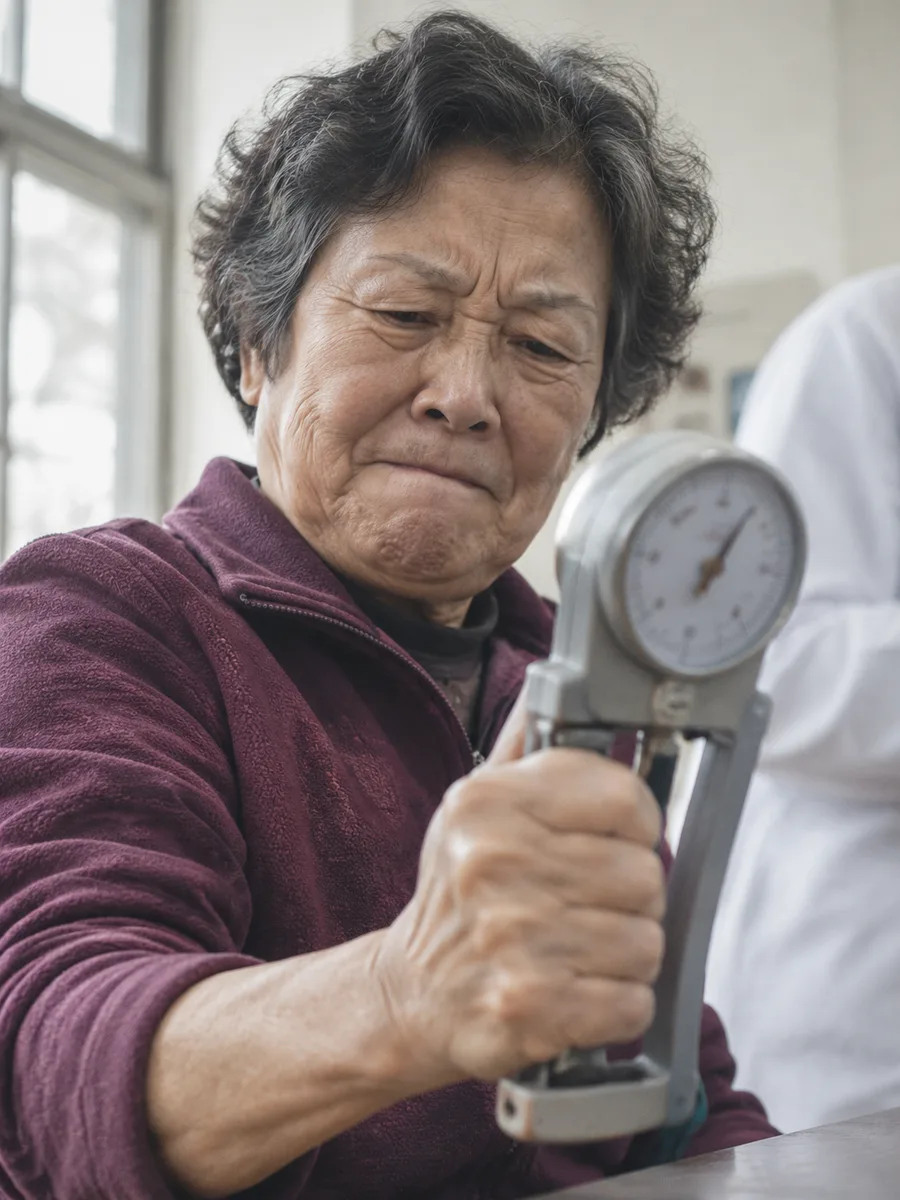
《柳叶刀》研究:握力是健康的信号
Grip Strength and Health: Lancet Study Links Weak Grip to Higher Death Risk and Cognitive Decline
About this story
A Lancet study of 139,691 people in 17 countries links weaker grip to higher death risk; grip asymmetry may also signal cognitive decline. HSK 5+ Chinese listening practice.
This is an HSK 5+ Chinese listening episode that runs about 3 minutes. The full Mandarin script is shown with tap-for-pinyin and a line-by-line English translation, so you can listen and read at once — comprehensible input in the sense of Stephen Krashen's i+1 theory. It teaches 12 key vocabulary words such as 预测、风险、肌肉 and walks through 7 grammar patterns, each explained in English with examples. The same news story is retold at 4 difficulty levels — use the level selector above to find the version that is challenging but still understandable for you.
Read at your level
原文Read the complete story in Chinese. Reveal pinyin and English only when you need them.
English transcript reference
The force of that handshake is actually used by researchers to predict a person's life or death over the coming years.
A study covering 17 countries and nearly 140,000 people, with an average follow-up of four years, put grip strength and death risk on the same table.
For every 5 kg decrease in grip strength, the risk of all-cause death is 16% higher, and the risk of cardiovascular death is 17% higher.
What surprised the researchers even more was that grip strength's ability to predict these two outcomes exceeded that of systolic blood pressure.
In other words, besides measuring blood pressure, giving a dynamometer a squeeze might reveal something blood pressure cannot.
Repeatedly squeezing a grip trainer alone is probably not enough to extend your lifespan.
But it may be an extremely low-cost window for health monitoring.
The reason hand strength can reveal so much information is that it was never just about muscles.
Brian Clark, a physiologist at Ohio University, has a saying: muscles are the puppets at the very end of the neurological chain of command.
The brain gives orders, nerves transmit them, and muscles execute them; if any link loosens, the final grip force will change.
Clenching a hand requires the brain to coordinate and control the 39 muscles of the palm and wrist.
The combined force of the fingers is not a simple sum of their individual strengths; when they tighten together, the total force is actually less than the sum of each finger's strength alone.
This is also why grip strength is often seen as a readout of the state of the nervous system.
A small 2024 experiment with older adults found that participants with lower cognitive test scores had a larger strength gap when exerting force.
In other words, if the hand cannot exert force, the problem may not be in the hand.
Ivan Bautmans, who studies aging at the Free University of Brussels, believes that weakened grip strength may be a precursor to cognitive decline.
He points out that a simple and inexpensive grip strength test can provide valuable early warning.
He also warns that when one hand's strength drops to half that of the other, decline may be accelerating.
Some asymmetry between left and right hands is common; the dominant hand being about 10% stronger than the other is within the normal range.
If the gap is larger, it is worth paying attention.
The reason is that each hand is mainly controlled by the opposite hemisphere of the brain, and degeneration of the nervous system is often uneven.
A meta-analysis published in April this year pooled nine cohort studies involving about 900,000 people.
The results showed that people with a clear difference in strength between hands had a 29% higher risk of dying from cardiovascular disease.
Another meta-analysis published in June, co-authored by Bautmans, included 60 observational studies and about 380,000 people.
The group with stronger grip strength had a 19% lower likelihood of cognitive decline.
However, weak grip strength or left-right imbalance is not itself a diagnosis.
It suggests a more comprehensive examination, not a verdict.
Existing research shows that whole-body resistance training helps maintain mental sharpness.
This is exactly where the grip dynamometer is useful: it is cheap, can be done anywhere, and can prompt a person to seek a more comprehensive check before symptoms appear.
Listen again
Try it without the transcript and notice what sounds clearer.
What vocabulary does this episode teach?
词汇HSK 5. Common verb; used in the script as 预测生死 (predict life or death).
HSK 5. Often collocates with 高/低: 风险高出百分之十六 (risk is 16% higher).
HSK 5. Appears in 肌肉是神经指挥链最末端的木偶 (muscles are puppets at the end of the neurological chain of command).
HSK 5. Used in 神经系统 (nervous system) and 神经传导 (nerve transmission).
HSK 5. Common noun; appears in 大脑下令 (the brain gives orders).
HSK 4. Used in 控制手掌与手腕的三十九块肌肉 (control the 39 muscles of the palm and wrist).
HSK 4. Appears in 一项针对老年人的小型实验 (a small experiment targeting older adults).
HSK 4. Used in 荟萃分析 (meta-analysis).
HSK 5. Used in 认知测试 (cognitive test) and 认知衰退 (cognitive decline).
HSK 5. Appears in 认知衰退 (cognitive decline) and 衰退可能正在加速 (decline may be accelerating).
Beyond HSK 5. The core topic word; appears throughout, e.g. 握力每低五公斤 (for every 5 kg decrease in grip strength).
Beyond HSK 5. Medical term; used in 平均随访四年 (average follow-up of four years).
* beyond level超纲词
What grammar patterns appear in this episode?
语法Passive voice marker. Indicates that the subject is acted upon.
握手时那一下的力道,居然被研究者拿来预测一个人未来若干年的生死。
每 + Verb/Adjective + 就 + Verb/Adjective
Expresses a proportional relationship: 'for every... then...' or 'the more..., the more...'.
握力每低五公斤,全因死亡风险就高出百分之十六,心血管死亡的风险高出百分之十七。
之所以...是因为...
Pattern meaning 'the reason why... is because...'. Used to explain causes.
手部力量之所以能透露这么多信息,是因为它从来就不只是肌肉的事。
并非...,反而...
Contrast structure: 'not... but rather...' or 'not..., on the contrary...'.
手指的合力也并非各自力量的简单相加,一起收紧时,总力量反而小于单指力量之和。
当...时,...
Temporal clause: 'when...'. Sets the time or condition for the main clause.
他同时提醒,当一只手的力量降到另一只手的一半,衰退可能正在加速。
再...,就...
Conditional sequence: 'if... further, then...'. Often used to indicate a threshold.
差距再大,就值得留意了。
算不上...
Means 'cannot be counted as...' or 'is not really...'. Used to deny a classification.
不过,握力偏弱或者左右不均衡,本身算不上一个诊断。
Proper nouns
专有名词Sources
来源Free account
Keep learning from this story
Create a free account to keep saved words and your preferred level together.
- Keep words with their story context
- Remember your preferred level
- Build your vocabulary over time