
A Chinese podcast · Same story, 4 levels
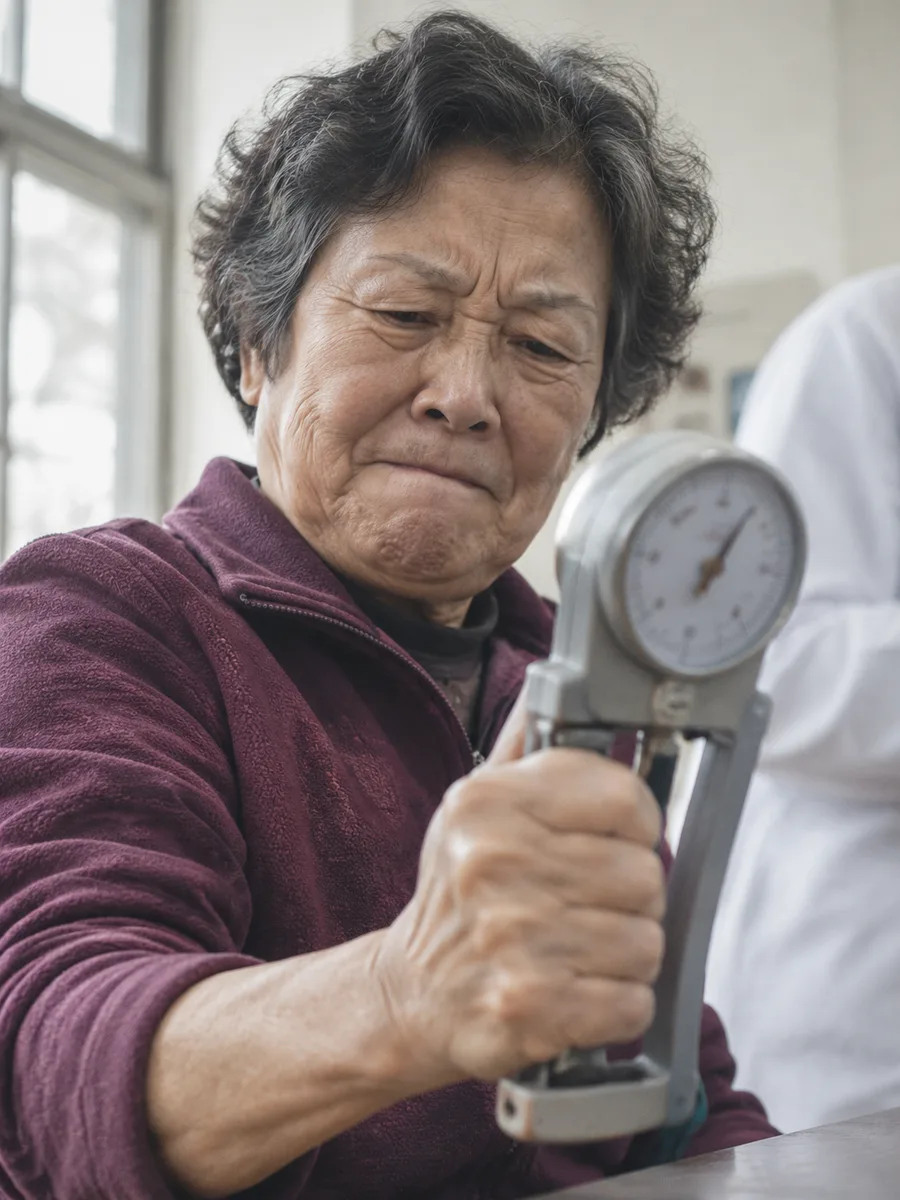
《柳叶刀》研究:握力是健康的信号
Grip Strength and Health: Lancet Study Links Weak Grip to Higher Death Risk and Cognitive Decline
About this story
Medium: A 2015 Lancet study of 140,000 people in 17 countries links weaker grip to higher death risk; later research ties grip asymmetry to heart and cognitive decline. HSK 4 Chinese listening practice.
This is an HSK 4 Chinese listening episode that runs about 3 minutes. The full Mandarin script is shown with tap-for-pinyin and a line-by-line English translation, so you can listen and read at once — comprehensible input in the sense of Stephen Krashen's i+1 theory. It teaches 12 key vocabulary words such as 力气、研究、风险 and walks through 7 grammar patterns, each explained in English with examples. The same news story is retold at 4 difficulty levels — use the level selector above to find the version that is challenging but still understandable for you.
Read at your level
原文Read the complete story in Chinese. Reveal pinyin and English only when you need them.
English transcript reference
That bit of force in a handshake may predict how long a person will live better than blood pressure does.
In 2015, a study tracked nearly 140,000 people across 17 countries.
Researchers followed them for an average of four years, seeing who later fell ill and who died.
The conclusion was simple: the lower the grip strength, the higher the risk of death.
For every 5-kilogram decrease in grip strength, the risk of death was 16% higher.
The risk of dying from cardiovascular disease was also 17% higher.
What surprised researchers even more was that grip strength predicted both types of death better than systolic blood pressure.
However, just squeezing a grip trainer every day cannot make a person live several more years.
Its value is not in exercise, but in being cheap and measurable at any time.
So why can the strength in the hands reflect the condition of the whole body?
Clark, a physiologist at Ohio University, says muscles are puppets.
The strings are in the hands of the brain and nerves; muscles are merely the last link in the chain of command.
A powerful fist clench requires the brain to coordinate the 39 muscles of the palm and wrist.
When the fingers tighten together, the total force is actually less than the sum of their individual strengths.
What grip strength reflects is precisely the efficiency with which the brain sends commands down this chain.
A small 2024 experiment with older people pointed in the same direction.
People with lower cognitive test scores also had a larger shortfall in force when exerting themselves.
At the Free University of Brussels there is a scholar who studies aging, named Bautmans.
He says that weakening grip strength is sometimes an early signal of cognitive decline.
A simple, cheap grip test could become a valuable early warning.
A meta-analysis in April of this year pooled nine long-term studies.
Together these studies included nearly 900,000 people and also compared the strength of both hands.
The result: people whose two hands differed greatly in strength were more at risk.
Their likelihood of dying from cardiovascular disease was 29% higher.
It is very common for the dominant hand to be about 10% stronger than the other.
Each hand is mainly controlled by the opposite side of the brain, and degeneration often progresses at different rates on the two sides.
Bautmans warns that when one hand is left with only half the strength of the other, one should be alert.
Of course, weak grip or asymmetry between the two sides is not itself a diagnosis.
It only suggests that perhaps further examinations should be done.
Bautmans also co-authored a meta-analysis published in June of this year.
This analysis compiled 60 observational studies involving about 380,000 people.
People with stronger grip strength were 19% less likely to experience cognitive decline.
The article also mentions that full-body strength training can help keep the mind clear.
This ordinary number, hand strength, is increasingly being treated by researchers as a window.
Listen again
Try it without the transcript and notice what sounds clearer.
What vocabulary does this episode teach?
词汇HSK 3. Refers to bodily strength; often used in phrases like 用尽力气 (use up all one's strength).
HSK 3. Common in academic contexts; can be a noun or verb, e.g. 一项研究 (a study).
HSK 3. Used with verbs like 增加/降低风险 (increase/decrease risk).
HSK 3. Can refer to physical or abstract strength; e.g. 力量训练 (strength training).
HSK 3. Used for decreases in numbers or abilities, e.g. 认知能力下降 (cognitive decline).
HSK 3. Often used as a verb or noun, e.g. 早期提醒 (early warning).
HSK 3. Common in medical contexts, e.g. 做检查 (do an examination).
HSK 3. Formal term for death; appears in 死亡风险 (risk of death).
HSK 3. Body part; common in health contexts, e.g. 肌肉力量 (muscle strength).
HSK 3. Refers to the brain; often used in expressions like 大脑控制 (brain control).
Beyond HSK 3. Compound of 握 (grip) and 力 (strength); central term in the script.
Beyond HSK 3. Medical term: 收缩 (contraction) + 压 (pressure).
* beyond level超纲词
What grammar patterns appear in this episode?
语法比 + Noun + 更 + Adjective
Comparison structure meaning 'more [adjective] than [noun]'. Used to highlight a stronger predictor.
握手时的那点力气,可能比血压更能预测一个人能活多久。
更让研究者意外的是,握力比收缩压更能预测这两种死亡。
每 + Verb + 数量 + 就 + Verb + 数量
Pattern showing a proportional relationship: 'for every X, then Y'. Often used with 增加/减少.
握力每低五公斤,死亡风险就高出百分之十六。
是……的 + Noun
Emphatic construction highlighting a fact; here 是……的提前信号 emphasizes 'is an early signal'.
他说,握力变弱有时是认知能力下降的提前信号。
把 + Object + Verb Phrase
Disposal construction: 'take object and do something to it'.
今年四月的一项汇总分析,把九项长期研究放在一起。
对 + Noun + 有 + Noun
Pattern meaning 'have [noun] toward/for [noun]', e.g. 'be helpful for'.
文章还提到,全身的力量训练,对保持头脑清醒也有帮助。
Proper nouns
专有名词Sources
来源Free account
Keep learning from this story
Create a free account to keep saved words and your preferred level together.
- Keep words with their story context
- Remember your preferred level
- Build your vocabulary over time