
A Chinese podcast · Same story, 4 levels
广西本来不地震:5.2 级柳州地震发生了什么
The Guangxi Quake: Why a 5.2 in Liuzhou Matters
About this story
The Guangxi Quake: Why a 5.2 in Liuzhou Matters. HSK 3 Chinese listening practice.
This is an HSK 3-4 Chinese listening episode that runs about 5 minutes. The full Mandarin script is shown with tap-for-pinyin and a line-by-line English translation, so you can listen and read at once — comprehensible input in the sense of Stephen Krashen's i+1 theory. It teaches 12 key vocabulary words such as 城市、感觉、严重 and walks through 4 grammar patterns, each explained in English with examples. The same news story is retold at 4 difficulty levels — use the level selector above to find the version that is challenging but still understandable for you.
Read at your level
原文Read the complete story in Chinese. Reveal pinyin and English only when you need them.
English transcript reference
At 0:21 a.m. on May 18.
In Guangxi in southern China,
a magnitude 5.2 earthquake occurred.
The epicenter
was Taiyangcun Town in Liunan District, Liuzhou.
Only 16 kilometers from downtown Liuzhou.
In this earthquake,
people in Liuzhou felt it very strongly.
Other places in Guangxi —
Nanning, Guilin, Hechi, Laibin —
all clearly felt it.
Even people in Hong Kong
said "I felt the ground move."
This earthquake has a few characteristics.
First,
it didn't happen suddenly.
On May 17,
Liunan District had already had three small earthquakes.
Magnitude 2.5, 3.0, 3.2.
All small ones.
But these three small quakes
were actually a warning before the big one.
Scientists call these small quakes "foreshocks."
Sometimes they happen,
sometimes they don't.
Second,
the time was in the early morning.
At 0:21 a.m.,
most people were asleep.
When an earthquake happens while people are asleep,
the danger is greatest.
Because people don't know what's happening,
and don't know where to run.
So most of the injured this time
were the ones who didn't get out.
Third,
the focus was shallow.
The depth of this earthquake was only 8 km.
The shallower the depth,
the stronger people feel it at the surface.
8 km counts as "shallow-focus earthquake,"
so the damage this time was comparatively large.
The result of the earthquake,
officials said:
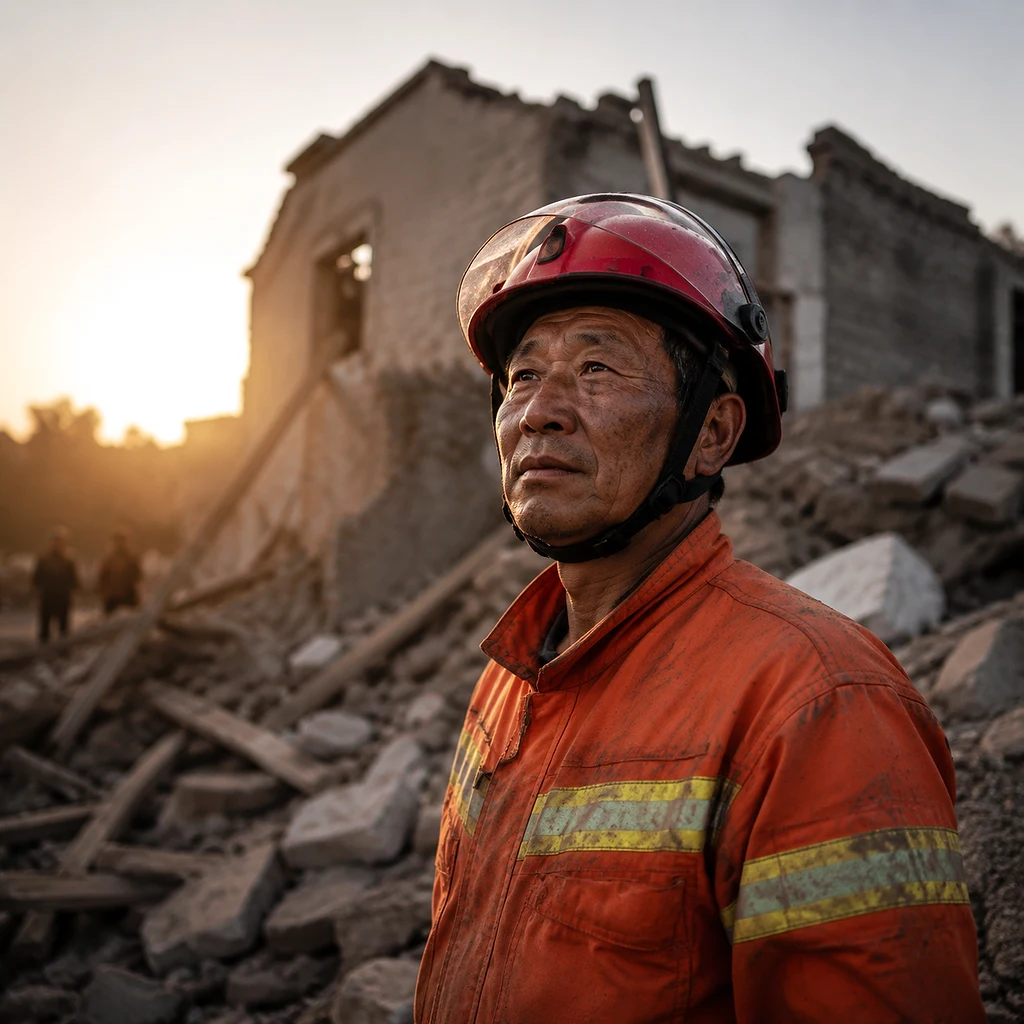
13 self-built houses collapsed.
3 people missing.
4 people injured.
Over 7,000 people
have been relocated.
What is a "self-built house"?
It's a house in a village or town
built privately by an individual.
Not a high-rise,
not built by a company.
Some of these houses
have stood for decades.
No rebar,
no concrete columns.
So when an earthquake comes,
they fall most easily.
The houses that fell
were all this kind of old self-built house.
New, tall buildings
none of them fell.
Why is this earthquake
something the whole country is watching?
First,
Guangxi isn't normally a place with many earthquakes.
The places in China with many earthquakes
are in the west.
Wenchuan in Sichuan,
Yushu in Qinghai,
Ludian in Yunnan,
Xinjiang.
These places
have strong seismic belts.
Plates are moving,
so earthquakes happen often.
But not Guangxi.
Over the past few decades,
Guangxi has rarely had earthquakes above magnitude 5.
So this earthquake
surprised many experts too.
Seismologists say:
Guangxi has a seismic belt too,
it's just not very active.
This magnitude 5.2 earthquake
suggests that this belt
has become active recently.
In the next few years,
we have to pay more attention.
Second,
Guangxi's cities
are not very prepared for earthquakes.
Not like Sichuan.
Sichuan has earthquakes often,
so houses are built more solidly.
Schools also practice "what to do in an earthquake."
Guangxi?
Schools don't practice.
When houses are built,
earthquakes aren't always taken into account.
So once an earthquake comes,
neither the people nor the houses are ready.
Third,
this earthquake is also a reminder to China:
not just the west needs to watch out for earthquakes,
the south too.
China's seismic belts
are actually more widely distributed than we imagine.
Any place
could have an earthquake.
Just because "Guangxi never had one"
doesn't mean "Guangxi never will."
Finally,
I want to say a few things:
If the place you live
also isn't a place with many earthquakes,
you may never have thought about earthquakes.
But this Guangxi earthquake
is telling us:
"Never has,"
doesn't mean "never will."
Preparing a few things at home
isn't superstition,
isn't exaggeration.
It's giving yourself and your family
a little more time.
Water.
Food.
Important documents.
A flashlight.
A small backpack
to hold these things.
None of this is expensive,
none of it is troublesome.
But when an earthquake comes,
you'll thank your past self for preparing.
The people of Guangxi
need the country's care today.
And they need time to recover slowly.
We watch the news,
and we think of them.
Okay.
That's all for today.
Talk tomorrow.
Listen again
Try it without the transcript and notice what sounds clearer.
What vocabulary does this episode teach?
词汇A city. Liuzhou is an inland 城市 that almost never has earthquakes — which is part of why this one is significant.
To feel; sensation. The episode uses it repeatedly: people 'felt' it strongly in Liuzhou; people in the south normally don't know what an earthquake 'feels like.'
Serious, severe. The episode frames the magnitude: 5.2 级在中国近年的地震里,不算严重的 — 'a 5.2 isn't counted as severe among recent Chinese earthquakes' — to set up why the damage was still notable.
To pay attention, take note. 未来几年要更加注意 — in coming years we have to pay more attention. HSK 2 but used heavily in news writing.
To prepare. The structural lesson of the episode: 一旦地震来,人和房子都没有准备 — once the earthquake came, neither the people nor the houses were prepared.
Comparatively, relatively; to compare. 老房子比较多 (relatively many old houses) and 这次破坏比较大 (the damage was comparatively large).
A small earthquake that precedes a larger one. Technical seismology term. 前 (before) + 震 (quake). The May 17 trio in Liunan were 前震 to the May 18 main shock — though we only know this in hindsight.
The point inside the earth where an earthquake starts. 震 (quake) + 源 (source). The May 18 quake had a 震源深度 (focal depth) of only 8 km — shallow, which is why the surface damage was disproportionate to the magnitude.
To damage; destruction. The narrator explains why a 5.2 caused real 破坏 — the combination of early hour and shallow focus.
For a building to collapse, fall down. More formal than 倒 alone. The official report: 13 栋自建房屋倒塌 — 13 self-built houses collapsed.
A tectonic plate. The episode mentions earthquake belts where 板块在动 (the plates are moving). Concept from plate tectonics — explains why some regions are earthquake-prone.
Active. Used here in the seismological sense — 这条地震带最近变得活跃 (this seismic belt has become active recently). Also used socially (an 活跃 personality is outgoing).
* beyond level超纲词
What grammar patterns appear in this episode?
语法意味着 + clause
意味着 = 'to mean, to imply.' Used in analytical writing to translate a fact into its implication. The episode uses it for the cost of timing: 人睡着的时候发生地震,意味着人没有反应时间 — 'an earthquake when people are asleep means they have no reaction time.'
人睡着的时候发生地震,意味着人没有反应时间。
X 越 Verb, Y 越 Verb
Paired 越... 越... construction. The episode uses it for shallow earthquakes: 深度越浅,人在地面感觉越强 — 'the shallower the depth, the stronger the surface shaking.' Compact and powerful for any cause-and-effect statement.
深度越浅,人在地面感觉越强。
不是 A,就 B (correction by replacement)
Used to flip a wrong understanding. The narrator: '不是说广西从来没有,就以为广西永远不会有' — 'just because Guangxi has never had one doesn't mean it never will.' Tightens any rebuttal.
不是说"广西从来没有",就以为"广西永远不会有"。
一旦 + clause₁, clause₂
一旦 = 'once.' Marks the moment a sleeping situation becomes active. The episode: 一旦地震来,人和房子都没有准备 — 'once an earthquake comes, neither the people nor the houses are ready.' More dramatic than 如果 because it implies the trigger is inevitable.
一旦地震来,人和房子都没有准备。
Proper nouns
专有名词Free account
Keep learning from this story
Create a free account to keep saved words and your preferred level together.
- Keep words with their story context
- Remember your preferred level
- Build your vocabulary over time