
A Chinese podcast · Same story, 4 levels
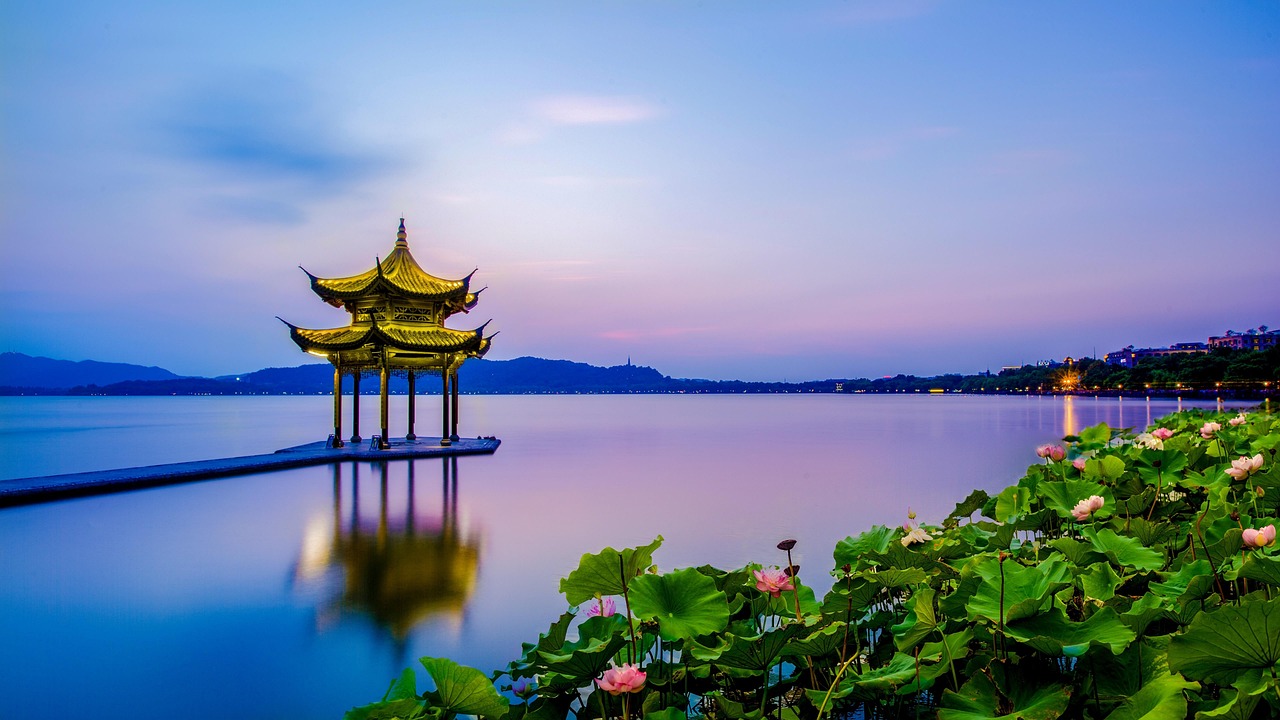
杭州:被维护了一千年的作品
Hangzhou: The Lake That Would Vanish If Nobody Dug It
About this story
A lake that survives only because it is dug out, a causeway made of its own sediment, and a pagoda destroyed one brick at a time. HSK 5-6 Chinese listening practice.
This is an HSK 5-6 Chinese listening episode that runs about 4 minutes. The full Mandarin script is shown with tap-for-pinyin and a line-by-line English translation, so you can listen and read at once — comprehensible input in the sense of Stephen Krashen's i+1 theory. It teaches 12 key vocabulary words such as 淤积、沉积物、干预 and walks through 3 grammar patterns, each explained in English with examples. The same news story is retold at 4 difficulty levels — use the level selector above to find the version that is challenging but still understandable for you.
Read at your level
原文Read the complete story in Chinese. Reveal pinyin and English only when you need them.
English transcript reference
The easiest thing to misunderstand about West Lake is that it looks entirely natural.
Six point three nine square kilometres of water, hills on three sides, the city on the fourth, in proportions comfortable enough to seem designed.
In fact it was designed, and then revised repeatedly for over a thousand years.
Start with a physical fact.
West Lake is a shallow lake; silt from the hills on three sides enters the water continuously with the rain, and the bed rises year by year.
Without human intervention, the natural fate of such a lake is to become marsh, and then land.
In other words, if West Lake were thoroughly "protected" into an untouched state, it would disappear.
What keeps it in existence is precisely the continuous artificial dredging.
Once you understand that, West Lake's famous features change character.
Most of them are products of the dredging works, rather than decoration added afterwards.
The clearest case is the Su Causeway.
The Su Causeway runs north-south across the lake, two point eight kilometres in all, with six bridges set into it to let the water through.
It was built in 1089, overseen by Su Shi, then prefect of Hangzhou.
He mobilized labour to clear the weed and silt from the lake, and piled the excavated earth on the spot into a causeway.
Which is to say: the long causeway visitors stroll along today is sediment taken off the lake bed over nine hundred years ago.
Engineering waste became the principal feature of the landscape — not a common outcome anywhere in the world.
In the Southern Song, the Ten Scenes of West Lake were formally established, over eight hundred years ago.
The ten names share a structure: each binds a specific place to a particular season, time of day or weather.
Spring Dawn at the Su Causeway, Autumn Moon over the Calm Lake, Lingering Snow on the Broken Bridge — each requires specific conditions to exist at all.
So the Ten Scenes are less ten places than ten sets of viewing instructions.
They train the viewer to notice differences of time and weather rather than to collect fixed images.
One side effect: when everyone expects "lingering snow," the Broken Bridge without snow seems incomplete.
Classic naming helps attention, and also decides in advance what is worth attending to.
Leifeng Pagoda offers a second layer of example.
The pagoda on the southern shore today was completed in 2002; it is a reconstruction.
The original collapsed on 25 September 1924, from neither earthquake nor warfare.
A popular belief at the time held that bricks from Leifeng Pagoda warded off evil and secured safety.
So over a long period people removed bricks from the base, one at a time.
Once the structure had been hollowed past a critical point, the entire pagoda collapsed on its own.
Lu Xun then wrote his piece on the fall of Leifeng Pagoda, addressing exactly this distributed damage in which each person takes only a little.
No single individual destroyed the pagoda, yet it was unquestionably destroyed by people.
It is a kind of damage that is very hard to assign responsibility for, and it remains visible today across many public things.
On the second day I went into the hills to the west.
Longjing is both a tea and a place name.
Walking from the lakeshore into the hills, the scenery, the smell and the density of people all change at once, and so does your grasp of the city.
In June 2011, the West Lake Cultural Landscape was inscribed on the World Heritage List.
What matters is that the category was cultural landscape, not natural heritage.
What was recognized is the whole formed by long-term interaction between people and nature here: a system of causeways, bridges, pagodas, temples, inscriptions, poems, hills and water together.
That category itself rejects the intuition that only the untouched is precious.
Hangzhou still dredges on a regular cycle today, extracting silt, transporting it, disposing of it.
Maintenance has never stopped; it is simply scheduled for hours when visitors can't see it.
If it stopped for a single year, this landscape would begin to degrade on a scale of decades.
On the last day, I walked the Su Causeway once more.
Six point three nine square kilometres of water, two point eight kilometres of causeway, six bridges, ten names fixed more than eight centuries ago.
Not one of those numbers arose naturally, and yet together they compose what Chinese people regard as the most natural scenery there is.
If the beauty in front of you is really the outcome of dozens of generations repairing it, would you cherish it more for that, or feel that something has gone missing?
Listen again
Try it without the transcript and notice what sounds clearer.
What vocabulary does this episode teach?
词汇HSK 6. The category that rejects the untouched ideal.
HSK 5. Scheduled when visitors can't see it.
HSK 4. Hollowed past a critical point.
HSK 4. An untouched one would be fatal here.
The process that would end the lake if unopposed.
What the causeway is actually made of.
Without it, protection would destroy the thing protected.
Very hard, when everyone took only one brick.
25 September 1924, from no single cause.
The Ten Scenes are ten sets of them.
Cultural landscape, not natural heritage.
Which became the main feature of the landscape.
* beyond level超纲词
What grammar patterns appear in this episode?
语法在没有 … 的情况下
States what obtains absent a condition.
在没有人工干预的情况下,这类湖泊的自然归宿是沼泽化,然后陆地化。
恰恰是 …
Emphasizes that it is precisely this.
维持它存在的,恰恰是持续不断的人工清淤。
与其说 A,不如说 B
Prefers one description over another.
因此十景与其说是十个地点,不如说是十套观看指令。
Proper Nouns
专有名词Free account
Keep learning from this story
Create a free account to keep saved words and your preferred level together.
- Keep words with their story context
- Remember your preferred level
- Build your vocabulary over time