
A Chinese podcast · Same story, 4 levels
哈尔滨:江借给我们的
Harbin Ice Festival Builds With Borrowed River Ice
About this story
Walk on the frozen Songhua, watch 200,000 cubic metres of ice come off the river, and find out where it all goes in March. HSK 1 Chinese listening practice.
This is an HSK 1 Chinese listening episode that runs about 3 minutes. The full Mandarin script is shown with tap-for-pinyin and a line-by-line English translation, so you can listen and read at once — comprehensible input in the sense of Stephen Krashen's i+1 theory. It teaches 8 key vocabulary words such as 冰、江、块 and walks through 3 grammar patterns, each explained in English with examples. The same news story is retold at 4 difficulty levels — use the level selector above to find the version that is challenging but still understandable for you.
Read at your level
原文Read the complete story in Chinese. Reveal pinyin and English only when you need them.
English transcript reference
Today I'm in Harbin.
It's January now.
Harbin is very cold in January.
Today it's twenty-something below zero.
I have a lot of clothes on, and I'm still cold.
Harbin has a big river.
This river is called the Songhua.
In January there's no water on the Songhua.
The river is all ice.
There's a lot of ice, and it's very big.
People can walk on the ice.
I walk on the ice.
In the afternoon, I see a lot of people working on the river.
They're making blocks of ice.
One block of ice is very big.
I say: what do you want all this ice for?
A man says: to make buildings.
I say: buildings made of ice?
He says: yes.
He says: we use a lot of ice every year.
He says: last year we used two hundred thousand cubic metres.
I say: two hundred thousand?
He says: yes, two hundred thousand.
He says: all this ice is given by the river.
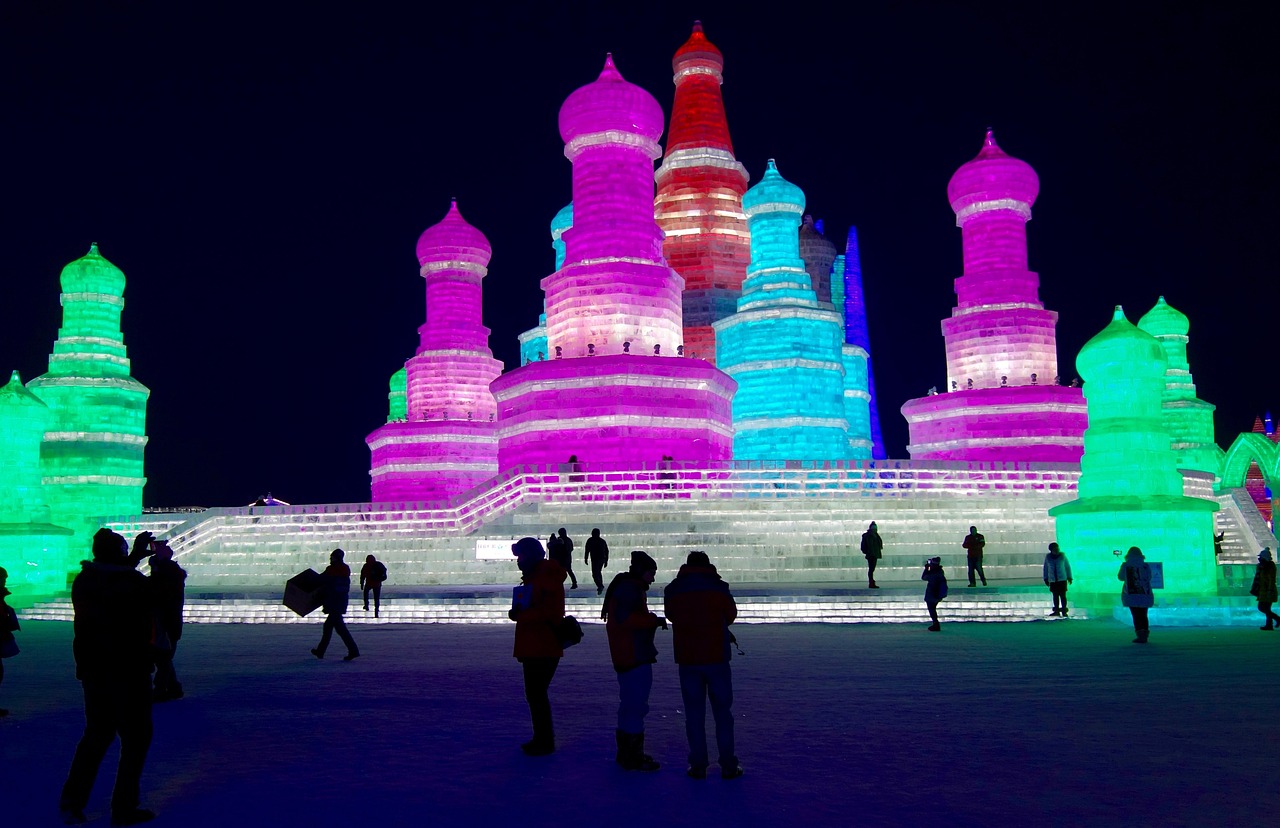
Now, I go to see the buildings made of ice.
The buildings are very big.
There are lights inside the buildings.
The lights have a lot of colours.
Ice isn't one colour.
I say: what's this place called?
He says: the Ice and Snow World.
He says: it was started in 1999.
I say: and before 1999?
He says: before that there were ice lanterns.
He says: they've been here since 1963.
I say: 1963?
He says: yes — China had never had them before.
The next day, I go to Central Street.
Central Street is a road.
This road is one thousand four hundred and fifty metres long.
The road is all stone.
One stone, then another stone, a great many of them.
This road was made in 1898.
I say: 1898?
He says: yes — they were building a railway then.
The people building the railway came, and this road appeared.
The buildings on both sides of the road look very different.
At midday, I ate the food from here.
One dish is very big, and very hot.
He says: it's too cold here, so the food has to be hot, and it has to be big.
In the afternoon, I go back to the river.
I think: in March, these ice buildings will be gone.
I say: where does that ice go?
He says: back into the river.
He says: next year we'll make another one.
I think: the buildings are given by the river.
And later, the buildings go back into the river.
Do you want very hot weather, or do you want Harbin's ice?
Listen again
Try it without the transcript and notice what sounds clearer.
What vocabulary does this episode teach?
词汇HSK 1. Also the word for money; here it's a block of ice.
HSK 1. Twenty-something below, and the reason for everything else.
HSK 1. What the food has to be here.
HSK 1. In March the ice goes 回 the river.
Two hundred thousand cubic metres of it, borrowed and returned.
The Songhua, which becomes a quarry every January.
Buried inside the ice so the whole block glows.
Made of ice, and gone by spring.
* beyond level超纲词
What grammar patterns appear in this episode?
语法可以 + verb
States what is possible.
人可以在冰上走。
是 … 做的
Says what something is made of or by.
我说:冰做的房子?
要 + verb
States what is needed or required.
他说:这里太冷,菜要热,也要大。
Proper nouns
专有名词Free account
Keep learning from this story
Create a free account to keep saved words and your preferred level together.
- Keep words with their story context
- Remember your preferred level
- Build your vocabulary over time