
A Chinese podcast · Same story, 4 levels
哈尔滨:从一根蜡烛开始
Harbin Ice Festival Builds With Borrowed River Ice
About this story
China's first ice lantern fair was 7 February 1963. Sixty years later it uses 200,000 cubic metres of river ice a year. HSK 2 Chinese listening practice.
This is an HSK 2 Chinese listening episode that runs about 5 minutes. The full Mandarin script is shown with tap-for-pinyin and a line-by-line English translation, so you can listen and read at once — comprehensible input in the sense of Stephen Krashen's i+1 theory. It teaches 8 key vocabulary words such as 冰灯、蜡烛、立方米 and walks through 3 grammar patterns, each explained in English with examples. The same news story is retold at 4 difficulty levels — use the level selector above to find the version that is challenging but still understandable for you.
Read at your level
原文Read the complete story in Chinese. Reveal pinyin and English only when you need them.
English transcript reference
I came to Harbin in January, and my friend said I'd come at the right time.
She said: people who come in summer don't see the real Harbin.
Coming out of the airport it was twenty-something below zero.
In January, Harbin's average temperature runs between minus twenty-four and minus thirteen.
I put on a hat and gloves.
But after five minutes of walking, my face hurt.
My friend laughed and said: this is only the beginning.
She took me to the Songhua River.
In winter, all the water in the river turns to ice.
The ice is thick — sixty to ninety centimetres.
People can walk on it, and in some places cars can drive on it.
There are a lot of people on the river.
Some ride bikes on the ice, some sit on the ice, and some sell things on the ice.
I said: it's lively here in winter.
My friend said: because winter is too long.
She said: if you stayed home for six months, you'd be miserable.
So we turned winter into a time when you can go out and play.
In the afternoon, I saw a lot of people working on the river.
They used machines to cut the ice into very big blocks.
One block of ice is as tall as a person.
Trucks pulled the blocks away.
I asked: where does this ice go?
My friend said: to make buildings.
She said: last winter they took two hundred thousand cubic metres of ice off the river.
She said: some of this ice is kept through the summer as well.
I said: kept through the summer?
She said: yes — stored somewhere very cold, waiting for the next winter.
In the evening, we went to the Ice and Snow World.
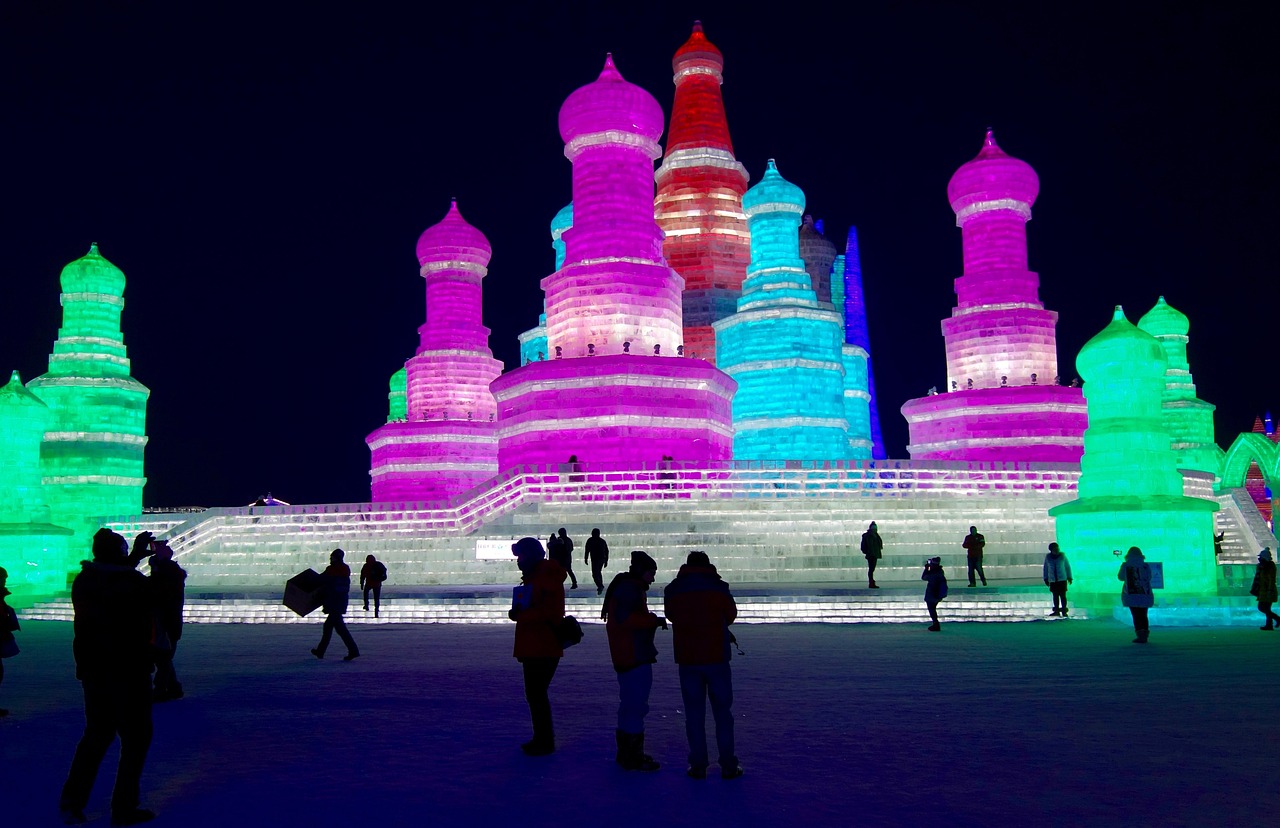
I saw a lot of buildings made of ice.
Some looked like palaces, some like towers.
There were lights set inside the buildings.
The colours of the lights kept changing.
Blue ice, red ice, green ice.
I'd always thought ice was white.
But once you put lights inside, ice has a lot of colours.
My friend said: this place was started in 1999.
This year is already the twenty-seventh one.
I said: so what about before 1999?
She said: before that there were ice lanterns.
She said: on 7 February 1963, Harbin held the first ice lantern fair.
That was the first time anyone in China had organized ice lanterns like that.
I said: 1963.
She said: yes, over sixty years ago.
She said: the ice lanterns then were very simple.
You freeze water into a hollow shell of ice and put a candle inside.
Even if there's wind outside, it can't blow it out.
I said: so a place this big started from one candle.
She said: you could put it that way.
The next day, we walked down Central Street.
This street is one thousand four hundred and fifty metres long and over twenty-one metres wide.
It's the longest pedestrian street in Asia.
The surface isn't concrete — it's square stone blocks, one after another.
Local people call them bread stones.
This street has been here since 1898.
My friend said: this city exists because of a railway.
In 1898, work started on the Chinese Eastern Railway.
In June that year, the railway engineering bureau arrived in Harbin by boat.
Central Street began as nothing more than a dirt road for hauling railway materials.
As more and more Russians arrived, the dirt road turned into a stone street.
So there are Russian-style buildings on the street, and Chinese ones.
At midday we ate northeastern food.
One plate was enormous.
My friend said: somewhere this cold, food has to be hot, and there has to be a lot of it.
In the afternoon, I went back to the river.
I thought: after March, all these ice buildings will melt.
The water will go back into the Songhua.
Next winter, they'll take it off the river again.
One candle, sixty years, two hundred thousand cubic metres of ice.
All of it on this river.
In your city, what do you do with the hardest season of the year?
Listen again
Try it without the transcript and notice what sounds clearer.
What vocabulary does this episode teach?
词汇HSK 2. Ice turns out not to be white.
HSK 2. Carries the explanation of why winter is celebrated here.
HSK 3. What the frozen river becomes, precisely because winter is long.
A hollow shell with a candle in it — where the whole festival started.
One candle, and sixty years later, a city-scale exhibition.
Two hundred thousand of them taken off the river last winter.
The river ice runs sixty to ninety of them thick.
What cuts the river into blocks each winter.
* beyond level超纲词
What grammar patterns appear in this episode?
语法把 + object + verb + 成
把 fronts the object and 成 states what it becomes.
他们用机器把冰切成很大的块。
如果 …,…
A condition and its consequence.
她说:如果六个月都在家里,人会很难过。
所以 …
Introduces the conclusion that follows.
所以我们把冬天变成一个可以出来玩的时间。
Proper nouns
专有名词Free account
Keep learning from this story
Create a free account to keep saved words and your preferred level together.
- Keep words with their story context
- Remember your preferred level
- Build your vocabulary over time