
A Chinese podcast · Same story, 4 levels
哈尔滨:把冬天做成产品
Harbin Ice Festival Builds With Borrowed River Ice
About this story
Ice harvested and stored through summer, a 1963 lantern fair, and a street built in 1898 because of a railway. HSK 3 Chinese listening practice.
This is an HSK 3-4 Chinese listening episode that runs about 5 minutes. The full Mandarin script is shown with tap-for-pinyin and a line-by-line English translation, so you can listen and read at once — comprehensible input in the sense of Stephen Krashen's i+1 theory. It teaches 12 key vocabulary words such as 封冻、取冰、储存 and walks through 3 grammar patterns, each explained in English with examples. The same news story is retold at 4 difficulty levels — use the level selector above to find the version that is challenging but still understandable for you.
Read at your level
原文Read the complete story in Chinese. Reveal pinyin and English only when you need them.
English transcript reference
The most interesting thing about Harbin is its attitude to winter.
Most cities treat winter as a season to be got through.
Harbin turned winter into a product.
In January, Harbin's average temperature runs between minus twenty-four and minus thirteen.
You have to wear a hat and gloves to go out, and after five minutes your face starts to hurt.
Under conditions like that, a city has two options.
One is to keep people indoors as much as possible and wait for spring.
The other is to turn winter itself into a usable resource.
Harbin chose the second.
The basis of that choice is the Songhua River.
The Songhua runs through the city, freezes solid in winter, and the ice reaches sixty to ninety centimetres thick.
You can walk on the surface, and in some places drive on it.
The key step is harvesting the ice.
Every winter, workers use machines on the river to cut the ice into neat large blocks.
A single block is about as tall as an adult.
Last winter they took two hundred thousand cubic metres of ice off the river.
What's more interesting is that this ice isn't simply used up in one season.
Some of it is stored, kept cold right through the summer, and held for the following winter.
This year the park used more than four hundred thousand cubic metres of ice and snow in total.
So those ice buildings aren't material brought in from somewhere else.
They are what this river looks like in winter, just relocated.
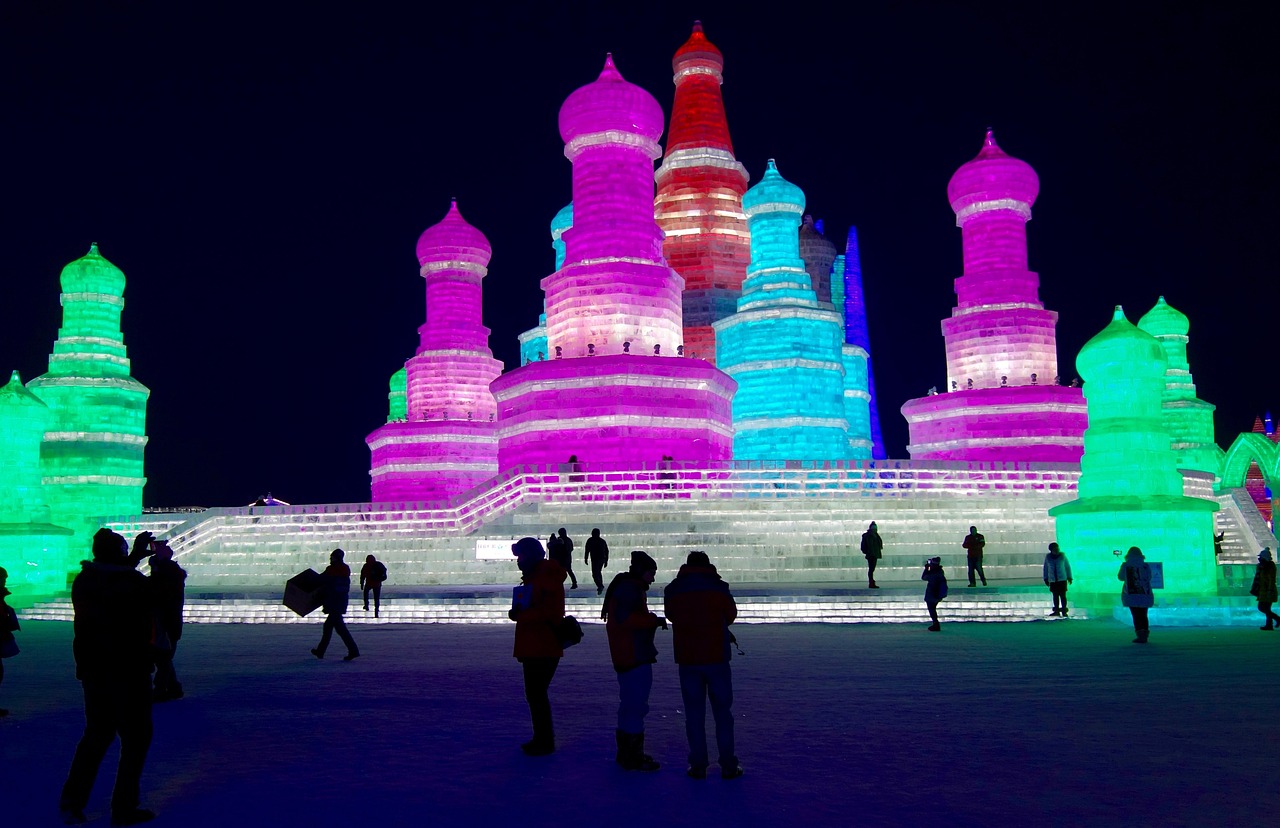
Going to the Ice and Snow World at night, the first impression is colour.
Lights are buried inside the huge ice walls and ice towers.
When the lights come on, the whole block of ice begins to glow.
Blue, red and green move around inside the ice.
Many people assume this is coloured ice.
In fact it's transparent ice plus coloured light.
The Ice and Snow World has run since 1999; this year is the twenty-seventh edition.
But the origin of the practice goes back much further.
On 7 February 1963, Harbin held China's first ice lantern fair.
That day was the fourteenth of the first lunar month.
Before that, ice lanterns were something fishermen and farmers used: freeze water into a hollow shell, put a candle inside, and the shell blocks the wind so the flame can't be blown out.
A windproof lighting device became, sixty-odd years later, an exhibition at the scale of a city.
When spring arrives, all these buildings melt.
The water returns to the Songhua, and the next year it's harvested again.
I asked a member of staff whether this was wasteful.
His answer stayed with me.
He said: we didn't buy the ice, the river lent it to us.
When we're done we give it back, and next year we can borrow it again.
It sounds simple, but it describes an unusual relationship with a resource.
The next day I went to Central Street.
This street is one thousand four hundred and fifty metres long and over twenty-one metres wide — the longest pedestrian street in Asia.
The surface is laid with square stone blocks, which locals call bread stones.
The architecture on this street is unlike most Chinese cities; the styles come from Russia and Europe.
The reason is the railway.
In 1898, construction began on the Chinese Eastern Railway.
In June that year, the railway engineering bureau arrived in Harbin by boat.
Central Street began as nothing more than a dirt road for hauling railway materials.
As Russian workers and merchants kept arriving, that dirt road gradually became the stone street it is today.
Put another way, this city was largely brought into being by a railway.
At midday I ate northeastern food.
The plates were absurdly large, the portions generous, with plenty of oil and salt.
In a city where it's twenty-something below outdoors, that kind of eating has a clear function.
In the afternoon I went back to the river.
The sun went down, the ice turned from white to pale blue, and the lights of the Ice and Snow World began to come on in the distance.
I thought about what the staff member had said.
One candle, sixty-odd years, two hundred thousand cubic metres of ice, and a street from 1898.
A city took its own hardest condition and made it into something people will travel specifically to see.
If the place you live has a season everyone complains about, could it become that place's defining feature?
Listen again
Try it without the transcript and notice what sounds clearer.
What vocabulary does this episode teach?
词汇HSK 4. Most cities endure this one; Harbin sells it.
HSK 4. Two available, and Harbin took the second.
HSK 4. Made of the river, and returned to it.
HSK 3. Brought into being by a railway.
The river closes solid and becomes a quarry.
The key step that makes everything else possible.
The ice is kept cold right through the summer.
The ice is clear; only the light is coloured.
A windproof tool that became an industry.
What the cold becomes once you decide to use it.
Every building goes back into the river each spring.
Central Street started as a haul road for them.
* beyond level超纲词
What grammar patterns appear in this episode?
语法把 A 当作 B
Says how something is regarded or treated.
大多数城市把冬天当作要熬过去的季节。
一 … 就 …
As soon as the first happens, the second follows.
灯一亮,整块冰就开始发光。
换句话说
Restates the previous point more plainly.
换句话说,哈尔滨这座城市几乎是被一条铁路带出来的。
Proper nouns
专有名词Free account
Keep learning from this story
Create a free account to keep saved words and your preferred level together.
- Keep words with their story context
- Remember your preferred level
- Build your vocabulary over time