
A Chinese podcast · Same story, 4 levels
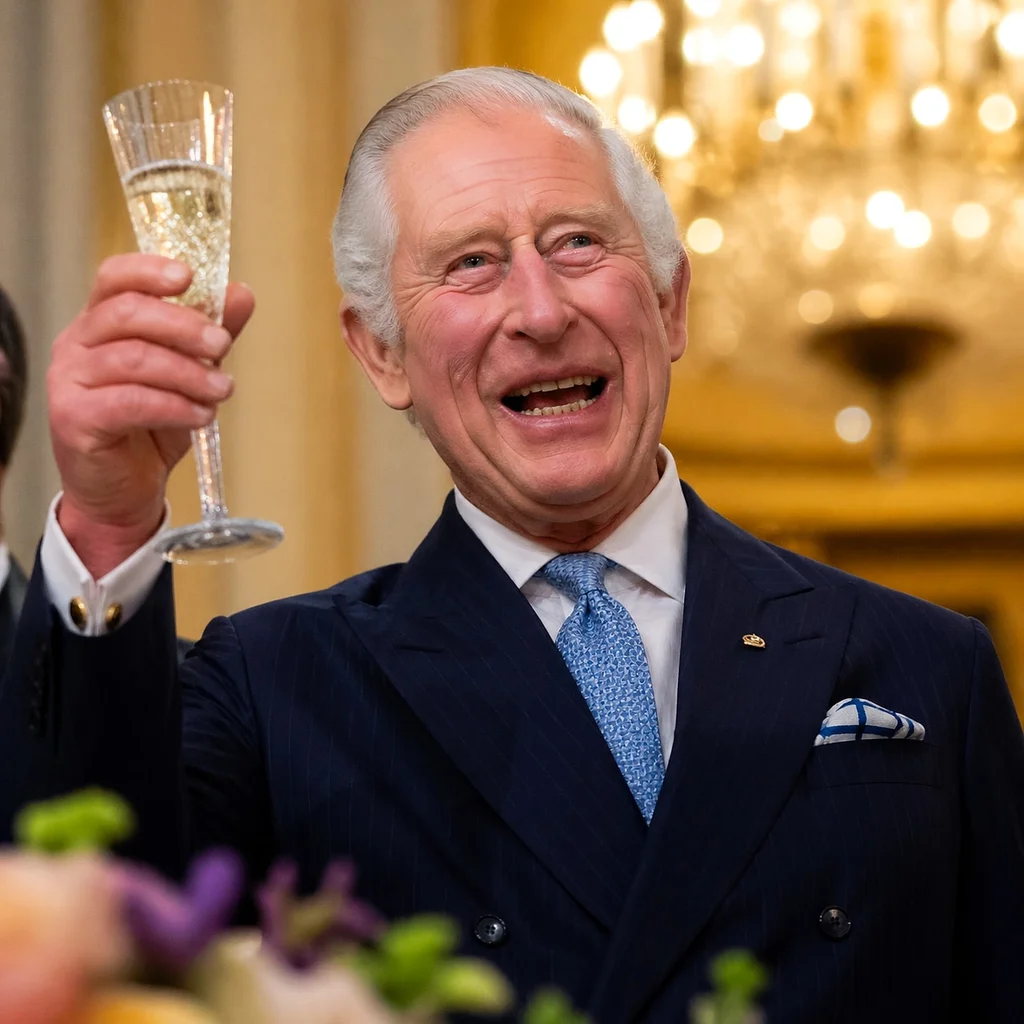
查尔斯三世访美:一场用笑话化解的外交大戏
King Charles Jokes About 1814 White House Fire
About this story
King Charles III's US state visit — a 1814 White House joke to Trump and a bipartisan standing ovation on Ukraine. HSK 3 Chinese listening practice.
This is an HSK 3-4 Chinese listening episode that runs about 12 minutes. The full Mandarin script is shown with tap-for-pinyin and a line-by-line English translation, so you can listen and read at once — comprehensible input in the sense of Stephen Krashen's i+1 theory. It teaches 17 key vocabulary words such as 历史、庆祝、首都 and walks through 7 grammar patterns, each explained in English with examples. The same news story is retold at 4 difficulty levels — use the level selector above to find the version that is challenging but still understandable for you.
Read at your level
原文Read the complete story in Chinese. Reveal pinyin and English only when you need them.
English transcript reference
Speaking of the most fascinating story this week — it's the visit of British king Charles III to America.
We'll tell the whole story today.
After hearing it, you'll see: this was truly a smart person's performance.
First, the background.
This year is America's 250th anniversary.
On July 4, 1776, America became independent from Britain.
That is, 250 years ago, America was not yet an independent country.
Back then, the land we now call America was a British colony.
A "colony" is land controlled by one country but located somewhere else.
Whatever the British king said, the colonists had to obey.
But gradually, the colonists had had enough.
They felt: it's unfair for Britain to rule us from so far away.
So they decided to become independent.
"Independent" means making your own country, not being ruled by others.
The Revolutionary War lasted eight years.
In the end, America won.
The British king at that time was named George III.
George III is Charles III's ancestor.
Not directly his great-grandfather, but from the same family line.
The British throne passed from George III, generation by generation, down to today's Charles III.
So you can think of it this way: 250 years ago, Charles's ancestor lost to America.
And it doesn't end there.
Thirty years after the Revolutionary War, Britain and America fought again.
This one is called "the War of 1812."
In 1814, British troops reached America's capital, Washington.
Then they did something shocking:
They burned down the White House.
Yes — they really burned it.
The White House we see today is the one that was rebuilt afterwards.
The old White House that was burned down is gone.
So you see — over 200 years ago, Britain and America really had fought wars and burned each other's buildings.
This historical context is very important.
Now back to 2026.
At the end of April, British king Charles III and Queen Camilla came to America for a state visit.
They were invited by President Trump.
A "state visit" is when one country's top leader formally visits another country.
The protocol is the highest possible.
There must be an official welcoming ceremony, a state banquet, and political talks.
Charles came mainly to celebrate America's 250th anniversary.
Picture this scene:
250 years ago, George III lost to America.
250 years later, Charles III comes to congratulate America.
Isn't that interesting?
On April 28, Trump held a state banquet at the White House.
A grand formal dinner, hosting a foreign leader.
By tradition during dinner, both host and guest give speeches.
Trump spoke first.
He said Britain and America are the most special friends on Earth.
He also said many polite things.
When it was Charles's turn to speak, something especially brilliant happened.
Charles said first:
"I see you've been doing some new construction at the White House recently."
What construction?
It turns out Trump has been building a very large ballroom on the east side of the White House.
A huge meeting and dance room.
This project is somewhat controversial in America.
"Controversial" means some people like it, others don't.
Anyway, the White House is now full of construction workers.
Then Charles said something that made everyone laugh out loud.
He said:
"I'm sorry, we British people once burned down your White House."
And then he laughed.
The whole room burst into laughter.
Think about how perfect this line is:
Charles is the British king.
His ancestors burned down the White House over 200 years ago.
Now, Trump is rebuilding parts of the White House.
Charles smiles and says: "Sorry, we burned down your White House."
One sentence, linking two events together.
He acknowledged the bad things of the past, and dissolved the awkwardness.
And he made a small joke about Trump's new construction project too.
Trump heard it and laughed too.
Right after that, Charles quoted a famous saying.
He quoted a British writer's words.
That writer is named Oscar Wilde — a very famous Briton from the nineteenth century.
Charles quoted Wilde:
"England and America have everything in common, except the language."
This joke is actually quite deep.
Britain and America both speak English.
But the pronunciation, vocabulary, and habits are different.
So this line sounds like it's saying "we're the same."
But on closer thought, it's also saying "we're different."
This kind of British humor is at a very high level.
The whole room laughed again.
Through these two jokes, Charles did a very smart thing.
He used humor to dissolve hundreds of years of complex history between Britain and America.
No grand speeches, no serious words.
Just a few jokes.
But everyone understood his meaning:
"The past is past.
We are friends now.
But Charles's truly impressive moment was on the second day.
On April 29, Charles gave a speech to the US Congress.
"Congress" is the body in America that makes laws.
A bit like China's People's Congress.
A British monarch addressing the US Congress is very rare.
The previous time was Charles's mother, Elizabeth II.
That was in 1991, 35 years ago today.
So this Charles speech is the second time in history.
Charles spoke for about 25 minutes in Congress.
He talked about several especially important things.
First, he spoke about unity.
"Unity" means being together and helping each other.
He said: the world is changing fast right now, with many problems.
One country alone cannot solve them.
Britain and America must stand together.
And stand together with their other friends in Europe.
Why is this important?
Because lately, Trump has been criticizing Europe a lot.
Trump says: Europe won't help America, so America shouldn't help you either.
Charles, in saying this, was very politely telling Trump:
"That's not the way — we should be together."
He didn't directly criticize Trump.
He just talked about reasoning.
But everyone listening understood what he was saying.
Second, Charles talked about rules.
He said: a country needs rules.
Those who do big things cannot just do whatever they want.
There must be others overseeing them.
"Overseeing" means watching, ensuring you act according to the rules.
He used an English phrase: "checks and balances."
The Chinese translation is "制衡."
It means: different people or different branches watch each other; no one alone gets the final word.
He also mentioned a very famous English document, the Magna Carta.
The Magna Carta is a document signed in England in 1215.
It states: even the king must follow the law.
When Charles said this, the members of Congress all stood up and applauded.
"Members of Congress" are people who serve in Congress.
Picture this scene:
The British king, in the US Congress, talking about rules and checks and balances.
Britain is a country that has a king.
America is a country that doesn't have a king.
But the British king is telling Americans to follow the rules.
Why is this especially important?
Because many Americans feel that lately, Trump hasn't been following the rules.
Charles's words sound like they're about history.
But they're really, very politely, a reminder to Trump and to Americans.
The third thing was the most surprising.
Charles said: America and Britain must firmly support Ukraine.
Ukraine, a country, has been at war with Russia recently.
Russia is much bigger than Ukraine.
One country alone, Ukraine cannot win.
So Ukraine needs other countries to help.
But the problem is: lately many Republican members of Congress in America don't want to keep helping Ukraine.
They feel it costs too much.
Trump thinks the same way.
Charles said: "support Ukraine firmly."
"Firmly" means it won't change — keep doing this.
After he said this, the members of Congress all stood up and applauded.
Not just Democratic members.
Even Republicans, who originally didn't want to help Ukraine, also stood up.
This is called "bipartisan applause."
In English: bipartisan standing ovation.
What did Charles accomplish?
With one sentence, he made even people who originally opposed helping Ukraine, also stand up to support it.
This kind of skill is called "soft power."
"Soft power" is not using force, not using threats, but still making others listen to you.
Why does Charles have this kind of soft power?
Because he is the British king.
The British king is, politically, neutral.
"Neutral" means not taking any side.
Precisely because he's not part of any party, what he says, everyone is willing to hear.
A British king has more influence on Americans than the British prime minister.
This is the magic of the monarchy system.
Charles's visit this time can be called very successful.
British newspapers called it: a master-class performance.
Trump kept saying Britain wasn't helping enough.
Trump kept criticizing British prime minister Starmer.
But once Charles arrived, Trump completely changed.
He was extremely polite to Charles, calling Charles "my good friend."
So you see — the king did what the prime minister couldn't.
Finally, let's think about the meaning of this event.
First: history can pass.
Britain and America fought wars and burned buildings 250 years ago.
But today, they can have dinner together, share jokes together.
There's no bad thing that can't be gotten past.
Second: humor is the smart kind of power.
Charles didn't deliver lectures or open criticism.
He just told a joke about burning down the White House.
But this joke was more useful than a thousand other words.
Third: soft methods are sometimes more effective than hard methods.
Trump's method is hard: criticism, threats, harsh words.
Charles's method is soft: jokes, courtesy, quotations.
But look at the result — Charles made the US Congress stand and applaud.
Trump can't do that.
That's all for today's story.
On April 29, British king Charles III gave a speech to the US Congress.
With humor and courtesy, he turned a tense relationship into something more relaxed.
And along the way, he reminded Americans to follow the rules, to stand together, and to keep helping Ukraine.
That's the power of soft power.
Listen again
Try it without the transcript and notice what sounds clearer.
What vocabulary does this episode teach?
词汇HSK 3. 在历史上 = in history. The episode's anchor word — used to frame the entire 250-year arc.
HSK 4. 庆祝美国二百五十周年 = celebrate America's 250th anniversary. Both verb and noun.
HSK 3. 首 (head) + 都 (metropolis). 美国的首都华盛顿 = America's capital Washington.
HSK 4. 特朗普邀请他们来 = Trump invited them. Both verb and noun.
HSK 3. 决定独立 = decide to become independent.
HSK 2. 这话重要 = this is important.
HSK 3. 很客气地告诉特朗普 = very politely told Trump.
HSK 3. 需要别的国家帮忙 = needs other countries' help.
HSK 3. 比英国首相更能影响美国人 = more able to influence Americans than the British PM.
HSK 4. 这一次的访问非常成功 = this visit was very successful.
HSK 6. Glossed inline as 'land controlled by one country located somewhere else.' The American colonies were British 殖民地.
HSK 4. Glossed inline. 独立战争 = the Revolutionary War. 美国从英国独立 = America became independent from Britain.
Glossed inline. 国 (state) + 宴 (banquet). The most formal type of dinner — when one country's leader hosts another's head of state.
HSK 5. The episode uses it for Trump's controversial 白宫舞厅工程 (White House ballroom project).
HSK 5. 有争议 = controversial. The construction project is politically contested in the US.
HSK 5 (loanword from English). 英式幽默 = British humor. Charles's whole strategy was to use 幽默 as a diplomatic tool.
HSK 6+. Glossed inline as 'different people or different branches watching each other so no one alone gets the final say.' Charles's central political reference in his Congress speech.
* beyond level超纲词
What grammar patterns appear in this episode?
语法X 就是 Y (definition)
The teaching gloss pattern. Used throughout the episode to define new terms.
国宴就是非常隆重的晚宴。
团结就是大家在一起,互相帮忙。
监督就是看着,确保你按规则做事。
因为 ... 所以 ...
Cause-effect connector. Either half can be omitted, but the textbook form uses both.
因为最近特朗普经常批评欧洲。
所以查尔斯告诉美国:你们也要这样。
正因为他不属于任何一党,所以他说的话,大家都愿意听。
虽然 ... 但是 ...
Concessive structure. 虽然 sets up an expectation, 但是 negates it.
英国虽然有国王,但是国王不能太自己想。
听起来是在讲历史。其实是在很客气地,给特朗普和美国人提个醒。
把 + Object + Verb + Result
Disposal construction. Frontloads the object so the verb can carry a result/disposal.
他们把白宫一把火烧了。
他用幽默,把英国和美国之间几百年的复杂历史,都化解了。
他把以前不好的事情,变成了大家一起笑的事。
对 X 来说
Topicalizer. 'For X, ...' or 'From X's perspective, ...'.
对Meta来说,是一个大打击。
对其他想搬到新加坡的中国公司来说,这是一个警告。
X 比 Y + Adj (+ amount)
Comparison. The amount of difference comes after the adjective.
俄罗斯比乌克兰大很多。
比英国的首相,更能影响美国人。
通过 ... (by means of / through)
Adverbial preposition introducing the means/method. Common in expository register.
通过这两个笑话,查尔斯做了一件非常聪明的事。
Proper nouns
专有名词Free account
Keep learning from this story
Create a free account to keep saved words and your preferred level together.
- Keep words with their story context
- Remember your preferred level
- Build your vocabulary over time