
A Chinese podcast · Same story, 4 levels
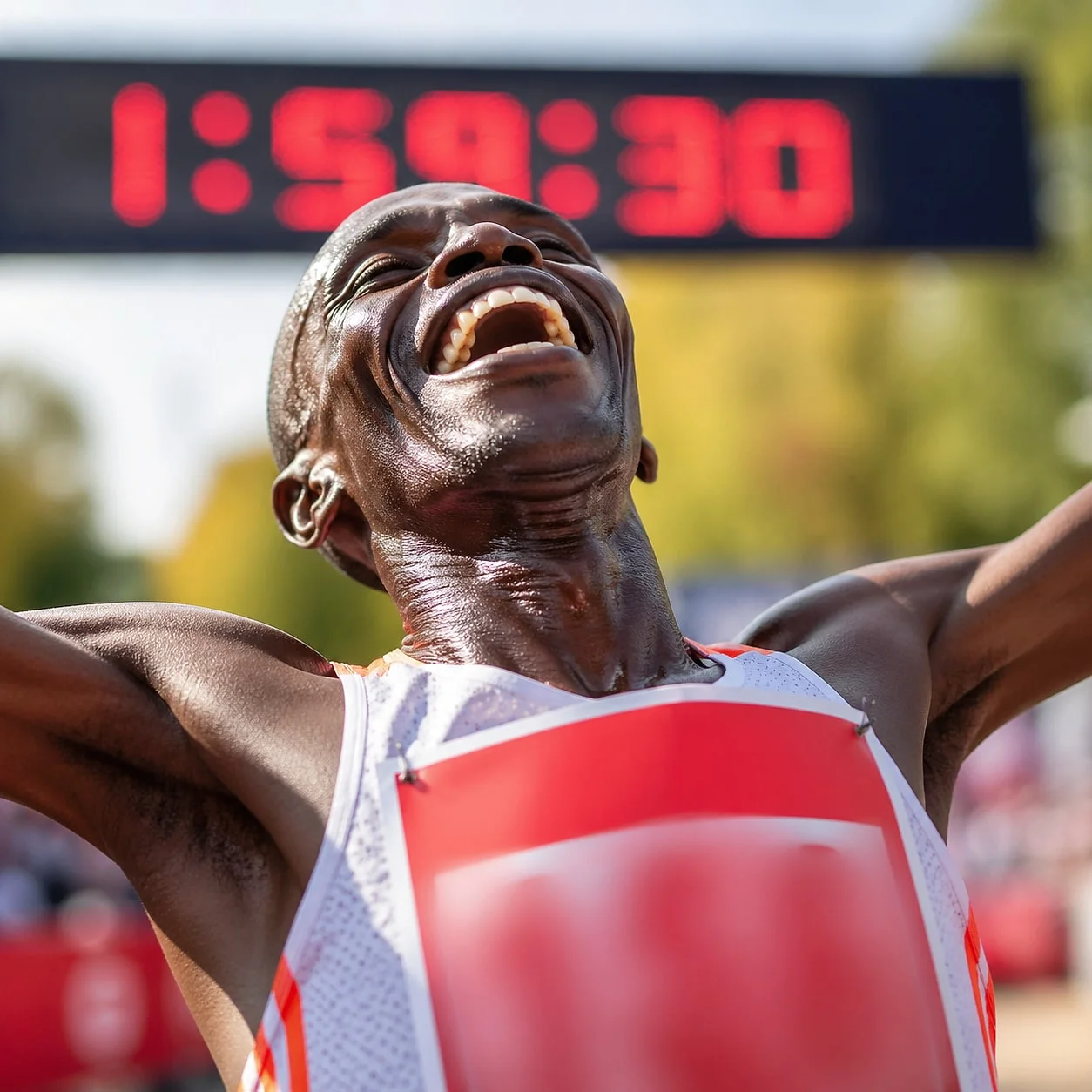
马拉松破二!
Sebastian Sabbe Runs Official 1:59:30 Marathon
About this story
Kenya's Sebastian Sabbe runs 1:59:30 at 2026 London Marathon — the first sub-2 in an officially sanctioned race. HSK 3 Chinese listening practice.
This is an HSK 3-4 Chinese listening episode that runs about 7 minutes. The full Mandarin script is shown with tap-for-pinyin and a line-by-line English translation, so you can listen and read at once — comprehensible input in the sense of Stephen Krashen's i+1 theory. It teaches 17 key vocabulary words such as 成绩、速度、进步 and walks through 7 grammar patterns, each explained in English with examples. The same news story is retold at 4 difficulty levels — use the level selector above to find the version that is challenging but still understandable for you.
Read at your level
原文Read the complete story in Chinese. Reveal pinyin and English only when you need them.
English transcript reference
Speaking of the most exciting sports news of this weekend — it's the 2026 London Marathon.
April 26th, Sunday — London witnessed a "shower" the whole world didn't see coming.
This "shower" wasn't real rain — it was the result of a race.
Kenyan athlete Sabbé ran a time that no one could believe.
One hour, fifty-nine minutes, thirty seconds.
Did you hear that clearly?
Under two hours.
He became the first human in history to break the two-hour mark in an official marathon race.
What does that mean exactly?
Let me explain.
A marathon is a little over 42 kilometers in total.
A typical amateur takes around four hours to finish.
Professional athletes — the best in the world — used to need just over two hours at their fastest.
Going under two hours has been a dream of the sport.
A dream that, for decades, no one had achieved.
Why is it so hard?
Let's think about it.
To run 42 kilometers, you need to average under two minutes fifty seconds per kilometer.
Two minutes fifty seconds for one kilometer doesn't sound that fast.
But you have to keep that pace continuously for 42 kilometers.
You can't stop for even a second along the way.
You can't slow down.
You can't catch your breath.
The demand on the body is just too high.
People have done research on this.
Experts have analyzed whether the human body can actually run that fast.
Many experts used to say: probably not.
But Sabbé did it.
He didn't just do it — he made it look easy.
What's going on here?
Let's look at the previous record.
In 2023, there was a Kenyan named Kiptum.
He ran two hours and thirty-five seconds at the Chicago Marathon in the USA.
That was the world record at the time.
Incredibly fast.
Everyone said: Kiptum is very likely to break two hours in his next race.
Sadly, Kiptum later died in a car accident.
So he never realized that dream.
Surprisingly, a few years later, it was his fellow countryman Sabbé who fulfilled the dream.
And not just by going under two hours either.
Sabbé beat Kiptum's record by more than a minute.
A minute or so doesn't sound like much.
But in marathon terms, it's a huge improvement.
What's even more astonishing is that two other people also ran very fast that day.
Second place was Kojelcha, from Ethiopia.
He ran one hour, fifty-nine minutes, forty-one seconds.
Also under two hours.
And it was his first marathon ever!
Running that kind of time in your debut marathon — unprecedented.
"Unprecedented" means it has never happened before.
Third place was Kiplimo, from Uganda.
He ran two hours and twenty-eight seconds.
He didn't break two hours, but he was still faster than Kiptum's old world record.
So that day, three people all broke the previous world record.
This kind of thing has never happened in marathon history before.
Now let's talk about the women's race.
The women's race started earlier than the men's.
The winner was Asefa, from Ethiopia.
She ran two hours, fifteen minutes, forty-one seconds.
She was already the holder of the women's marathon world record.
"Holder" means the person who currently has the record.
This time, she improved her own record by another nine seconds.
So the women's marathon world record is still hers.
Now the question is —
Why 2026?
Why London?
Why these three people?
Let's analyze it.
First, running shoe technology has improved.
In recent years, many companies have been making a special kind of running shoe.
These shoes have something elastic inside.
"Elastic" means it bounces back when you press on it.
That bounce helps athletes run faster.
Some people call them "tech shoes."
Others say they're a bit like cheating.
But World Athletics says these shoes are allowed.
So now all the athletes wear them.
Second, training methods have advanced.
Today's athletes train more scientifically than before.
They use many scientific methods — analyzing heart rate, breathing, every aspect of the body.
That way they know how to train, how to eat, how to rest.
Then there's the weather.
The weather in London that day was great.
Not cold, not hot.
No wind.
Perfect running weather.
Lastly, it's the competition between athletes.
When three people are all running fast, they help each other.
I follow you, you follow him.
That way everyone runs faster.
If you're alone, you usually can't run that fast.
So this success was the result of many factors coming together.
So what about next time?
Some say more and more people will go under two hours from now on.
Maybe in a few years, going under two hours won't be a big deal.
Like many years ago, going under ten seconds was considered the limit of the 100 meters.
Now lots of people go under ten.
Maybe the marathon will be the same.
But no matter what, Sabbé will always be the first.
His name will be written into sports history.
The story of his day in London will be told for many, many years.
Now let's think — what does this have to do with ordinary people like us?
We aren't professional athletes.
We can't run a two-hour marathon.
But we can learn some things from this.
First, things that look impossible may actually be possible.
They just need more effort, better methods, more time.
Second, having a goal matters.
From a young age, Sabbé had a goal: to run the fastest.
He worked toward that goal every day.
Eventually, he made it.
We can have our own goals too.
Not necessarily running.
Maybe a goal at work, maybe a goal in our studies.
People with goals go further than people without.
Third, everyone has their own timing.
Sabbé broke the record at age thirty-one.
Among runners, thirty-one isn't young.
But he still did it.
So, don't think you're too late.
It's never too late to start.
That's the story of the 2026 London Marathon.
Sabbé from Kenya, one hour, fifty-nine minutes, thirty seconds.
The first runner in history to break two hours.
On April 26th, he changed the history of sport.
Listen again
Try it without the transcript and notice what sounds clearer.
What vocabulary does this episode teach?
词汇HSK 3. Used for race times, exam scores, work performance. 跑出一个成绩 = post a time. 创造好成绩 = produce a great result.
HSK 3. 速度 = speed. 这样的速度 = this kind of speed. Compare 速 (fast) + 度 (degree).
HSK 3 noun + verb. 一个非常大的进步 = a very big improvement. Often paired with 取得 (achieve) or 有 (to have).
HSK 3-4. 梦 = dream, 想 = think/want. Specifically a long-held aspiration, not the dream you have when sleeping (那是 做梦).
HSK 4 but very common. 目 = eye, 标 = mark. Set a 目标, work toward a 目标. Compare 梦想 (loftier) vs 目标 (more concrete).
HSK 4 — written 纪录 (achievement record) is distinct from 记录 (a written log). 世界纪录 = world record. Verbs: 打破/保持纪录.
HSK 4. 保持纪录 = hold the record, 保持冷静 = stay calm. The 保持者 (holder) of a record.
HSK 4. 提 = lift; 高 = high. 提高纪录 = improve a record. Often paired with 水平 (level), 成绩, 速度.
HSK 4. 分 = divide; 析 = take apart. 分析心跳 = analyze heart rate. Both verb and noun.
HSK 4. Adverb. 互相帮助 = help each other, 互相学习 = learn from each other. Always before the verb.
HSK 5. Used for limits, barriers, comfort zones. 突破极限 = break through the limit. The 二 (sub-2) was a 突破.
弹 = spring/bounce; 性 = quality. Describes both physical springiness (in shoes) and metaphorical flexibility (e.g. 弹性工作时间 = flexible hours).
反 = reverse; 弹 = spring. Used for balls, prices, markets. In the episode: shoes 反弹 to push the runner forward.
Four-character 成语. 前 (before) + 所未有 (what has not existed). The episode glosses this in-line — listen for the explanation.
HSK 4-5. The shoes 是允许的 = are allowed (by World Athletics). Often used in formal/regulatory contexts.
作 = do/make; 弊 = malpractice. Specifically cheating in tests, sports, or contests — not romantic cheating (that's 出轨).
车 = vehicle; 祸 = disaster. Specifically a car/road accident. 出车祸 = to be in a car accident. Used neutrally for both minor crashes and fatal ones.
* beyond level超纲词
What grammar patterns appear in this episode?
语法如果 / 要是 ... 就 ... (conditional)
If-then structure. 如果/要是 introduces the condition; 就 marks the consequence. Either half can sometimes be dropped in spoken Chinese.
如果只有一个人跑,往往跑不了这么快。
X 比 Y + Adjective + (Quantity)
Comparison with quantification. The comparison difference comes after the adjective. 'By how much faster/more/etc.' Watch the position of 还/更.
萨维比基普图姆的纪录还快了一分多钟。
比基普图姆以前的世界纪录还要快。
把她自己保持的纪录又提升了九秒。
不但 ... 还/而且 ... (not only ... but also)
Two-clause structure for adding emphasis. 不但 in the first clause, 还/也/而且 in the second. Stronger than just listing two facts.
他不但做到了,还跑得很轻松。
因为 / 所以 ... (because/so)
Standard cause-effect connector. Either half alone is fine in spoken Chinese, but the textbook pattern uses both.
所以他没能完成这个梦想。
所以这一次的成功,是很多原因加起来的结果。
所以现在所有的运动员都穿这种鞋。
X 就是 Y (definition / equivalence)
Used to define a term inline. Common in teaching-register Chinese. Compare with 'X 即 Y' (more written/formal).
跑进两个小时,就是体育界的一个梦。
'前所未有'就是以前从来没有过。
'保持者'就是拿着这个纪录的人。
把 sentence (disposal/result)
Frontloads the object before the verb so that a result/disposal can follow. Can't have a 把-sentence if the verb has no result.
他把别人都甩在了后面。
把她自己的纪录又提高了九秒。
Topic + 来 + Verb (let me/ let us)
'Let me/us do X.' Used for soft proposals. 我来给你解释 = let me explain it to you. 我们来想一想 = let's think about it.
我来给你解释一下。
我们来想一想。
我们再来说说女子组。
Proper Nouns
专有名词Free account
Keep learning from this story
Create a free account to keep saved words and your preferred level together.
- Keep words with their story context
- Remember your preferred level
- Build your vocabulary over time