
A Chinese podcast · Same story, 4 levels
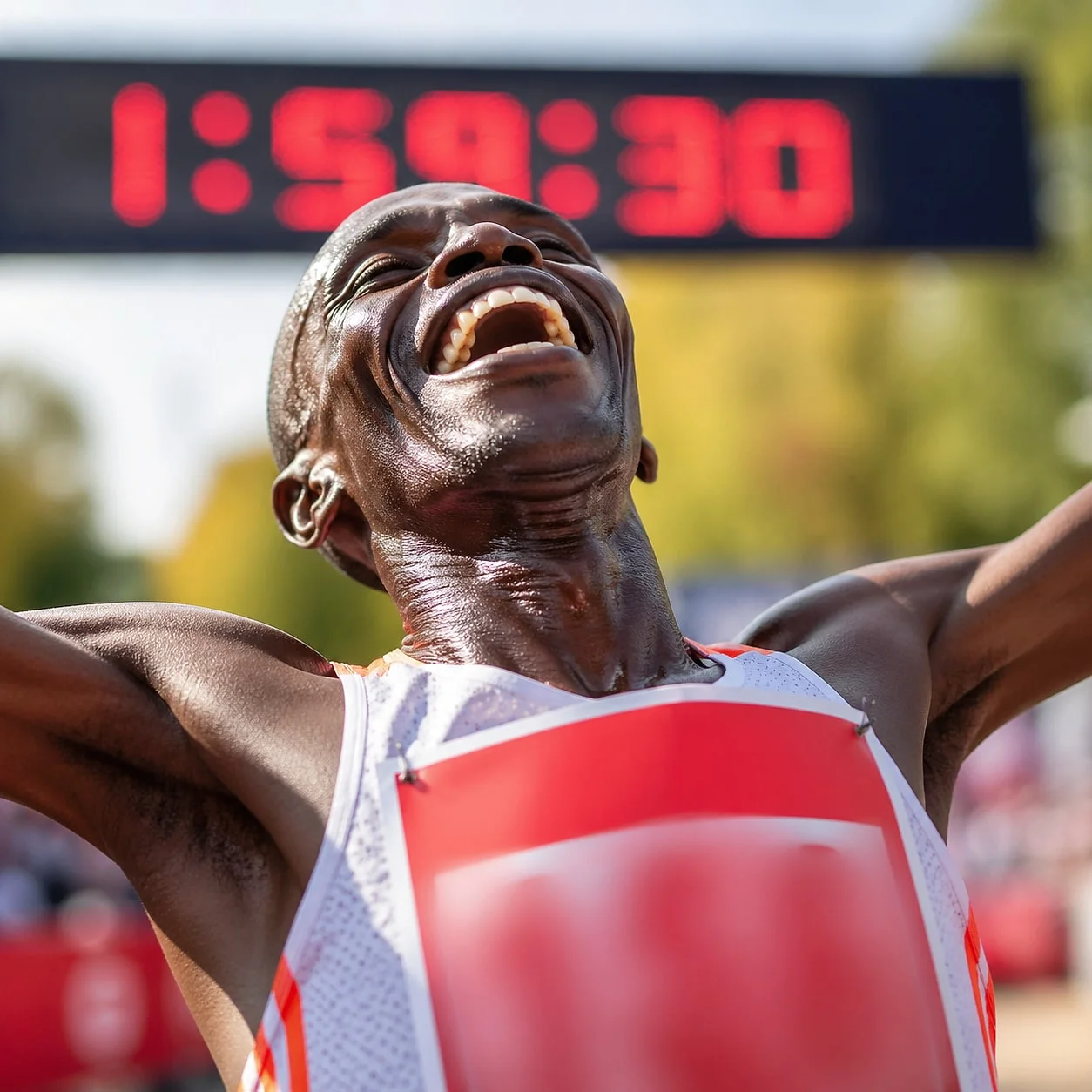
伦敦的一场赛跑
Sebastian Sabbe Runs Official 1:59:30 Marathon
About this story
Kenyan runner Sebastian Sabbe finishes the 2026 London Marathon in 1 hour 59 minutes — a world first. HSK 2 Chinese listening practice.
This is an HSK 2 Chinese listening episode that runs about 7 minutes. The full Mandarin script is shown with tap-for-pinyin and a line-by-line English translation, so you can listen and read at once — comprehensible input in the sense of Stephen Krashen's i+1 theory. It teaches 18 key vocabulary words such as 比赛、运动员、开始 and walks through 7 grammar patterns, each explained in English with examples. The same news story is retold at 4 difficulty levels — use the level selector above to find the version that is challenging but still understandable for you.
Read at your level
原文Read the complete story in Chinese. Reveal pinyin and English only when you need them.
English transcript reference
Speaking of an astonishing race, today we'll chat about something that happened last Sunday.
April twenty-sixth, that day was a Sunday.
In London, the capital of the UK, there was a very big competition.
This competition is called the marathon.
A marathon is a very, very long running race.
How long, exactly?
A total of forty-two kilometers and a bit.
A kilometer is one thousand meters.
Forty-two kilometers is roughly the distance of running from one city to another.
An ordinary person can't even walk that far.
But some people can run the whole thing.
These people are athletes who run for a living.
"Athletes" are people whose job is doing sports.
That day, tens of thousands of people came to watch the race.
Hundreds of millions more watched on TV.
Why did so many people watch?
Because they wanted to see one thing.
What thing?
They wanted to see whether anyone could finish in under two hours.
Two hours sounds like a lot.
But to run forty-two kilometers within two hours is extremely, extremely hard.
How hard, exactly?
For over a hundred years, no one had ever done it.
But this time, someone did!
The person who did it is called Sabbé.
Sabbé is thirty-one this year, from Kenya.
Kenya is a country in Africa.
This country has many incredibly skilled distance runners.
Sabbé is one of them.
That day, he ran extremely fast right from the start.
He ran kilometer after kilometer.
The other athletes followed behind him.
Halfway through, everyone was still together.
At thirty kilometers, Sabbé started to surge forward.
"Surge" means using your full strength to push ahead.
He ran faster and faster, leaving everyone else behind.
"Leaving them behind" means no one could catch up.
Finally, he reached the finish line.
The finish line is the place where the race ends.
He glanced at the clock.
One hour, fifty-nine minutes, thirty seconds.
Truly under two hours!
He had done it!
People all over the world were thrilled.
"Thrilled" means extremely happy, with your heart pounding.
Why so thrilled?
Because the previous best time was two hours and thirty-five seconds.
That time had been set by another Kenyan.
He was called Kiptum.
He ran it in 2023 in Chicago, USA.
That time was already amazing.
But it was still thirty-five seconds away from two hours.
Thirty-five seconds doesn't sound like much.
But to be that much faster again was simply too hard.
So many people said: it's impossible for a human to go under two hours.
"Impossible" means it cannot be done.
But this time, Sabbé did it.
And not only Sabbé.
Two more people also did it!
One of them was named Kojelcha.
He's from Ethiopia.
Ethiopia is also an African country.
He ran one hour, fifty-nine minutes, forty-one seconds.
A bit slower than Sabbé, but still under two hours.
What makes him even more impressive?
This was his very first marathon!
Running this fast in your first race — no one has ever done it before.
There's also a person called Kiplimo.
He's from Uganda, another African country.
He ran two hours and twenty-eight seconds.
Although he was over two hours, he was still faster than Kiptum's old record.
So this day, three people all broke the previous world record!
"Breaking the record" means being even better than the previous best.
The world record is the best time anywhere in the world.
Three people breaking it at the same time — incredible!
Now let's talk about the women's race.
That day, there was also a women's marathon.
The first place went to Asefa.
Asefa is from Ethiopia.
She had already been the world's fastest before.
This time, she ran even faster.
She ran two hours, fifteen minutes, forty-one seconds.
Nine seconds faster than her previous time.
So she has the world record again!
Many people ask: how can they run so fast?
The answer isn't simple.
They have to train every day.
"Training" means doing one thing over and over so you keep getting better.
They run many kilometers every day.
They eat special food to give their bodies strength.
They sleep well.
Their job is running.
That's why they can be this fast.
Also, the racecourse matters a lot.
The weather that day was good too.
Not cold and not hot.
No strong wind.
So conditions were good.
"Conditions" means the situation around you.
With good conditions, athletes can run faster.
Now let's think — what does this mean?
Under two hours sounds like just a number.
But this number represents the limits of what humans can do.
"The limit" means the farthest, fastest, best place.
People used to say: humans can't reach that place.
But Sabbé reached it.
So this tells us:
Some things look impossible.
But as long as you keep trying, you may reach them.
Not just running — it's the same with other things.
Studying too.
Work too.
No one can tell you: you can't do it.
Try, and you might just do it.
Sabbé used to be an ordinary person.
He grew up in a small village in Kenya.
He liked running from the time he was little.
He ran every day, every day.
He ran for many, many years.
Finally, he broke the world record.
So, do the things you love.
Do the things you want to do.
Don't be afraid of being slow.
Take it slow, and keep going.
In the end, you can surprise yourself too.
This is what we're talking about today.
April twenty-sixth, the London Marathon.
Sabbé from Kenya, one hour, fifty-nine minutes, thirty seconds.
The first time in human history.
In an official race, breaking two hours.
This is a day people will remember.
Maybe later someone will run even faster.
But Sabbé will always be the first.
Listen again
Try it without the transcript and notice what sounds clearer.
What vocabulary does this episode teach?
词汇HSK 2 noun and verb. 一场比赛 (one match — measure word 场), 比赛开始了 (the match has begun). Often paired with 参加 (to take part).
HSK 2. 运动 = sports/exercise; the suffix 员 marks a person who does the activity. Compare 服务员 (waitstaff), 演员 (actor).
HSK 2 verb. 开始跑 = start running. Often takes a verb as object: 开始 + V. 开始 with a noun: 比赛开始了 (the match has started).
HSK 2. Used for race times, test scores, work results. 跑出成绩 = post a time. The previous 成绩 here is 'previous (best) time'.
HSK 2. 每天练习 = practice every day. Both verb and noun. Pair: 做练习 (do exercises), 练习汉语 (practice Chinese).
HSK 2 measure of distance = 1000 meters (米). 一公里 = one km. The 公 prefix marks 'metric public unit' (cf. 公斤 kg).
HSK 2. 一个大城市 = a big city. London = 伦敦, 一个城市. Often contrasted with 农村 (countryside).
HSK 2. 其他人 = other people, the others. 其他的 used as a stand-alone pronoun for 'the others'.
HSK 2. 比赛结束 = the match ends. Opposite of 开始. The 终点 (finish line) is literally where the race 结束.
HSK 2. 这件事很重要 = this matter is very important. Often follows 很/非常. The 重 here means 'heavy, weighty', as in 'matters of weight'.
HSK 3. 首 = head/first; 都 = metropolis. 中国的首都是北京 = China's capital is Beijing.
Loanword. 42.195 km foot race. Outside sport, used metaphorically: 马拉松式的会议 = a 'marathon' meeting.
终 = end/final; 点 = point. The opposite is 起点 (starting point). In context: 跑到终点 = reach the finish line.
HSK 4. Mix of excitement and emotion. 我很激动 = I'm thrilled. Often used when watching sports, weddings, concerts.
可能 = possible. 不可能 = impossible. Used as adjective and standalone exclamation: 不可能! = No way!
Literal: hit-break. Used for breaking records, breaking silence, breaking glass. 打破纪录 is the standard collocation.
世界 = world, 纪录 = record (of an achievement; note: not 记录 which is a written record). Always 打破 (break) or 保持 (hold) 世界纪录.
HSK 5. 人的极限 = the limits of human ability. 极 = extreme/utmost, 限 = limit. The verb is 突破极限 (break through the limit).
* beyond level超纲词
What grammar patterns appear in this episode?
语法X 就是 Y (definition)
The workhorse pattern in Fluentide-style explanation. Used to gloss any new term inline. Translates as 'X is exactly/just Y' or 'X means Y'.
公里就是一千米。
运动员就是工作就是做体育的人。
条件就是周围的情况。
因为...所以... (because...therefore...)
Two-clause cause-effect. 因为 introduces the cause, 所以 the result. Either half can be omitted, but using both is the textbook pattern.
因为他们想看一件事情。
所以他们才能这么快。
所以条件好。
虽然...但是... (although...still...)
Concessive structure. 虽然 sets up an expectation, 但是 negates it. Both halves are usually present in this register.
虽然超过了两个小时,但是还是比基普图姆以前的成绩快。
比 comparison
A 比 B + adj/verb-phrase. To say 'by how much,' add a measure phrase after the adjective: 比她以前快了九秒 = nine seconds faster than before.
比她以前快了九秒。
比萨维慢一点。
比基普图姆以前的成绩快。
越来越 + Adj
'More and more X.' Indicates a progressive increase. Although here you'll mostly see 越 used in episode-internal phrasing 'X 越...越...' as well.
他越跑越快。
让自己越来越好。
Verb + 完 / 到 (resultative)
These complements mark completion (完) or arrival/achievement (到). 跑完 = finish running, 跑到 = run to (a place), 做到了 = managed to do it.
可以跑完。
跑到一半的时候。
但是萨维做到了。
把 sentence (BA construction)
把 fronts the object so the verb can carry a result/disposal. 'Took A and did Y to it.' Common with verbs of placement, change, removal.
把别人都甩在了后面。
Proper nouns
专有名词Free account
Keep learning from this story
Create a free account to keep saved words and your preferred level together.
- Keep words with their story context
- Remember your preferred level
- Build your vocabulary over time