
A Chinese podcast · Same story, 4 levels
破二之夜:人类马拉松的圣杯
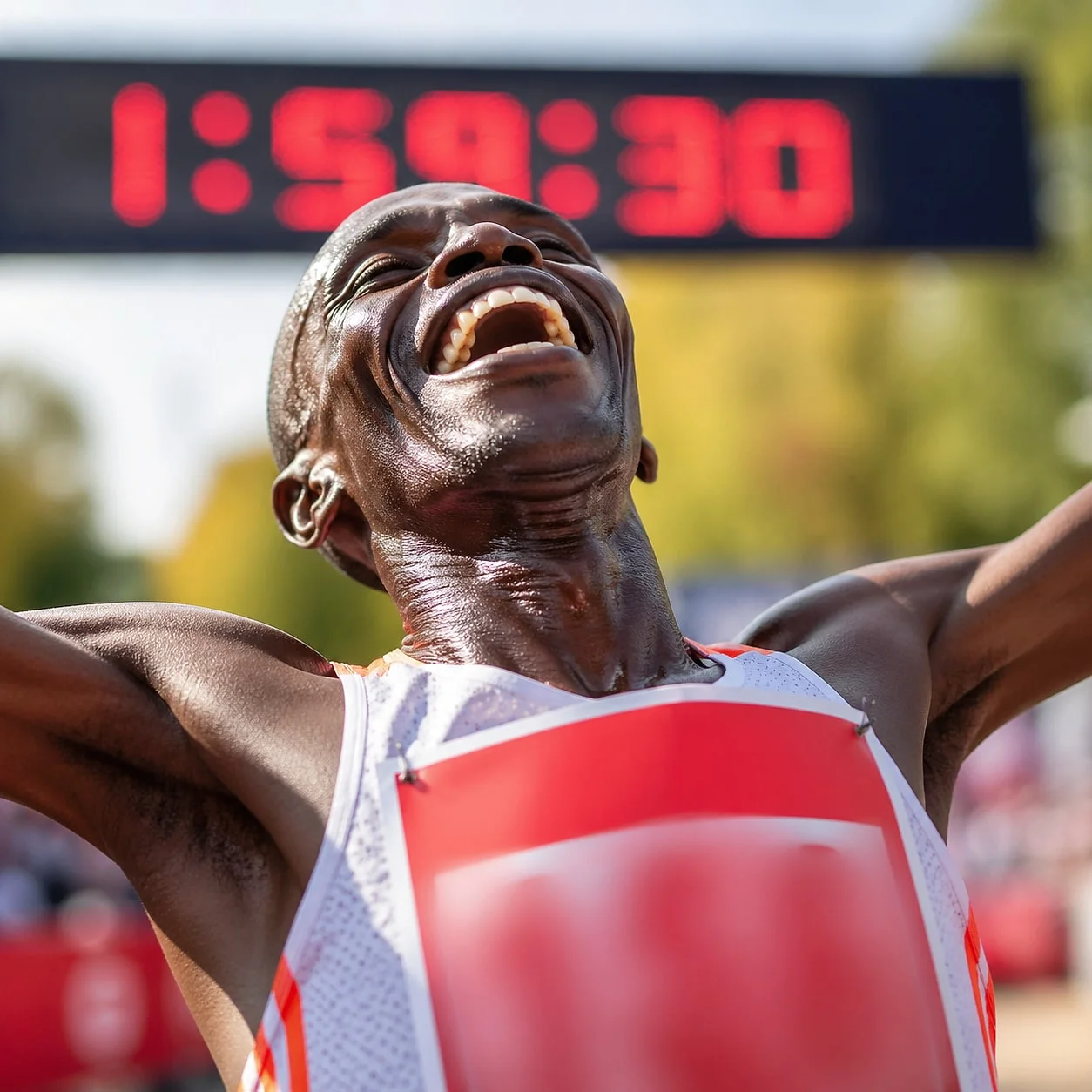
Sebastian Sabbe Runs Official 1:59:30 Marathon
About this story
Sebastian Sabbe runs 1:59:30 at 2026 London Marathon, officially breaking the sub-2 barrier Kipchoge chased for years. HSK 5-6 Chinese listening practice.
This is an HSK 5-6 Chinese listening episode that runs about 9 minutes. The full Mandarin script is shown with tap-for-pinyin and a line-by-line English translation, so you can listen and read at once — comprehensible input in the sense of Stephen Krashen's i+1 theory. It teaches 16 key vocabulary words such as 认证、传奇、极限 and walks through 8 grammar patterns, each explained in English with examples. The same news story is retold at 4 difficulty levels — use the level selector above to find the version that is challenging but still understandable for you.
Read at your level
原文Read the complete story in Chinese. Reveal pinyin and English only when you need them.
English transcript reference
Speaking of the most thrilling sports news of this weekend — it has to be the 2026 London Marathon.
April 26th, Sunday — London witnessed what was, in sporting terms, an "earthquake."
Kenyan runner Sebastian Sabbé crossed the finish line in one hour, fifty-nine minutes, thirty seconds.
You heard that right — under two hours.
This is the first time in human history that anyone has broken the two-hour mark in an officially-sanctioned World Athletics marathon.
What does that mean exactly?
Let me lay out the background first.
A marathon is 42.195 kilometers in total.
"Sub-2," meaning breaking two hours, has long been considered the "holy grail" of distance running.
You have to average under two minutes fifty seconds per kilometer for over 42 kilometers — without dropping the chain even for a second.
The demands on the cardiovascular system, muscles, pacing strategy, and fueling strategy push the human body literally to the brink of its limits.
Back in 2019, the Kenyan legend Kipchoge ran one hour, fifty-nine minutes, forty seconds in Vienna.
But that race was unofficial.
The pacers could rotate without limit, the shoes were custom-made, the course was closed off — even the wind was carefully calculated for.
So that time was not certified by World Athletics.
Kipchoge himself said it was just a "demonstration," meant to show where the human limit was.
The real officially-recognized record was Kiptum's two hours and thirty-five seconds at the Chicago Marathon in 2023.
At that point, Kiptum was everyone's biggest hope — the runner most likely to "go sub-2."
But to everyone's shock, he died in a tragic car accident in 2024.
The "sub-2" baton thus passed to the next generation of Kenyan runners.
And Sabbé is the one who took up that baton.
Thirty-one-year-old Sabbé wasn't actually the most heavily favored before the race.
His previous best was two hours and a bit over a minute.
On paper, there were probably four or five runners ahead of him.
But marathons of this level are most unpredictable when it comes to form and luck.
That day, the weather in London was just right.
Around twelve degrees Celsius, no wind, moderate humidity.
Runners know this is what they call "course weather."
Right from the start, the lead pack of African runners pulled out an extremely aggressive pace.
The first ten kilometers were already on a sub-two-hour rhythm.
For the middle twenty kilometers, the pace barely changed.
After the thirty-kilometer mark, only Sabbé, Kojelcha, and Kiplimo were left.
Everyone else couldn't hang on anymore.
The competition between these three was the real storyline of the race.
The decisive moment came at the thirty-eight kilometer mark.
Sabbé suddenly accelerated.
Not the "final probe before the sprint" that everyone expected — he pushed the pace straight to a level that was almost inconceivable.
Kojelcha hung on for a few hundred meters, then dropped.
Kiplimo hung on for a kilometer, then dropped too.
Sabbé surged toward the finish line alone.
People watching said, in that moment, Sabbé's footsteps almost seemed to be floating.
As he crossed the line, he looked up at the giant screen.
One hour, fifty-nine minutes, thirty seconds.
He froze for a moment, then sank to his knees, covering his face with both hands.
At that instant, the entire London course erupted.
But the drama didn't end there.
Kojelcha eventually finished in one hour, fifty-nine minutes, forty-one seconds.
He, too, broke two hours.
Even more incredibly — this was his first marathon ever.
Going sub-2 in your debut marathon — there is no precedent in the history of the sport.
"No precedent" means it has never been done before.
Kiplimo took third in two hours and twenty-eight seconds.
He didn't break two, but he was still seven seconds faster than Kiptum's old world record.
So that day, the times of the top three all broke the previous world record.
Three runners breaking the world record in the same race — a first in marathon history.
That's the men's race; now for the women's.
The women's race started slightly earlier than the men's.
The winner was Tigist Asefa of Ethiopia.
She ran two hours, fifteen minutes, forty-one seconds, lowering her own pure women-only marathon world record by another nine seconds.
"Pure women-only" means the race had only female competitors — no male pacers helping her run.
Why emphasize this?
Because some women's times in the past were set with male pacers running alongside, which has different "credibility."
Asefa is now the genuine "strongest of pure women's marathons."
So the question becomes — why this day?
Why did three sub-2 runners suddenly emerge on the same day?
There are actually a few reasons behind it.
First is equipment.
In recent years, "super shoes" have become the most controversial topic in the marathon world.
The midsoles of these shoes have a carbon fiber plate embedded inside, plus a special elastic foam material.
While running, the plate and foam store energy, then release it when the foot lifts off.
Put plainly — they're like adding a "spring" to your legs.
Studies have shown that super shoes can improve an athlete's time by roughly 2 to 4 percent.
That doesn't sound like much.
But in a sport where times are measured in seconds, 2 percent is over two minutes.
Two minutes is enough to turn a 2:05 marathoner into a 2:03 marathoner.
So now every elite marathoner is wearing these shoes.
Second is training.
Training methods are becoming more scientific.
Heart rate monitoring, lactate threshold, VO2 max — metrics that used to live only in labs are now measured by every professional.
Coaches use these data to adjust training plans.
Third is altitude training.
Runners from Kenya and Ethiopia all live above two thousand meters of elevation.
The air is thin at altitude, and people who live there long-term have higher red blood cell counts and stronger cardiovascular function.
That's a natural advantage.
Fourth — and most important — is racing together.
When three people are all near the limit, they push each other.
It's not just physical pulling along.
It's also psychological — the cognitive breakthrough of "if he can do it, so can I."
Sports psychology has a concept called "the curse."
When an impossible time has gone unbroken for a long time, everyone subconsciously thinks "that's impossible."
But once one person breaks it, the curse breaks.
The next ones suddenly realize: it actually can be done.
The sub-10-second 100 meters, the sub-2-minute men's 800, the sub-4-minute mile — they all went through this same process.
Now, the sub-2-hour marathon joins that list.
So once "sub-2" becomes routine, where's the next target?
Some experts say the true human marathon limit may be around one hour and fifty-seven minutes.
That number comes from theoretical upper bounds based on VO2 max and muscular efficiency.
Sabbé's 1:59:30 is still over two minutes off that ceiling.
Maybe in our lifetime, we'll see more miracles.
Finally, I want to say something to the ordinary person.
After hearing this story, you might think: this has nothing to do with me.
I'm not a professional athlete.
But it actually does have something to do with us.
Sabbé didn't break two hours until age thirty-one.
In the world of marathons, that's not particularly young.
He came from a remote village in Kenya.
He didn't have proper training facilities as a child.
He didn't get here by being a born genius.
He got here through decades of training, plus a little bit of luck.
What does this tell us?
The things you think are impossible may not actually be impossible.
They just need more effort, more time, and more chances than you imagined.
And it also tells us:
When you see someone do something extraordinary, don't think "ah, that's a genius."
More often, it's an explosion of decades of accumulation.
So go and do the things you want to do.
Don't be trapped by other people's definitions of "impossible."
Before Sabbé did it, the whole world said "sub-2 is the human limit."
After Sabbé did it, the whole world said "so it can be done."
Same person, same thing — only the time changes, and the perception is completely different.
Your "impossible" may just mean you haven't reached that day yet.
This is the 2026 London Marathon.
Sebastian Sabbé, one hour, fifty-nine minutes, thirty seconds.
The beginning of the marathon's "1-handle" era for humans.
April 26th, London — a day for the history books.
Listen again
Try it without the transcript and notice what sounds clearer.
What vocabulary does this episode teach?
词汇HSK 5. 认 = recognize; 证 = certificate. 世界田联认证 = World Athletics certification. Used in regulatory contexts: 认证产品, 通过认证.
HSK 5. Originally referred to Tang dynasty fiction; now a noun for any 'legendary person' (基普乔格 is one). Adj: 传奇式的 (legendary).
HSK 5. 极 = utmost; 限 = limit. Used for human limits, physical extremes. 突破极限 = break through the limit; 挑战极限 = challenge the limit.
HSK 5. Both noun and verb. 一个重大突破 = a major breakthrough. 突破自我 = surpass oneself. The episode's central theme.
不可 = un-/cannot; 预测 = forecast/predict. Common formula 不可 + 2-syllable verb = 'un-Vable' (不可思议 inconceivable, 不可避免 unavoidable).
HSK 5. 决定 (decide) + 性 (-ness/quality). 决定性的时刻 = the decisive moment. Same -性 suffix in 重要性, 可能性.
HSK 5. 争 = argue; 议 = discuss. 有争议 = controversial. The 'super shoes' are 最有争议的话题 (the most controversial topic).
Four-character 成语. Lit. 'before — not yet — have'. Common in journalistic register. The episode also uses the variant 前无古人.
Borrowed from Christian/Arthurian lore. Used metaphorically for the ultimate prize in any field. 体育的圣杯 = the holy grail of the sport.
Marathon-specific. 配 = match; 速 = speed. The strategy of pace control. 配速员 = a pacer (runner who sets pace for the leader).
Material science term. 碳 = carbon; 纤维 = fiber. The plate inside super shoes. Also used in racing bikes and aircraft.
Highly technical sports-science vocab — gloss/skip if not interested. 乳酸 = lactic acid; 阈值 = threshold. The point at which lactate accumulates faster than it can be cleared.
Four-character idiom. 天赋 = innate gift; 异禀 = uncommon endowment. Used to describe rare talents — the episode says Sabbé is NOT this.
魔 = devil/magic; 咒 = curse. Used metaphorically in sports for psychological barriers (e.g. the 'sub-10 curse', the 'sub-4-mile curse').
HSK 6. 认知突破 = cognitive breakthrough. Used in psychology, education, business: 认知偏差 (cognitive bias).
Stock journalistic phrase. 载入 = to be entered/loaded into; 史册 = the historical record. 载入史册的一天 = a day for the history books.
* beyond level超纲词
What grammar patterns appear in this episode?
语法X 也就是 Y (apposition / paraphrase)
Used to restate or clarify. 'X — that is, Y.' More formal than the simple 就是 definition pattern. Common in expository registers.
'破二',也就是跑进两小时,多年来一直被认为是人类长跑的'圣杯'。
把 + Object + Verb + Result
Disposal construction. The object is fronted by 把 so a result/effect can follow the verb. Required when the verb has a quantitative result.
把她自己保持的纯女子马拉松世界纪录又提升了九秒。
把人体往极限的方向往死里逼。
被 + (Agent) + Verb + Result (passive)
The Mandarin passive. Often paired with 给/所. In formal writing/news, 被 + 认证/承认 are very common.
世界田联没有认证。
在马拉松圈子里最有争议的话题。
被认为是人类长跑的'圣杯'。
不仅...还/也... (not only...but also)
More formal than 不但...而且... Steps up emphasis. 不仅仅是 = it's not only that...
不仅仅是身体上的跟随。
还有心理上的'我能做到,他也能做到'的认知突破。
一旦 + Clause + 就 + Clause
'Once X happens, Y...' Stronger than 如果 — implies inevitability once the trigger fires.
但是一旦有一个人做到了,魔咒就破了。
X 跟 Y + 有 / 没有关系
Common spoken structure for relevance. 'Has (no) relation to X.' Often introduces a topic relevance check.
这跟我们普通人有什么关系?
这跟我没关系。
但是其实有关系。
靠 + Object (relying on)
靠 = rely on, depend on. 靠的不是 = what we relied on is not (X). 靠 takes a noun or noun phrase. More casual than 依靠/依赖.
靠的不是天赋异禀。
靠的是几十年如一日的训练,加上一点点运气。
未必 (not necessarily)
Adverb. 未 = not yet; 必 = certainly. 未必真的不可能 = not necessarily truly impossible. More literary/cautious than 不一定.
你以为不可能的事情,未必真的不可能。
Proper nouns
专有名词Free account
Keep learning from this story
Create a free account to keep saved words and your preferred level together.
- Keep words with their story context
- Remember your preferred level
- Build your vocabulary over time