
A Chinese podcast · Same story, 4 levels
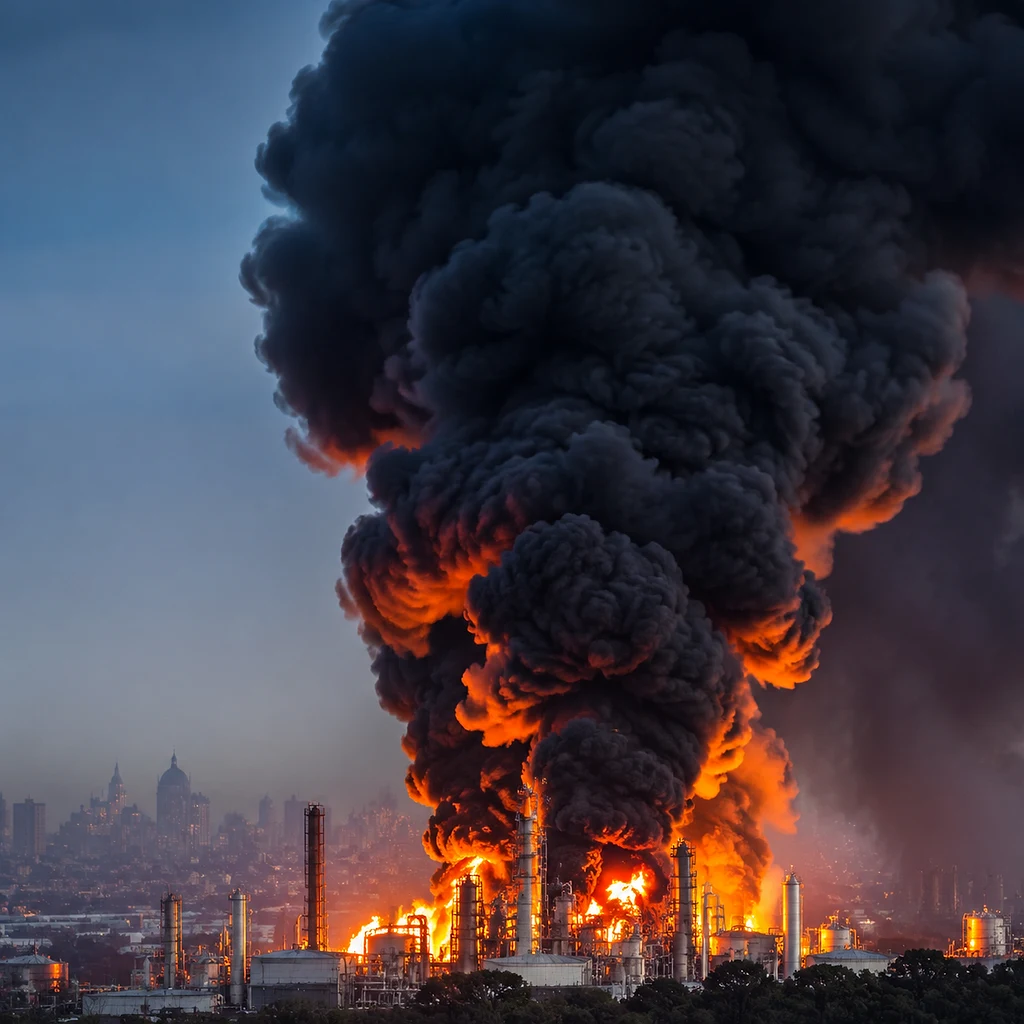
莫斯科的大炼油厂,着火了
Drone Strike Burns Moscow Oil Refinery
About this story
The story of a war reaching a big city: drones from one country flew to another country's capital and set a huge oil factory on fire — why oil matters in war, who got hurt, and how it disrupted ordinary people's day — told slowly in beginner Chinese. HSK 1 Chinese listening practice.
This is an HSK 1 Chinese listening episode that runs about 4 minutes. The full Mandarin script is shown with tap-for-pinyin and a line-by-line English translation, so you can listen and read at once — comprehensible input in the sense of Stephen Krashen's i+1 theory. It teaches 12 key vocabulary words such as 飞机、我们、他们 and walks through 7 grammar patterns, each explained in English with examples. The same news story is retold at 4 difficulty levels — use the level selector above to find the version that is challenging but still understandable for you.
Read at your level
原文Read the complete story in Chinese. Reveal pinyin and English only when you need them.
English transcript reference
Today we'll talk about a big event.
This thing happened in a faraway place.
Not in China.
In a place very, very far away.
There, there are two countries.
These two countries are at war.
What is being 'at war'?
Being at war is when two countries fight.
You hit me, I hit you.
War is a very bad thing.
When there's war,
many people die.
And many people
lose their homes.
These two countries
have fought for one year.
Fought for two years.
Fought for many, many years.
They've fought until today,
and they're still fighting.
Back and forth they fight,
and the people on both sides
are all in a bad way.
Today's event
happened this very week.
Let's first talk about
one of the two countries.
Just one.
This country is very big.
Its name
is Russia.
Russia has a big city.
This city is called Moscow.
Moscow is very important.
It's Russia's biggest city.
Just this week,
in the sky over Moscow,
many little planes arrived.
These little planes
have no one on board.
We call them drones.
These drones
were sent over by another country.
That country is called Ukraine.
Ukraine is the other country
that's at war with Russia.
These drones
flew to Moscow.
The place they were headed for
was a very big factory.
This factory makes oil.
Cars need oil to run.
Planes need oil to fly.
War needs even more oil.
So this factory is very important.
The drones
flew above the factory,
and then exploded.
The factory caught fire.
The fire was huge.
Black smoke
rose into the sky.
Many people in Moscow,
looking up,
could see it.
Actually,
this factory,
earlier this week,
had already caught fire once.
Today is the second time.
Both times,
it was drones.
This time,
an especially large number of drones came.
More than a hundred.
It was, in these past few years,
the largest such attack.
It wasn't only the factory that caught fire.
In some places,
houses were damaged too.
More than ten people
were injured.
Among them,
there were even two children.
The city's airports
were also closed.
The planes
could not take off.
Many people
couldn't leave,
and couldn't get home.
All they could do
was wait at the airport,
slowly.
And in some places,
there was no more fuel.
People wanting to buy fuel
at the stations
formed long, long lines.
Some people
waited a long time
and still couldn't buy any.
You see,
war
was supposed to be in a faraway place.
Now,
it has come into a big city,
come into ordinary people's
every single day.
Finally, I want to ask you.
If one day,
something like this
happened in the city where you live,
how would you feel?
Listen again
Try it without the transcript and notice what sounds clearer.
What vocabulary does this episode teach?
词汇HSK 2. 小飞机 = little plane; built up to introduce 无人机 (drone).
HSK 1. we; us.
HSK 1. they; them.
HSK 1. what.
HSK 1. today.
HSK 1. time / moment.
Glossed inline: 打仗,就是两个国家,在打 = war is when two countries fight.
那里,有两个国家 = there are two countries there. The whole story is about two countries.
Proper noun. 它的名字,叫俄罗斯 = its name is Russia.
俄罗斯,最大的城市 = Russia's biggest city. The city that was attacked.
HSK 3. 俄罗斯,有一个大城市 = Russia has a big city.
Glossed inline: 上面没有人,我们叫它,无人机 = it has no one on board, we call it a drone. 无人 = without people.
* beyond level超纲词
What grammar patterns appear in this episode?
语法要 + Verb (need to / must)
Expresses need or necessity.
车要走,要用油。
飞机要飞,也要用油。
Verb + 不了 (unable to)
Potential complement: cannot do the action.
飞机,都飞不了。
走不了,也回不了家。
然后就 + Verb (and then...)
Sequences events: then, right away.
飞到工厂的上面,然后就炸了。
A 是 B 最 + Adj 的 (A is the most Adj B)
Superlative.
它是俄罗斯,最大的城市。
是这几年里,最多的一次。
不只是 X (not only X)
Adds that there is more beyond X.
着火的,不只是工厂。
本来 ... 现在 ... (originally ... now ...)
Contrasts a past state with a changed present.
打仗,本来在很远的地方。现在,它来到了大城市。
如果 ... ,你会 ... ? (if ... , would you ...?)
Hypothetical question, used in the reflective close.
如果有一天,这样的事,发生在你住的城市,你会是什么感觉?
Proper nouns
专有名词Free account
Keep learning from this story
Create a free account to keep saved words and your preferred level together.
- Keep words with their story context
- Remember your preferred level
- Build your vocabulary over time