
A Chinese podcast · Same story, 4 levels
莫斯科的天,黑了:一座大工厂,为什么会着火?
Drone Strike Burns Moscow Oil Refinery
About this story
Ukraine's June 2026 drone attack on Moscow explained simply: ~200 drones, an oil refinery ablaze, why armies depend on fuel, the wounded and shut airports, and the president's vow that 'Moscow will burn too.'. HSK 2 Chinese listening practice.
This is an HSK 2 Chinese listening episode that runs about 4 minutes. The full Mandarin script is shown with tap-for-pinyin and a line-by-line English translation, so you can listen and read at once — comprehensible input in the sense of Stephen Krashen's i+1 theory. It teaches 14 key vocabulary words such as 机场、为什么、问题 and walks through 7 grammar patterns, each explained in English with examples. The same news story is retold at 4 difficulty levels — use the level selector above to find the version that is challenging but still understandable for you.
Read at your level
原文Read the complete story in Chinese. Reveal pinyin and English only when you need them.
English transcript reference
Today we'll talk about a big event.
This thing has to do with war.
You probably know
there are two countries
that have been fighting for several years.
One is called Russia.
The other is called Ukraine.
What we're talking about today
is something that just happened this week.
Just this week,
Ukraine,
toward Russia's capital,
Moscow,
launched a great many drones.
What is a drone?
It's a little plane that flies in the sky.
But there's no one on board.
A person, far away,
can make it fly.
This time,
an especially large number of drones came.
Russia said
there were nearly two hundred.
This was, in several years,
the hardest Moscow has been hit.
the worst single time.
These drones,
their main target,
was a big factory.
This factory
specially makes oil.
We call it an oil refinery.
In fact,
just within this one week,
this refinery
has already been hit twice.
Today's strike
is the second time.
You could say
Ukraine has
set its sights on it.
You might ask:
in a war, why attack a factory?
The reason is simple.
War uses a lot of oil.
Cars need oil,
planes need oil too.
The army's vehicles,
the army's planes,
all of them can't do without oil.
An oil refinery
is the place that makes this oil.
So,
what Ukraine is thinking is:
if I knock out your oil,
it'll be harder for you to fight.
That morning,
the drones flew to the refinery,
and then blew it open.
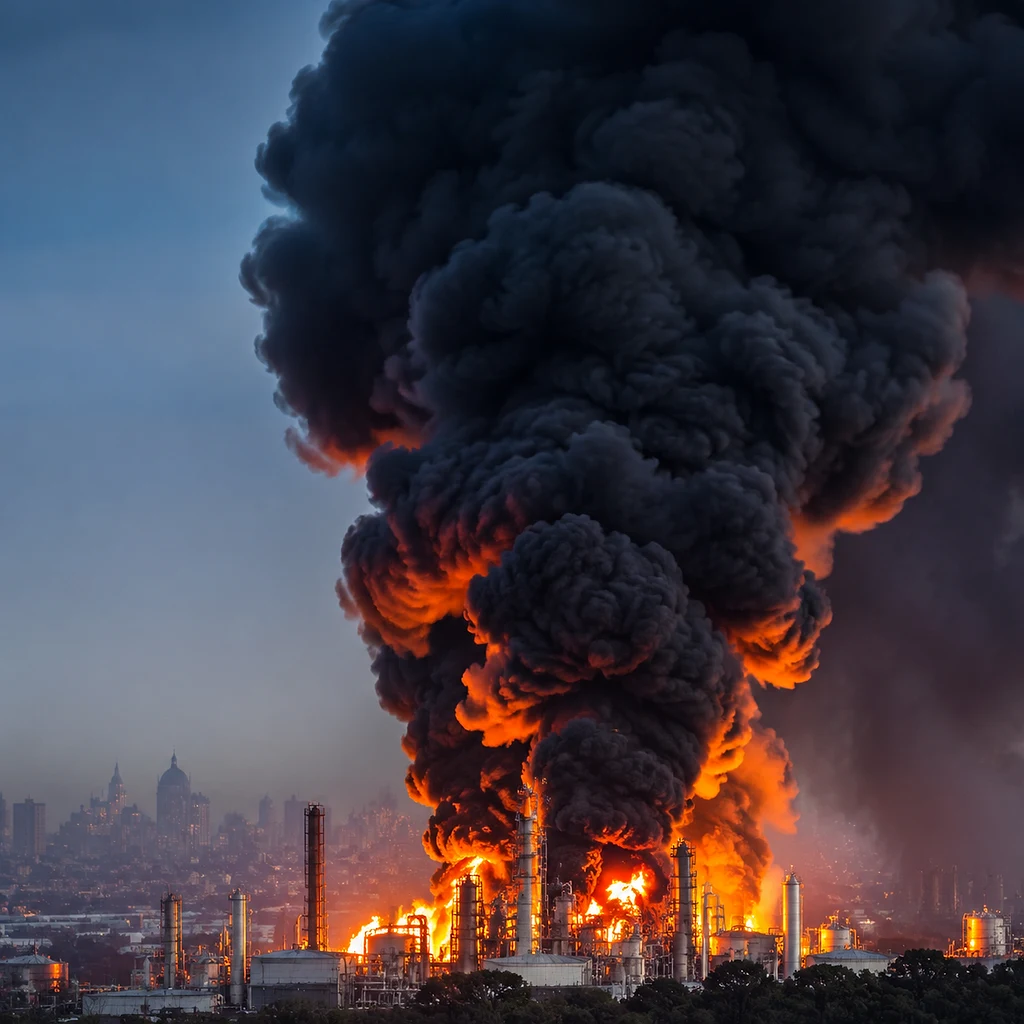
Inside the factory,
several fires broke out at once.
Thick black smoke
drifted up into the sky.
Many people in Moscow,
looking up, could see it.
Some people said
things even fell from the sky,
like black rain.
What caught fire
was not only the factory.
Some houses
were damaged too.
A total of seventeen people
were injured.
Among them,
there were even two children.
On this day,
Moscow was thrown into chaos.
Several of the city's airports
stopped letting planes take off.
Many people
were stuck at the airports,
unable to get home.
And in some places,
fuel started running short;
people wanting to buy it
couldn't get any at all.
Ukraine, which did this,
also spoke up.
Their president said something very heavy.
He said:
if Ukraine is to burn,
then Moscow will burn too.
Meaning:
you hit me, and I will hit you back.
Speaking of this,
I'd like to talk with you for a moment.
This war
has gone on for several years now.
In the past,
it seemed far away from us.
But this time,
it burned into the heart of a big city,
burned into ordinary people's
every single day.
Finally, I want to ask you a question.
When war
is no longer just two words in the news,
but is really
the black smoke drifting over your head,
what will you think?
Listen again
Try it without the transcript and notice what sounds clearer.
What vocabulary does this episode teach?
词汇城市里的好几个飞机场 / 被困在了机场 = several of the city's airports; stuck at the airport.
HSK 1-2. why.
HSK 1-2. problem / question.
HSK 1-2. meaning / interest.
HSK 1-2. news.
HSK 1-2. morning.
HSK 1-2. place.
有两个国家,已经打了好几年了 = two countries that have fought for several years.
向俄罗斯的首都,莫斯科 = toward Russia's capital, Moscow.
Glossed inline: 天上飞的小飞机,但是它上面,没有人 = a little plane in the sky, but with no one on board.
Glossed inline: 是专门做油的,我们叫它,炼油厂 = the place that specially makes oil — the refinery.
无人机最主要的目标 = the drones' main target.
军队的车,军队的飞机,全都离不开油 = the army's vehicles and planes all depend on oil.
全都离不开油 = none of them can do without oil.
* beyond level超纲词
What grammar patterns appear in this episode?
语法已经 ... 了 (already...)
Marks a completed or ongoing-up-to-now state.
已经打了好几年了。
已经被打了两次。
被 + Verb (passive)
Marks the subject as the receiver of the action.
莫斯科被打得,最厉害的一次。
如果乌克兰会被烧。
Verb + 得 + 最 + Adj (degree complement)
Describes how something is done to the highest degree.
莫斯科被打得,最厉害的一次。
全都 / 全 + Verb (all, without exception)
Emphasizes totality.
军队的车,军队的飞机,全都离不开油。
为什么 ... ?原因很简单 (why...? the reason is simple)
Rhetorical question answered plainly — a host device.
打仗,为什么要打工厂?原因很简单。
不再是 X,而是 Y (no longer X, but Y)
Reframes from abstract to concrete — the reflective close.
当打仗,不再是新闻里的两个字,而是真的,飘到了你头顶的黑烟。
如果 ... ,那 ... (if ... , then ...)
Conditional.
如果乌克兰会被烧,那莫斯科,也会被烧。
Proper Nouns
专有名词Free account
Keep learning from this story
Create a free account to keep saved words and your preferred level together.
- Keep words with their story context
- Remember your preferred level
- Build your vocabulary over time