
A Chinese podcast · Same story, 4 levels
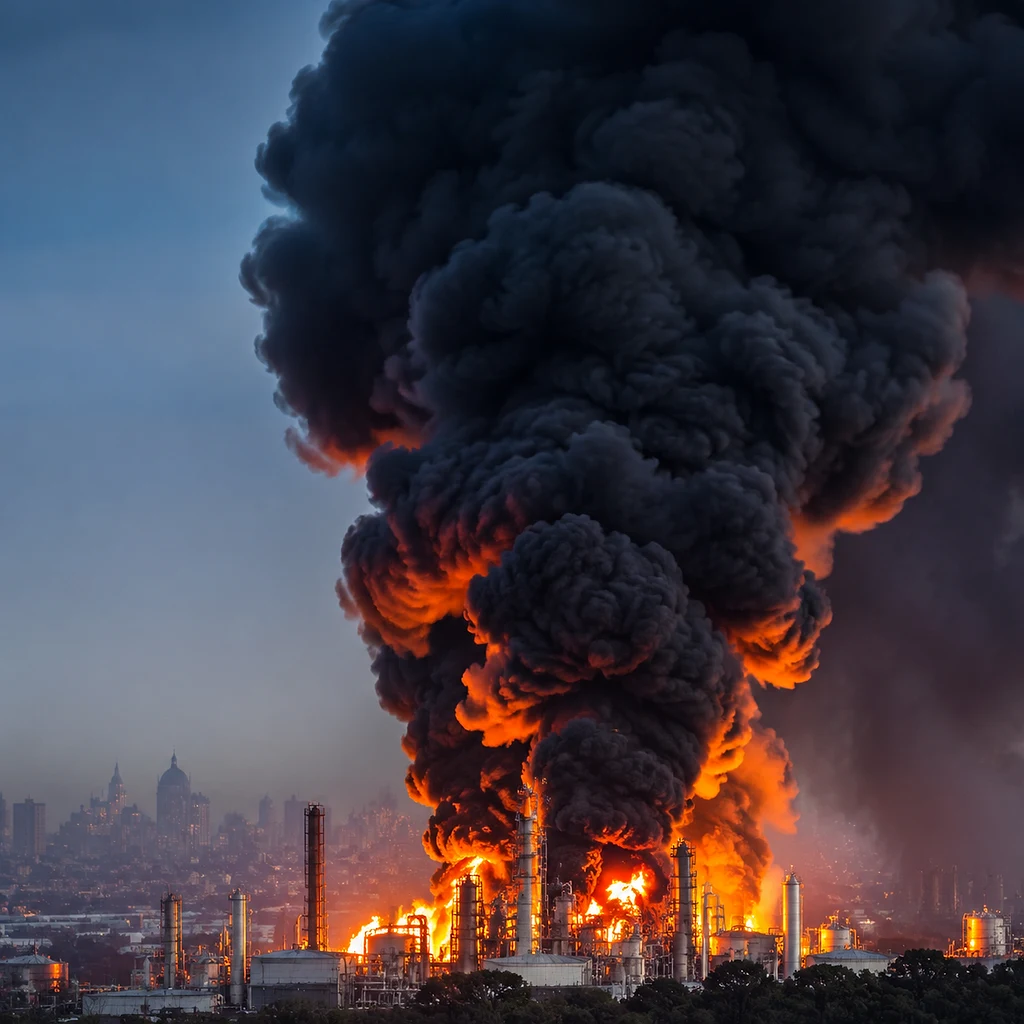
黑烟笼罩克里姆林宫上空:当无人机把战火,烧进莫斯科的心脏
Drone Strike Burns Moscow Oil Refinery
About this story
Advanced Chinese listening practice. The full story of Ukraine's largest drone attack on Moscow (June 18 2026): nearly 200 drones intercepted, the Kapotnya refinery ablaze for the second time in a week, the attrition logic of striking energy, 17 wounded, shut airports, fuel shortages, Zelensky's 'an eye for an eye' vow — and a meditation on who truly bears the cost when war burns into a great city, whether Kyiv or Moscow. HSK 5-6 Chinese listening practice.
This is an HSK 5-6 Chinese listening episode that runs about 5 minutes. The full Mandarin script is shown with tap-for-pinyin and a line-by-line English translation, so you can listen and read at once — comprehensible input in the sense of Stephen Krashen's i+1 theory. It teaches 14 key vocabulary words such as 工厂、工业、数字 and walks through 7 grammar patterns, each explained in English with examples. The same news story is retold at 4 difficulty levels — use the level selector above to find the version that is challenging but still understandable for you.
Read at your level
原文Read the complete story in Chinese. Reveal pinyin and English only when you need them.
English transcript reference
Today we'll talk about something
that is redefining this war.
In the early hours of this Thursday, June 18th,
Russia's capital, Moscow,
woke to a morning
shrouded in black smoke.
Ukraine,
against this city,
launched the largest drone attack
since the war began over four years ago.
Let's first use a number
to feel its weight.
According to the Russian side,
merely on the approach to Moscow,
nearly two hundred drones
were intercepted.
Nearly two hundred.
Which means
the number that actually pierced layer upon layer of air defense
and reached their targets
was far more than that.
And the core target of it all
was, inside the city of Moscow,
a large oil refinery.
It belongs to Russia's state gas-and-oil corporation,
set in Moscow's southeastern outskirts,
in a district called Kapotnya.
It's worth noting
that this was already, within a single week,
the second time this refinery
had come under attack.
That dawn,
drone after drone
dove toward the refinery.
Within the plant,
at least five large fires erupted in an instant,
and dense black smoke
all but blanketed half of Moscow's sky.
In footage circulating from the scene,
after one violent explosion,
the enormous roof of the plant building
was hurled whole into the air by the blast wave.
From the sky,
there even drifted down, mixed with black ash,
a 'black rain'.
Seeing this,
you might ask a question:
with the fires of war dragging on,
why does Ukraine
fixate so doggedly on the refinery?
The answer
lies in fact in war's plainest logic.
Modern war,
fought to its very end,
is a war over energy.
Tanks run on fuel,
warplanes take off on fuel,
the supply trucks stretching hundreds of kilometers
likewise cannot do without oil.
And an oil refinery
is precisely where crude oil
is turned into all this fuel.
So,
Ukraine's strategic aim is very clear:
since it cannot, on the open battlefield,
crush the enemy's vast army,
it turns instead to strike its 'lifeblood' —
energy.
To sever the fuel
is, at the root,
to weaken the enemy's ability to keep fighting.
It is a kind
aimed straight at the foe's 'fuel tank' and 'purse' —
a war of attrition.
Of course,
the price paid for this attack
was by no means only one factory.
According to the Russian side,
this strike
left a total of seventeen people injured,
including two children.
Some residential buildings
were struck and damaged by falling drone debris.
And the order of the whole city
was utterly upended that day.
The many airports around Moscow
urgently imposed controls,
suspending all takeoffs and landings.
One airline alone
cancelled more than a hundred and seventy flights,
with over a hundred more
forced into delay.
Countless travelers
were stranded in the terminals,
unable to return home.
At the same time,
a fuel shortage began in some areas;
queuing to fill up,
even with money you might not manage it.
Ukraine, which launched this attack,
struck an unusually hard posture.
Just hours before the strike,
Ukraine's president
had just held, with the leaders of the US and France,
an important coordination call,
and at this week's G7 summit
had secured further pledges of support.
Afterward,
he delivered a line of immense weight:
if Ukraine is to be burned to ashes,
then your Moscow,
all the same, will burn.
The subtext of that line
is cold and blunt:
an eye for an eye,
fire for fire.
Speaking of this,
I want to talk with you about
a deeper layer of this matter.
This war
has dragged on for over four years.
For those of us far away,
all too often
it is only, recurring in the news,
a somewhat numbing background hum.
But when nearly two hundred drones
swoop toward a nation's capital,
when rolling black smoke
shrouds the skies above the Kremlin,
when ordinary citizens
are stuck at airports, unable to fuel up,
and look up to a sky charred black,
war
is no longer, on a map,
those cold little arrows.
It has become
the explosions and flames that slam, solid and real, into the daily lives of millions,
the blasts, the firelight,
and that one
black rain falling on their heads.
At the end of the show,
I want to leave you
with two questions.
First,
this attrition warfare — striking at energy,
striking at the rear —
will it truly speed a war's end,
or will it only make the hatred
burn longer, and deeper?
Second,
when the fires of war,
again and again,
charge into the heart of a great city,
whether they fall on Kyiv,
or fall on Moscow,
in the end,
who truly bears all of it —
which
ordinary, everyday people?
These two questions
have no standard answer.
But they
are worth thinking about slowly.
Listen again
Try it without the transcript and notice what sounds clearer.
What vocabulary does this episode teach?
词汇HSK 1-4. factory.
HSK 1-4. industry.
HSK 1-4. number, digit.
HSK 1-4. energy / energy source.
HSK 1-4. modern times / modern.
HSK 1-4. standard.
HSK 1-4. scale / scope.
被黑烟笼罩的清晨 / 笼罩在克里姆林宫的上空 = a morning shrouded in black smoke; shrouding the skies over the Kremlin.
六月十八号的凌晨 = the early hours of June 18th.
就有将近两百架无人机,被拦截下来 = nearly 200 drones were intercepted.
穿过层层防空网 = piercing layer upon layer of air defense.
它隶属于俄罗斯天然气工业石油公司 = it belongs to Russia's state gas-and-oil corporation.
无人机一架接一架,俯冲向炼油厂 = drone after drone dove toward the refinery.
正是把原油,变成这一切燃料的地方 = precisely where crude oil is turned into all this fuel.
* beyond level超纲词
What grammar patterns appear in this episode?
语法正在 + Verb (in the middle of...)
Marks an ongoing, unfolding process.
正在重新定义这场战争的事。
仅仅是 ... ,就 ... (merely ..., already ...)
Stresses that even a limited scope yields a striking figure.
仅仅是在飞向莫斯科的途中,就有将近两百架无人机,被拦截下来。
既然 ... ,那就 ... (since ..., then ...)
Draws a consequence from an established premise.
既然无法在正面战场上,击溃对方庞大的军队,那就转而去打它的'血液'。
当 ... ,当 ... ,... 便不再是 ... (when..., when..., X is no longer...)
Stacked conditionals building to a reframing — the rhetorical core.
当将近两百架无人机,扑向一国之都,当滚滚黑烟,笼罩在克里姆林宫的上空,战争,便不再是地图上,那一个个冰冷的箭头。
无论 X,还是 Y,... (whether X or Y, ...)
Asserts something holds across alternatives.
无论它落在基辅,还是落在莫斯科,最终,真正承受这一切的,又是哪些,普普通通的人?
绝不只是 / 远不止 ... (by no means only / far more than)
Emphatic negation that the truth exceeds the stated figure.
绝不只是一座工厂。
还远不止这个数字。
这两个问题,没有标准答案。但是它们,值得你慢慢地想。
The channel's signature normal-level close.
这两个问题,没有标准答案。但是它们,值得你慢慢地想。
Proper nouns
专有名词Free account
Keep learning from this story
Create a free account to keep saved words and your preferred level together.
- Keep words with their story context
- Remember your preferred level
- Build your vocabulary over time