
A Chinese podcast · Same story, 4 levels
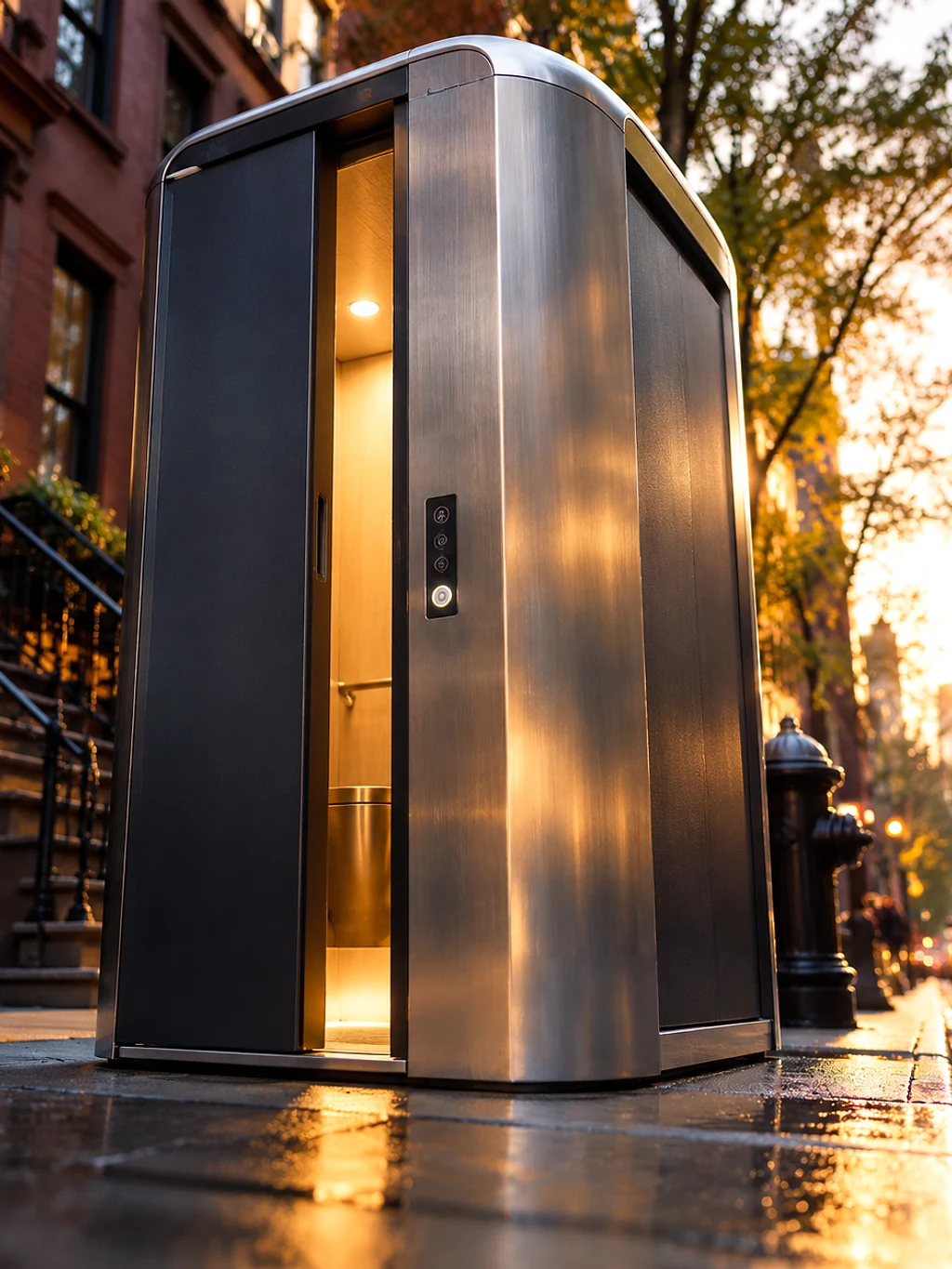
纽约街头的免费机器人厕所:十分钟一到,门自己打开,不管你好了没有
New York Put Free Toilets on the Street, and the Door Slides Open by Itself After Exactly Ten Minutes — Finished or Not
About this story
New York City has roughly 1,000 public toilets for more than eight million residents, and issued over 10,000 public-urination summonses last year. In September 2026 it put the first of a new kind on the sidewalk: free, unlocked by a text message or a tap card, and hard-capped at ten minutes, after which the door slides open on its own. Two are live in Brooklyn and Queens; seventeen more are coming on a $4 million pilot. Chinese listening practice at four levels. HSK 5-6 Chinese listening practice.
This is an HSK 5-6 Chinese listening episode that runs about 4 minutes. The full Mandarin script is shown with tap-for-pinyin and a line-by-line English translation, so you can listen and read at once — comprehensible input in the sense of Stephen Krashen's i+1 theory. It teaches 12 key vocabulary words such as 限制、成本、政府 and walks through 3 grammar patterns, each explained in English with examples. The same news story is retold at 4 difficulty levels — use the level selector above to find the version that is challenging but still understandable for you.
Read at your level
原文Read the complete story in Chinese. Reveal pinyin and English only when you need them.
English transcript reference
A city of more than eight million permanent residents has roughly a thousand public toilets.
This has been New York's reality for a long time.
Count in the people who come into the city every day to work, study and sightsee, and the ratio looks worse still.
The consequences can be quantified.
Last year alone, New York issued more than ten thousand tickets for public urination.
Enforcement treats it as individual bad behaviour, but the sheer order of magnitude — over ten thousand — says this looks far more like a gap in public infrastructure.
This September, the city set down its first batch of answers on the street.
They are free-standing modular toilets, attached to no building, placed directly on the sidewalk.
Two went into service first, one in Brooklyn and one in Queens.
Under the plan, seventeen more will follow.
The pilot's budget is four million dollars.
The three most visible design choices in these toilets happen also to be three positions.
The first position is that it is completely free.
In a city where using a toilet often means buying a coffee first, that alone is a stance.
The second position shows up in how the door opens.
It is normally locked; you have to text a designated number from your phone before it will open.
That design exists to stop the unit from being occupied indefinitely or destroyed.
Since not everyone has a phone, the city also prepared tap cards, distributed through community organisations, which open the door the same way.
The third position, and the one drawing the most discussion, is that use is capped strictly at ten minutes.
As ten minutes approaches, the speaker inside gives one warning.
The moment the time is up, the speaker plays the same sentence in English and in Spanish: your use time has ended, the door is about to open.
Then the door slides open automatically.
Whether the user has finished, the system does not know, and will not ask.
If someone refuses to leave, the operator receives an alert and can notify police if necessary.
The rule sounds cold, but behind it is a very plain piece of arithmetic.
When the number of units is severely limited, how long one user occupies one of them decides directly whether anyone else gets to use it.
One person inside for an hour means that for everyone further back in the queue, this toilet effectively does not exist.
Ten minutes is the line New York has drawn between individual dignity and collective access.
Wherever that line goes it is guaranteed to satisfy nobody completely, but it has to be drawn somewhere.
Introducing the project, the mayor said too many New Yorkers know the feeling: you are already out on the street, and there is nowhere you can go.
Pull back a little and the significance gets clearer.
For the past several decades, many American cities went in exactly the opposite direction.
Out of maintenance cost, safety worries and liability risk, public toilets were closed, demolished and locked one by one.
The result is that the city quietly outsourced a basic human need to private businesses: whether you can use a toilet depends on whether you can afford to buy something.
What New York is doing now is trying to push that default back the other way.
And the price of pushing it back is precisely that ten-minute rule — it is what allows the system to keep functioning in a reality of many people and few units.
Free, no barrier to entry, but time-limited.
Only when all three of those hold at once do you have the whole of what it means.
Now put yourself inside it.
You are in there, the speaker begins its announcement, and the door has already started sliding aside.
Those ten minutes — how do you plan to use them?
Listen again
Try it without the transcript and notice what sounds clearer.
What vocabulary does this episode teach?
词汇HSK 4. 使用时间被严格限制在十分钟 — passive, because the user has no say in it.
HSK 4. 出于维护成本 — one of the three reasons American cities closed toilets for forty years.
HSK 4. 市政府还准备了感应卡 — the tap card is a deliberate accessibility decision, not an afterthought.
HSK 3. 按照计划,后续还会陆续投放十七个。
HSK 3. 必要时可以通知警方 — where a free public amenity meets enforcement.
HSK 3. 结果是城市默认把这项基本需求外包给了私人商铺。
独立的模块化厕所,不依附任何建筑 — it can be dropped anywhere, which is why it exists at all.
扬声器会用英语和西班牙语各播报一遍同一句话 — two languages, because this is New York.
在个体的体面和整体的可及性之间划下的那条线 — the ten minutes is where the two meet.
把这项基本需求外包给了私人商铺 — the single sharpest word in the episode.
这一点本身就是一种立场 — in a city where a toilet costs a coffee, free is an argument.
被一间接一间地关掉、拆除、上锁 — three verbs describing forty years of policy.
* beyond level超纲词
What grammar patterns appear in this episode?
语法在 A 和 B 之间划下的那条线
The line drawn between A and B. A precise way to describe a policy number as a compromise rather than a fact.
十分钟,是纽约市在个体的体面和整体的可及性之间划下的那条线。
出于……
Out of, motivated by. Takes an abstract noun and attributes an institutional decision to it — the standard register for explaining policy.
出于维护成本、治安顾虑和责任风险,公共厕所被一间接一间地关掉。
……,才构成了它的全部意思
Only then does it amount to the whole of what it means. Used to insist that several conditions must hold simultaneously, not separately.
这三件事同时成立,才构成了它的全部意思。
Proper nouns
专有名词Free account
Keep learning from this story
Create a free account to keep saved words and your preferred level together.
- Keep words with their story context
- Remember your preferred level
- Build your vocabulary over time