
A Chinese podcast · Same story, 4 levels
一百一十七美元买到了毕加索
Ari Hodara Wins Picasso in €100 Raffle
About this story
Ari Hodara spent 117 dollars on a Paris raffle ticket and won a real Picasso painting worth a lot of money. HSK 2 Chinese listening practice.
This is an HSK 2 Chinese listening episode that runs about 6 minutes. The full Mandarin script is shown with tap-for-pinyin and a line-by-line English translation, so you can listen and read at once — comprehensible input in the sense of Stephen Krashen's i+1 theory. It teaches 12 key vocabulary words such as 抽奖、运气、有意思 and walks through 3 grammar patterns, each explained in English with examples. The same news story is retold at 4 difficulty levels — use the level selector above to find the version that is challenging but still understandable for you.
Read at your level
原文Read the complete story in Chinese. Reveal pinyin and English only when you need them.
English transcript reference
Speaking of lucky stories, there's a piece of news recently that's especially heartwarming.
A Frenchman spent one hundred and seventeen dollars.
And won an original Picasso painting worth one million dollars.
You heard right.
One hundred and seventeen dollars.
Won one million.
Let's talk about this story.
This person's name is Ari Hodara.
Fifty-eight years old.
Lives in Paris.
He's an engineer.
Works in sales.
He's not some big figure in the art world.
He's just an ordinary person who likes looking at paintings.
One day he was eating at a restaurant in Paris.
While eating, he happened to see a piece of news.
About a charity raffle event.
What does that mean?
You buy a 100-euro ticket.
Then you have a chance to win a Picasso painting.
All the raffle money goes to Alzheimer's research.
Alzheimer's is dementia.
A disease that slowly makes people lose their memory.
Ari thought this was very interesting.
100 euros isn't that much.
And the money goes to a good cause.
Even if you don't win, you don't lose.
So he bought one ticket.
There were 120,000 tickets total.
They all sold out.
Earning 12 million euros.
About 14 million dollars.
All the money goes to research.
The raffle was held at Christie's auction house.
Christie's is one of the most famous auction houses in the world.
The kind of place that sells paintings and antiques for millions and tens of millions.
Holding the raffle there made the whole thing feel more ceremonial.
Then they drew one ticket from 120,000.
Who won?
Ari Hodara.
When he got the phone call he couldn't believe it.
He spent one hundred euros.
About one hundred and seventeen dollars.
And won a Picasso worth one million dollars.
What's this painting called?
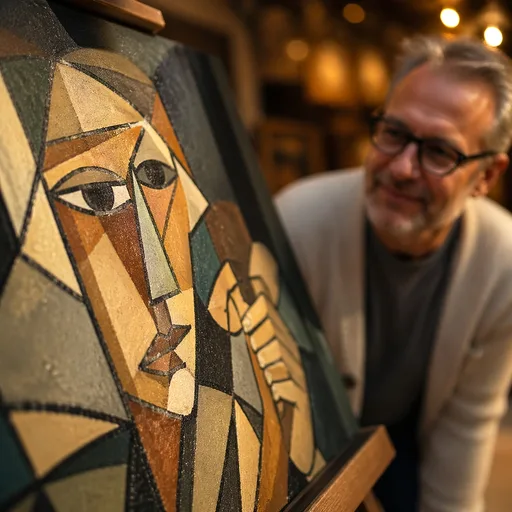
It's called "Head of a Woman."
In French, "Tête de femme."
Picasso painted it in 1941.
It's a portrait of a woman called Dora Maar.
Dora Maar was Picasso's partner and inspiration.
She herself was also a very famous artist and photographer.
Picasso painted her many times.
This "Head of a Woman" is one of them.
1941.
That was during World War II.
Picasso painted this in occupied Paris.
Over eighty years have passed.
This painting is now worth one million dollars.
And Ari got it for one hundred and seventeen dollars.
Ari says he's an "amateur art enthusiast."
He likes Picasso.
But he never imagined he could own a Picasso.
Because Picasso's paintings are too expensive.
Ordinary people simply can't afford them.
But this raffle gave ordinary people a chance.
One hundred dollars.
Anyone can afford it.
One ticket.
Could change everything.
This is the most beautiful thing about this story.
It's not a story about rich people.
It's a story about ordinary people.
A person who happened to see the news while eating at a restaurant.
He bought a ticket.
Then won a Picasso.
The probability of this happening is one in 120,000.
But it happened.
It happened to the most ordinary person.
Sometimes luck is just like this.
It's not only rich people who can have beautiful things.
Sometimes one hundred dollars is enough.
By the way, there's another interesting thing.
The woman in this painting.
Her name is Dora Maar.
She was Picasso's partner.
But she wasn't just Picasso's girlfriend.
She was also a very famous artist herself.
She was a photographer.
She took many amazing photos.
Picasso painted her many times.
This "Head of a Woman" is one of them.
It was painted in 1941.
That year was World War II.
Paris was occupied by Germany.
Picasso painted this in occupied Paris.
Over eighty years later.
An engineer eating at a restaurant.
Spent one hundred dollars.
And got it.
Would you call this luck or destiny?
Whatever it is.
This is a beautiful story.
Also, one more thing.
All the raffle money goes to Alzheimer's research.
Fourteen million dollars.
That's a lot of money.
It can help many scientists do research.
Maybe one day.
Because of this money.
Scientists will find a way to treat Alzheimer's.
When that happens.
One hundred dollars will change not just one person's life.
But millions of people's lives.
Listen again
Try it without the transcript and notice what sounds clearer.
What vocabulary does this episode teach?
词汇An event where tickets are drawn randomly to determine a winner.
Good fortune that happens by chance.
HSK 1-2. interesting.
HSK 1-2. woman.
HSK 1-2. meaning / interest.
HSK 1-2. matter/thing.
One of the most famous painters in history. Spanish, 1881-1973.
A genuine artwork painted by the artist themselves.
A company that sells valuable items through bidding.
Giving money or help to those in need.
A brain disease that causes memory loss.
A person who collects valuable items.
* beyond level超纲词
What grammar patterns appear in this episode?
语法Proper nouns
专有名词Sources
来源Free account
Keep learning from this story
Create a free account to keep saved words and your preferred level together.
- Keep words with their story context
- Remember your preferred level
- Build your vocabulary over time