
A Chinese podcast · Same story, 4 levels
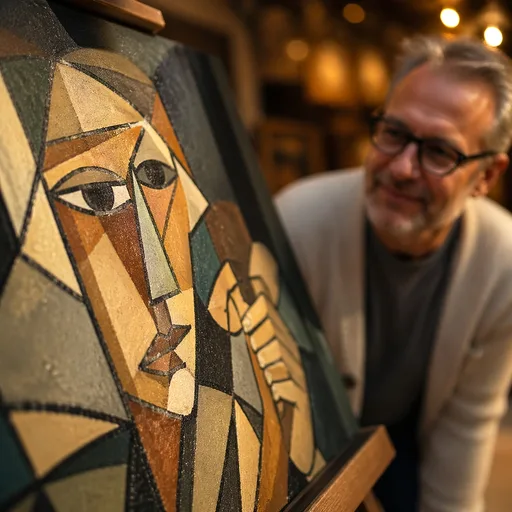
一百欧元、一幅毕加索、和偶然性的美学
Ari Hodara Wins Picasso in €100 Raffle
About this story
Ari Hodara wins a Picasso portrait of Dora Maar in a Paris raffle — 100 euros, 1-in-120,000 odds, Christie's appraisal pending. HSK 5-6 Chinese listening practice.
This is an HSK 5-6 Chinese listening episode that runs about 7 minutes. The full Mandarin script is shown with tap-for-pinyin and a line-by-line English translation, so you can listen and read at once — comprehensible input in the sense of Stephen Krashen's i+1 theory. It teaches 12 key vocabulary words such as 抽奖、运气、市场 and walks through 3 grammar patterns, each explained in English with examples. The same news story is retold at 4 difficulty levels — use the level selector above to find the version that is challenging but still understandable for you.
Read at your level
原文Read the complete story in Chinese. Reveal pinyin and English only when you need them.
English transcript reference
When it comes to good luck, most stories are about lottery winners.
But this story is a little different.
A Parisian sales engineer spent 100 euros on a charity raffle ticket.
Then he won an original Picasso painting worth one million dollars.
Not a reproduction.
Not a print.
An original painted by Picasso's own hands.
This kind of thing sounds like fiction.
But it actually happened.
Just this month.
The protagonist is Ari Hodara, 58 years old, Parisian.
His profession is sales engineer.
He's not a collector.
Not a gallery owner.
Not a hedge fund partner.
He's just an ordinary middle-class person who likes visiting museums and has some interest in Picasso.
How did he find out about this event?
He happened to see it while eating at a restaurant in Paris.
Just like you might happen to see an ad while scrolling your phone.
No dramatic prelude.
The event was called "Win a Picasso for 100 Euros."
Organized by a platform called Auctioneer.
All proceeds go to funding scientific research on Alzheimer's disease.
A total of 120,000 tickets were issued.
100 euros each.
All sold out.
Raising a total of 12 million euros.
About 14 million US dollars.
All of this money goes into the research fund.
This is why I say this story is positive from beginning to end.
Money goes to curing disease.
One person got something beautiful.
Nobody lost.
Except the 119,999 people whose luck wasn't chosen.
But they didn't really lose either.
Their money went to a good place.
The raffle was held at Christie's.
Christie's is one of the world's most prestigious auction houses.
Being announced as the winner at Christie's.
That experience alone is probably worth 100 euros.
One ticket drawn from 120,000.
Ari Hodara.
He says when he got the call he absolutely couldn't believe it.
He says he just happened to see it while eating.
Thought 100 euros wasn't expensive.
It's for a good cause anyway.
So he casually bought one.
This feeling of "a casual decision changing everything."
Is the most charming part of this story.
Now let's talk about the painting.
It's called "Head of a Woman."
In French, Tête de femme.
Picasso painted it in 1941.
The subject is Dora Maar.
Dora Maar was one of Picasso's most important partners from the late 1930s to mid-1940s.
She herself was also an extremely talented photographer and artist.
One of her most famous works is a surrealist photograph created using darkroom techniques.
Picasso painted numerous portraits of her.
Among the most famous is "The Weeping Woman."
This "Head of a Woman" isn't as famous as "The Weeping Woman."
But it's still an original Picasso.
1941.
This year alone carries enormous historical weight.
That year Paris was under Nazi German occupation.
Picasso refused to leave Paris.
He continued creating in the occupied city.
His studio was searched by the Gestapo.
Someone asked him "Did you paint Guernica?"
He replied "No, you did."
Works painted in that environment.
Every brushstroke carries a special kind of power.
And now.
Eighty-five years later.
This painting, because of a charity raffle.
Ended up in the hands of an engineer who happened to tap his screen while eating at a restaurant.
This is art's journey.
After it leaves the creator's hands.
Through galleries, collectors, auction houses, war, and peace.
It finally lands somewhere you could never predict.
Looking at this story from a bigger perspective.
It touches on an interesting topic.
The accessibility of art.
Picasso's paintings typically cost millions to tens of millions on the market.
In 2015, "The Women of Algiers" sold for 179 million.
This means Picasso's works in practice belong only to the world's wealthiest 0.001 percent.
The most ordinary people can do is visit a museum.
Behind a rope.
Take a look.
Then walk away.
This raffle did something special.
It lowered the threshold of "owning a Picasso" from millions of dollars to 100 euros.
Of course, one in 120,000 odds means most people won't win.
But what matters is that this mechanism exists.
It makes ordinary people feel "this is relevant to me."
Rather than "this could never be relevant to me."
This psychological shortening of distance is meaningful.
Ari Hodara didn't need to become a billionaire.
He just needed to be at an ordinary restaurant.
On an ordinary weekend.
Spend 100 euros.
And then a portrait painted in occupied Paris eighty-five years ago.
Appeared in his living room.
Honestly, in a news cycle of daily war, inflation, layoffs, and extreme weather.
A story about "an ordinary person winning a Picasso for 100 bucks."
Sounds like it came from a parallel universe.
It has no lesson.
No warning.
No "but."
It's just a purely good story.
Sometimes we need stories like this.
Not because they're important.
But because they're beautiful.
And two more details related to this story.
First, about Dora Maar herself.
She wasn't just "Picasso's woman."
She was an independent, extremely talented artist.
Before meeting Picasso she already had her own reputation in Paris's Surrealist circles.
Her most famous photographic works used darkroom techniques to create unsettling surrealist images.
The years Picasso spent with her were his most creatively prolific period.
"Guernica" was painted during that time.
And Dora Maar documented the creation of "Guernica" with her camera.
Those photographs themselves became important documents in art history.
But in mainstream narratives she is often reduced to "Picasso's muse."
This "Head of a Woman" is a portrait of her face.
But her story is far richer than a single face.
Second, about this type of charity raffle itself.
This isn't the first time.
There have been similar events before.
Using a high-value artwork as the prize.
Using low-priced tickets to attract massive participation.
The money raised far exceeds the prize's value.
This is a very clever charity model.
It leverages people's desire for "the impossible possibility."
100 euros is pocket change for most people.
But the magic of those three words "what if" is enormous.
120,000 "what ifs" added together.
Equals 14 million dollars in research funding.
One painting changed one person's collection.
120,000 tickets changed the research trajectory of a disease.
This is a win-win design.
From Ari's perspective he won a Picasso.
From patients' perspective they won research funding.
From the whole story's perspective.
Nobody lost.
This is too rare in today's news.
Listen again
Try it without the transcript and notice what sounds clearer.
What vocabulary does this episode teach?
词汇An event where tickets are drawn randomly to determine a winner.
Good fortune that happens by chance.
HSK 1-4. market.
HSK 1-4. price.
HSK 1-4. income.
HSK 1-4. a work (of art/media).
One of the most famous painters in history. Spanish, 1881-1973.
A genuine artwork painted by the artist themselves.
A company that sells valuable items through bidding.
Giving money or help to those in need.
A brain disease that causes memory loss.
A person who collects valuable items.
* beyond level超纲词
What grammar patterns appear in this episode?
语法Proper nouns
专有名词Sources
来源Free account
Keep learning from this story
Create a free account to keep saved words and your preferred level together.
- Keep words with their story context
- Remember your preferred level
- Build your vocabulary over time