
A Chinese podcast · Same story, 4 levels
拼豆:一颗一颗的塑料珠子,为什么让年轻人都"上头"了?
Pindou Pixel Beads Hit 37B Xiaohongshu Views
About this story
Pindou pixel beads hook Chinese young adults — Beijing shops sell out, Xiaohongshu posts explode, stress relief drives it. HSK 3 Chinese listening practice.
This is an HSK 3-4 Chinese listening episode that runs about 6 minutes. The full Mandarin script is shown with tap-for-pinyin and a line-by-line English translation, so you can listen and read at once — comprehensible input in the sense of Stephen Krashen's i+1 theory. It teaches 18 key vocabulary words such as 爱好、压力、解压 and walks through 7 grammar patterns, each explained in English with examples. The same news story is retold at 4 difficulty levels — use the level selector above to find the version that is challenging but still understandable for you.
Read at your level
原文Read the complete story in Chinese. Reveal pinyin and English only when you need them.
English transcript reference
Today we're talking about a small thing that's gone very viral in China lately, called pindou.
Hearing the name, you might think: isn't this something kids play with?
That's right — it originally was.
But over the past year, pindou has become one of the favorite "small hobbies" of college students and office workers.
So today we'll talk about — what is pindou?
Why is it so popular?
And what does it tell us about what young people today are thinking?
First, what is pindou?
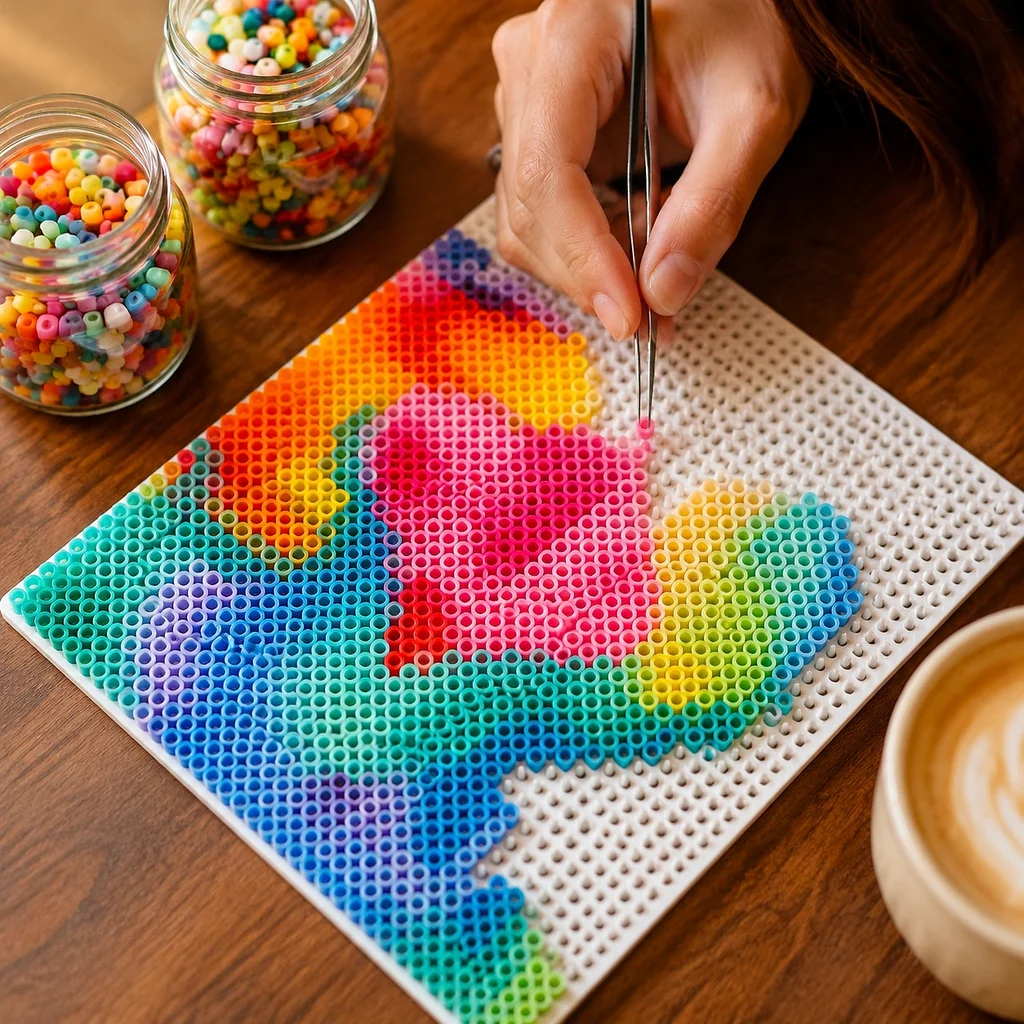
Pindou, simply put, is a bunch of very small plastic beads.
The beads are round, with a hole in the middle, in tons of colors — over a hundred shades.
You take a board, with lots and lots of small holes.
Then, following the picture you have in mind, you place the beads into the holes one by one.
Red here, yellow there, slowly piecing together a pattern.
It could be a cartoon character, a rabbit, or your favorite celebrity's portrait.
After it's done, you take an iron.
The iron is hot — you put it on top of the beads, and the beads stick together into one solid piece.
Then you can take it away, hang it on a backpack, put it on a desk, or give it to a friend.
Sounds simple, right?
But this simple little thing has gone genuinely viral lately.
Let me share a few numbers.
On Xiaohongshu there's a hashtag called "I'm hooked on pindou."
"Hooked" means: started loving it, can't stop.
That hashtag's view count is over thirty billion.
That's right, over thirty billion.
On the other side, on Douyin, related video plays have already topped a hundred and twenty billion.
In 2025, pindou's e-commerce sales in China were nearly nine times the previous year — about a 900% year-on-year jump.
There's a store in Beijing, near Shuangjing, that sold twenty-five thousand sets of pindou in one year.
This year, some predict, China's pindou market will reach 10 billion RMB.
A bit scary, isn't it?
So why is that?
Why is everyone "hooked"?
I think there are three reasons.
The first reason is decompression.
"Decompression" means setting down the pressure in your heart.
Today's young people have heavy work pressure.
Every day they look at their phones, check messages, attend meetings, fill in spreadsheets — their brains are very tired.
But while making pindou, you only need to think about one thing: where to put the next bead?
You don't have to think about your boss, or about housing, or about the future.
Just one bead, then another, placing them one by one — and slowly your heart becomes quiet.
As many people say: "When you're making pindou, the world goes quiet."
So in their eyes, pindou isn't just a craft — it's a kind of "psychological skincare."
The second reason is a sense of achievement.
You spend two or three hours, and at the end you have a real, hand-touchable thing.
This kind of pindou "achievement" is special — unlike video games, where once you turn it off, nothing's left.
After finishing pindou, you can take photos, give it to a friend, or hang it on your bag and look at it every day.
For the brain, that "I finished one thing" feeling is especially nice.
The third reason is socializing.
Pindou isn't a solo thing — many people go to pindou stores.
The stores have big tables, and everyone sits together.
Some make cartoon characters, some make celebrity portraits, some make their own cats.
While making, you slowly start chatting — "Where did you find that pattern?"
"Hey, you made it really well."
Without realizing it, you've made new friends.
And after finishing, you also post it on Xiaohongshu and wait for likes.
So pindou is both one person's quiet, and a group's liveliness.
There's also one thing that's quite interesting.
Why did pindou suddenly explode last year?
It has to do with one celebrity.
At the end of 2024, there was a TV drama called Yongye Xinghe.
The male lead, Ding Yuxi, made a pindou brooch and gave it to the female lead.
That scene was very sweet, and many girls watching were moved.
They started going to craft stores asking, "How do you make the Ding Yuxi version?"
This brought a huge wave of customers to pindou shops.
Owners said: during that time, everyone walking in was asking for the "Ding Yuxi version," and bookings were full.
Today's pindou shops already feel a lot like cafés.
The shops are full of young people.
The tables hold all kinds of colored beads, with coffee or milk tea beside them.
No one talks, but everyone's movements are very focused — eyes on the board, hands picking beads.
This kind of scene, some call it "modern Zen practice."
Meaning: just as the ancients sat to train their minds, today's people use beads to train theirs.
Finally, let's think — what does pindou's popularity tell us?
I think it tells us one thing: today's young people aren't unwilling to do things; they're just exhausted.
They want to do something small.
They don't need a huge goal, don't need to spend a lot of money, don't need to perform for everyone.
But this small thing has to be pretty, quiet, and have a result.
Pindou gives them all those things at once: cheap, pretty, quiet, and at the end, a real object.
You can touch it, photograph it, give it.
So today, walking down the street and seeing a pindou shop with young people inside —
don't think them childish.
Maybe they're doing the most important small thing of their week.
That's one bead after another, and one stretch of quiet time after another.
Maybe we can also try.
Find an afternoon, don't look at your phone, just place beads.
And see what this kind of quiet really feels like.
Listen again
Try it without the transcript and notice what sounds clearer.
What vocabulary does this episode teach?
词汇HSK 4. 一个小爱好 = a small hobby. The episode positions pindou as a 爱好 for adults.
HSK 4. 工作压力大 = work stress is heavy. Modern life's central word.
HSK 5. 解 (loosen) + 压 (pressure). Glossed inline. The most-used word in modern wellness slang.
HSK 4-5. 脑子非常累 = the brain is very tired. Colloquial alternative to 大脑.
HSK 5. The episode argues pindou hits this exactly because it has a clear end.
HSK 6. 社 (society) + 交 (interact). The episode lists 社交 as the third reason pindou wins.
HSK 4. 玩得非常认真 = doing it very seriously. Adults treat pindou like real work.
HSK 5. 一波客人 = a wave of customers. Used here for store traffic.
HSK 6. 胸 (chest) + 针 (pin). 拼豆胸针 — the viral object 丁禹兮 made for the female lead.
HSK 6. 不要觉得他们幼稚 = don't think they're childish. The episode pushes back against this judgment.
HSK 5. 塑料珠子 = plastic beads.
Beyond. The fusing tool that turns beads into a single piece.
HSK 6. 拼出一个图案 = piece together a pattern.
Internet slang. 让人上头 = makes you hooked. The keyword of the title.
HSK 5+. 染上拼豆 = catch the pindou bug. Glossed inline as 开始喜欢,停不下来.
Internet coinage. 心理 (psychological) + 护肤 (skincare). Treating one's mood like skin: small daily care.
HSK 6+. 现代禅修 = modern meditation. Used by the article to give pindou a philosophical frame.
Beyond. 应 (respond) + 援 (support). The fan-merchandise gift culture pindou plugged into.
* beyond level超纲词
What grammar patterns appear in this episode?
语法Corrective: 'not X, but rather Y.' Used to reframe an idea.
他们不是不想做事,他们只是太累了。
拼豆在他们眼里不只是手工,是一种'心理护肤'。
这件小事,要漂亮,要安静,要有结果。
Disposal construction. Frontloads the object.
把珠子一颗一颗放到洞里。
把它放在珠子上面。
拼豆正好把这几样都给了他们。
Proper nouns
专有名词Free account
Keep learning from this story
Create a free account to keep saved words and your preferred level together.
- Keep words with their story context
- Remember your preferred level
- Build your vocabulary over time