
A Chinese podcast · Same story, 4 levels
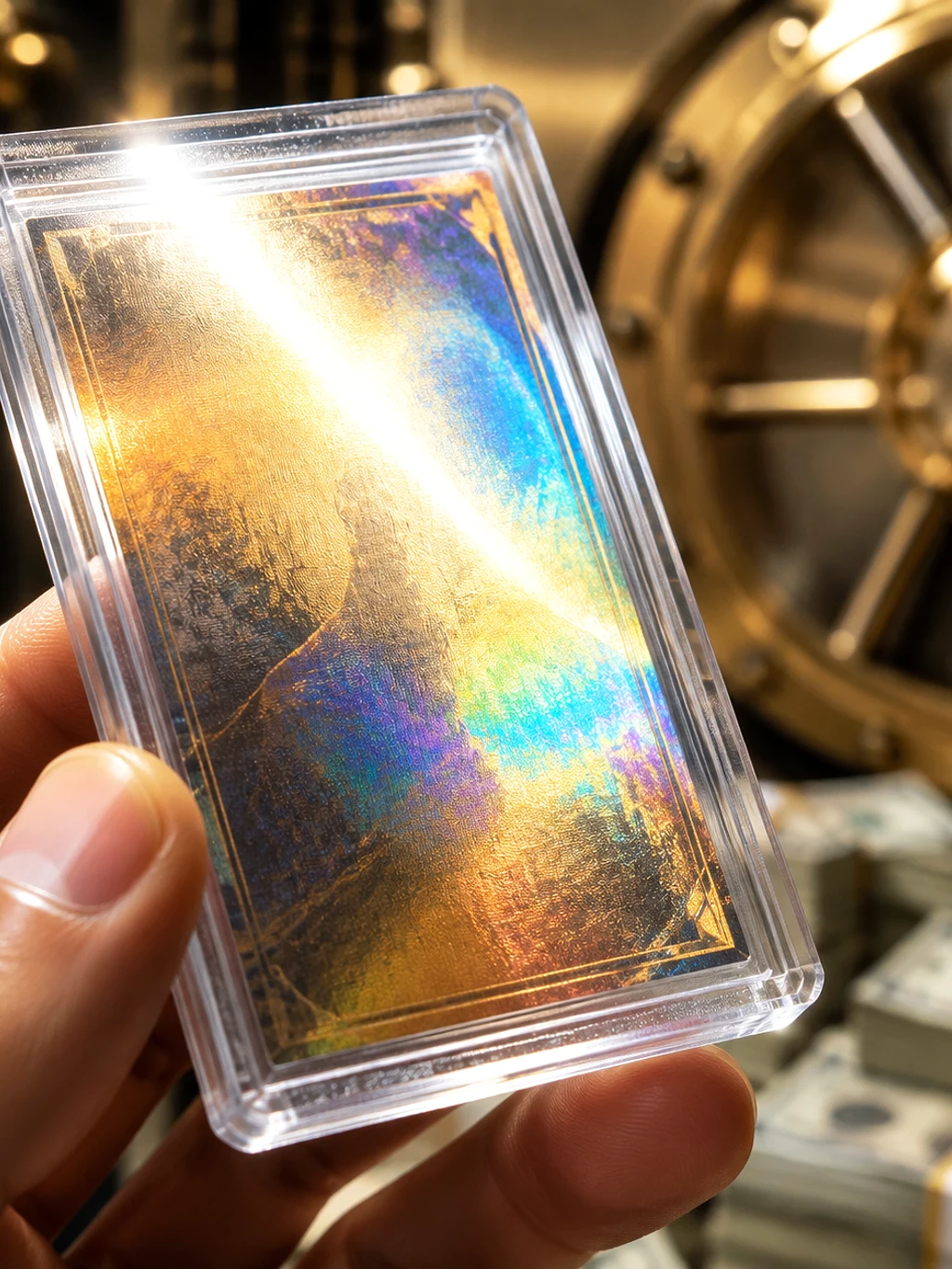
「如果明天世界完了,第二天全球的货币就是宝可梦卡」:一个手握五十万张卡的投资人是认真的,而他说错的地方比说对的地方更有意思
"If the World Ended Tomorrow, the Global Currency Would Be Pokemon Cards": an Investor Holding Half a Million of Them Means It, and Where He Is Wrong Is More Interesting Than Where He Is Right
About this story
A games-fund co-founder who owns well north of half a million Pokemon cards told The Hollywood Reporter that after an apocalypse the global currency would be Pokemon cards. Tested against the three standard conditions for money, his consensus argument is genuinely strong - and the two things wrong with it say more about money than the claim does. Chinese listening practice at four levels. HSK 3 Chinese listening practice.
This is an HSK 3-4 Chinese listening episode that runs about 4 minutes. The full Mandarin script is shown with tap-for-pinyin and a line-by-line English translation, so you can listen and read at once — comprehensible input in the sense of Stephen Krashen's i+1 theory. It teaches 12 key vocabulary words such as 相信、判断、成立 and walks through 3 grammar patterns, each explained in English with examples. The same news story is retold at 4 difficulty levels — use the level selector above to find the version that is challenging but still understandable for you.
Read at your level
原文Read the complete story in Chinese. Reveal pinyin and English only when you need them.
English transcript reference
One sentence travelled widely online last week, said by an investor.
He said: I am completely convinced that if the world were destroyed tomorrow, the day after that the currency used worldwide would be Pokémon cards.
It was passed around tens of thousands of times as a joke.
I want to take it seriously once, because what it asks is a very old question: what makes money money?
The man first.
He runs an investment firm focused on the games industry, and he collects cards himself.
By his own account, he holds "well north of five hundred thousand" Pokémon cards.
Five hundred thousand is not a collection any more. That is a warehouse.
He also cited a figure: these cards have risen three thousand percent more than the American market index.
There is something wrong with that figure, and I will come to it.
First let me take his thinking apart.
To judge whether something can serve as money, you usually look at three things.
The first is scarcity.
Anything you can make as much of as you like cannot be money.
The second is that it must be portable, divisible and not easily destroyed.
The third is that enough people accept it, and believe the next person will accept it too.
The third is fundamental; the first two exist to serve it.
Gold held the role for thousands of years because all three held at once.
Now run Pokémon cards through them.
The first: it holds.
The print run for a rare card is fixed at issue; once printing stops, no more are made.
The second: it holds well.
A card is lighter than gold of the same value by orders of magnitude.
Durability just about holds: paper does not like water, bending or light, but stored properly it lasts decades.
The one that matters is the third.
This is where his argument sits.
The people who play and collect these cards are not in one country.
Japan, North America, Europe, Southeast Asia, Latin America — all of them.
More importantly, there are companies that grade cards, scoring their condition.
With that grade, two people on opposite sides of the world can trade without ever seeing the card itself.
So the same card sells for roughly the same in Tokyo as in Los Angeles.
In other words, it already has a price the whole world agrees on.
Apart from gold, there really are not many things like that.
Up to this point, his argument stands.
What follows is two problems, and the second is fatal.
The first is that three thousand percent.
That figure is taken from the most expensive cards.
Count every card in circulation and most of them are worth nothing.
Open a new pack and the great majority of what is inside has no buyer.
Using the best few to represent an entire category is a classic arithmetic problem.
The second problem matters more.
Collectibles are worth money because some people have spare money.
Which is to say: there has to be a group of people who are fed and clothed and still willing to spend what is left on something impractical.
And the assumption "the world ended" destroys exactly that group first.
In the world he is describing, what people trade is water, medicine, fuel and food.
A piece of paper with a cartoon on it is of no use at all at that point.
So as a prediction, the sentence is wrong.
But as a question, it is a good one.
Because it forces you to answer: what makes that piece of paper in your pocket worth anything?
The answer is not in the paper.
The answer is how many people believe in it, and how long that belief can hold.
Think about it:
Of the things you hold, which is worth something purely because other people think so?
And if they stopped thinking so, what would be left of it?
Listen again
Try it without the transcript and notice what sounds clearer.
What vocabulary does this episode teach?
词汇HSK 3. 我完全相信 — his words, and also the mechanism he is describing.
HSK 4. 要判断宝可梦卡能不能当钱 — the episode runs an actual test.
HSK 5. Used for each condition in turn, and then for his argument as a whole.
HSK 4. 用最好的几张代表整个类别 — the survivorship problem, in plain words.
HSK 6. 而"世界完了"这个假设 — the premise that eats his own conclusion.
两个问题,第二个是致命的 — the episode flags the weight before making the point.
The claim: 第二天全世界用的钱就是宝可梦卡。
Third-party graders score condition, which lets strangers trade sight-unseen.
What gets graded — and grading is what creates the cross-border price.
隔着半个地球也能成交 — the friction that grading removes.
Collectibles are priced by it, and an apocalypse removes it first.
五十万张,这已经不是收藏了,这是一个仓库。
* beyond level超纲词
What grammar patterns appear in this episode?
语法第……条,成立。
Condition N: holds. Running a checklist aloud and marking each item is a clean way to structure spoken analysis.
第一条,成立。
第二条,也成立。
说到这里,……是站得住的
Up to this point, it holds. Concedes the strong part of an argument explicitly before attacking the weak part.
说到这里,他的话是站得住的。
它逼你回答:……
It forces you to answer. Frames a question as unavoidable rather than merely interesting.
因为它逼你回答:你口袋里那张纸,凭什么值钱。
Proper Nouns
专有名词Sources
来源Free account
Keep learning from this story
Create a free account to keep saved words and your preferred level together.
- Keep words with their story context
- Remember your preferred level
- Build your vocabulary over time