
A Chinese podcast · Same story, 4 levels
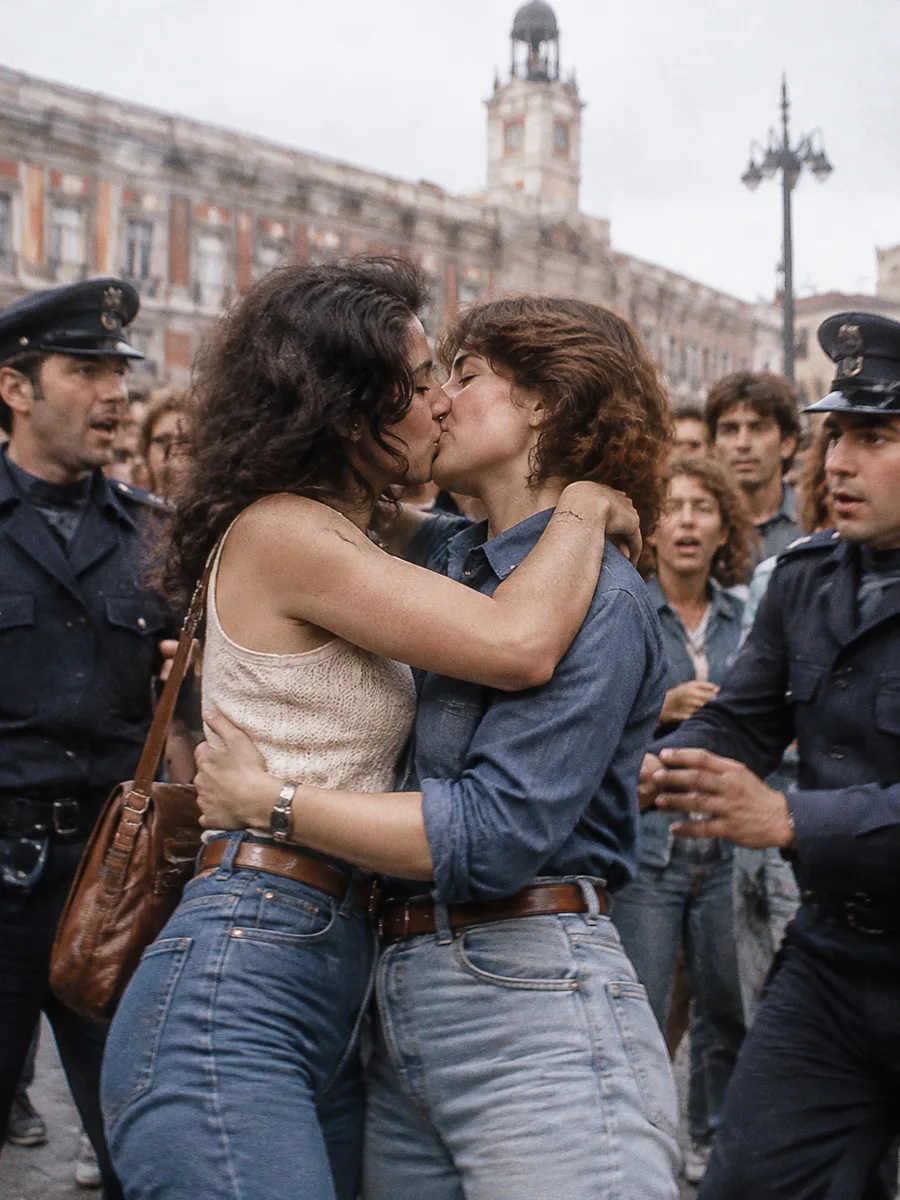
太阳门广场的吻
Why Public Kissing Is Everywhere in Spain: From Franco's Repression to the Streets of Madrid
About this story
HSK Medium: Spain's public kissing culture, from 1986 arrests under Franco-era 'public scandal' laws to La Movida Madrileña and today's housing-driven street intimacy. HSK 4 Chinese listening practice.
This is an HSK 4 Chinese listening episode that runs about 2 minutes. The full Mandarin script is shown with tap-for-pinyin and a line-by-line English translation, so you can listen and read at once — comprehensible input in the sense of Stephen Krashen's i+1 theory. It teaches 12 key vocabulary words such as 警察、法律、自由 and walks through 6 grammar patterns, each explained in English with examples. The same news story is retold at 4 difficulty levels — use the level selector above to find the version that is challenging but still understandable for you.
Read at your level
原文Read the complete story in Chinese. Reveal pinyin and English only when you need them.
English transcript reference
In 1986, two women in Madrid were taken away by police because of a kiss.
They were held at the police station for two days, charged with 'public scandal' under criminal law.
This charge originated from the Franco dictatorship era.
In that era, couples kissing on the street could be fined.
Public displays of affection have always been policed.
After Franco's death, a cultural wave called 'La Movida Madrileña' emerged in Madrid.
Young people talked about freedom and self-expression, and intimate scenes on the streets increased.
However, the law did not change accordingly.
LGBT groups protested about this for many years.
In 1987, activists organized a mass kiss at Puerta del Sol in Madrid.
This was a response to that arrest.
The protest method was simple: everyone agreed to kiss at the same time.
For many years afterward, Madrid's pride parades ended with a kiss.
When the procession reached Puerta del Sol, everyone would kiss.
In 1988, the 'public scandal' charge was abolished.
From then until now, kissing on the street in Spain has become a very ordinary thing.
One reason is actually at home: Spaniards live in cramped conditions.
Today about 65 percent of Spaniards live in apartments.
This is the highest proportion in the EU.
Housing prices are also expensive, making it hard for young people to move out of their parents' homes.
Amparo Lasén, a sociology professor at Complutense University of Madrid, says homes lack private space.
She says couples can only go outside to find a bench.
She also says that if no one gives you a dirty look, or you simply don't care, public expression becomes much easier.
Isabel Nieto Tous is twenty-eight years old.
She returned from abroad a few years ago and moved back in with her parents.
She says that in Spain, kissing is generally accepted.
However, Lasén also reminds us that not everyone is equally comfortable displaying affection.
Same-sex couples often receive more stares on the street than heterosexual couples.
In Valencia, Paula Furió, a former wedding photographer, has a saying.
She says kissing is just the tip of the iceberg.
In today's Spain, kissing is seen everywhere on streets, in parks, and in plazas.
Something that once meant two days in jail—now no one gives it a second glance.
Listen again
Try it without the transcript and notice what sounds clearer.
What vocabulary does this episode teach?
词汇HSK 3. Appears in '被警察带走' (taken away by police).
HSK 3. Used in '法律并没有跟着改' (the law did not change accordingly).
HSK 3. Used in '谈自由' (talk about freedom).
HSK 3. Appears in '自我表达' (self-expression).
HSK 3. Used in '很平常的事' (a very ordinary thing).
HSK 3. Appears in '原因之一' (one of the reasons).
HSK 3. Appears in '社会学教授' (sociology professor).
HSK 3. Used in '被人接受的' (accepted by people).
HSK 3. Common verb for 'to kiss'; used throughout the script.
HSK 3. Appears in '抗议了很多年' (protested for many years).
HSK 3. Used in '住在公寓里' (live in apartments).
Beyond HSK 3. Used in '佛朗哥独裁时期' (Franco dictatorship era).
* beyond level超纲词
What grammar patterns appear in this episode?
语法被 + Verb
Passive voice marker. Indicates that the subject is acted upon.
两名女子因为一个吻被警察带走。
公共丑闻这条罪名被废除。
对 + Noun + 的 + Noun
Expresses 'towards' or 'regarding' something, often used to attribute a response or attitude.
这是对那次抓捕的回应。
以 + Noun + 收尾
Means 'to end with' something.
马德里的骄傲游行都以一个吻收尾。
从 + Time + 到 + Time
Expresses a time span 'from... to...'.
从那时到现在,街上接吻在西班牙已经成了很平常的事。
如果 + Condition, 就 + Result
Conditional structure: 'if..., then...'.
如果没人给你白眼,或者你根本不在乎,公开表达就容易得多。
比 + Noun + 更 + Adjective
Comparative structure: 'more [adjective] than [noun]'.
同性伴侣在街上受到的注视,往往比异性情侣更多。
Proper nouns
专有名词Sources
来源Free account
Keep learning from this story
Create a free account to keep saved words and your preferred level together.
- Keep words with their story context
- Remember your preferred level
- Build your vocabulary over time