
A Chinese podcast · Same story, 4 levels
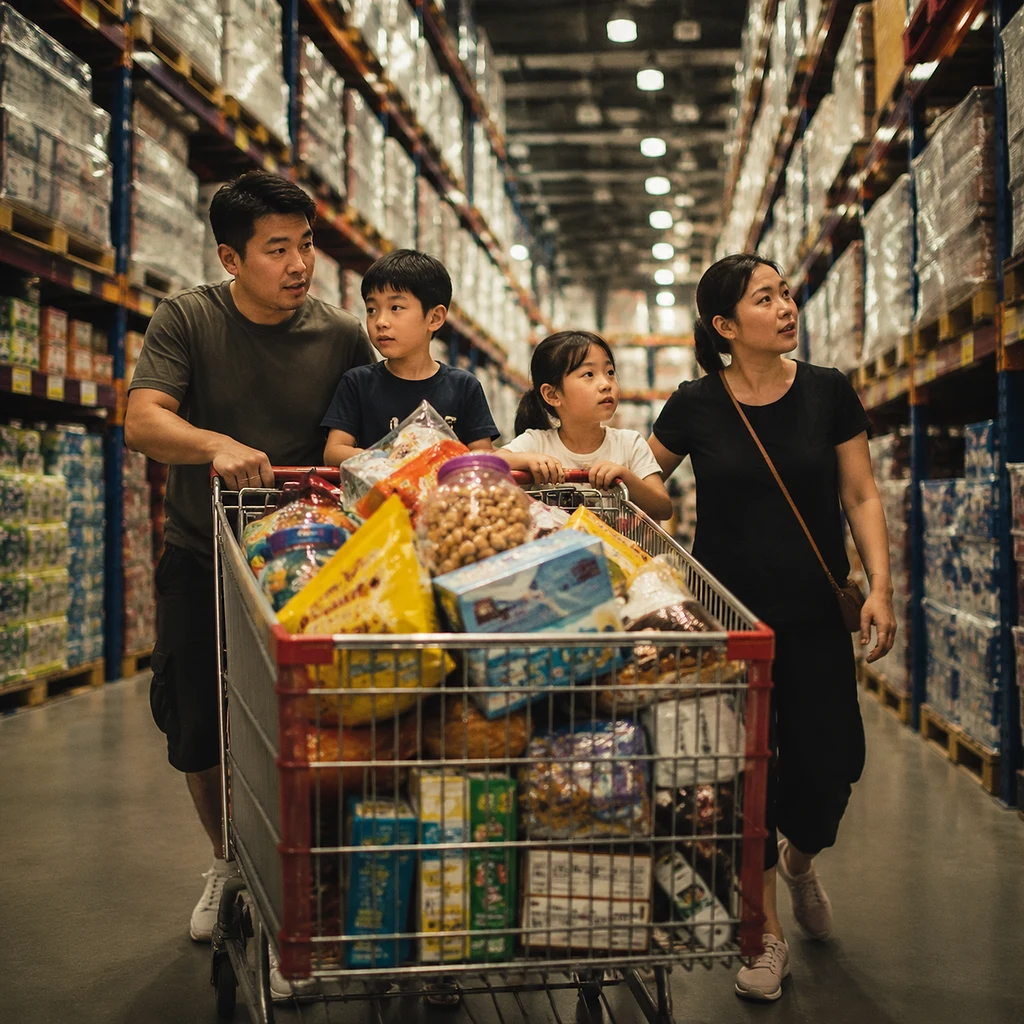
山姆商店在中国
Sam's Club Thrives in China While Rivals Retreat
About this story
A simple story about Sam's Club, the American store in China where things are expensive but shopping feels convenient. HSK 1 Chinese listening practice.
This is an HSK 1 Chinese listening episode that runs about 6 minutes. The full Mandarin script is shown with tap-for-pinyin and a line-by-line English translation, so you can listen and read at once — comprehensible input in the sense of Stephen Krashen's i+1 theory. It teaches 17 key vocabulary words such as 商店、东西、觉得 and walks through 5 grammar patterns, each explained in English with examples. The same news story is retold at 4 difficulty levels — use the level selector above to find the version that is challenging but still understandable for you.
Read at your level
原文Read the complete story in Chinese. Reveal pinyin and English only when you need them.
English transcript reference
Speaking of buying things, we can go to a big store to have a look.
Today we are going to a big store.
This store is very big.
Extremely big.
There are many things inside the store.
There are things to eat.
There are things to drink.
And useful things.
This store is called Sam's Club.
It is in China.
Many people go there.
Look, there are many people there.
There are people in front.
There are also people behind.
Everyone is buying things.
I also want to go buy things.
What are we going to buy?
Let's look at the food.
There is fruit here.
There are apples.
The apples are very big.
The apples are very red.
They look very delicious.
There is also beef here.
Look at this beef.
The beef is very fresh.
Before, the beef here was very big.
One piece of beef was extremely big.
It was too big.
We couldn't finish eating it.
There are few people in the family.
Only three people.
Big pieces of beef are not good.
But now it is different.
The beef has become smaller now.
Look at this piece.
This piece is not big.
And not small.
The size is just right.
We can finish it in one meal.
Dad can eat.
Mom can eat.
I can also eat.
Everyone is happy.
Why did it become smaller?
Because the store knows our thoughts.
The store knows Chinese families.
Chinese families do not have many people.
So things cannot be too big.
Small things are better.
This is called understanding us.
There are other things in the store.
Look at those boxes.
Red boxes.
Very beautiful.
Those are things for Chinese New Year.
Chinese people like Chinese New Year.
We need to buy things for Chinese New Year.
Need to buy delicious food.
Need to give gifts to friends.
There are many such things here.
There are nuts.
There is candy.
They are all things Chinese people like.
The people in the store say: "These are very good."
I also think they are very good.
So many people come to buy.
Everyone bought a lot.
Some things are sold out.
Because everyone likes them too much.
This store is American.
But it sells Chinese things.
It sells things we like.
So it is doing very well now.
This store exists in this city.
It also exists in that city.
There are more and more stores.
Look, they are opening a new store over there.
They are also opening a new store here.
How about other stores?
Some stores are not doing well.
Some stores have closed down.
Because no one goes there.
Because the things are not good.
Or the things do not suit us.
But Sam's Club is different.
Sam's Club knows what we want.
It is learning.
It is watching us.
It knows what we like to eat.
It knows what we like to use.
So it stayed.
It is still opening new stores.
Many people drive cars to come buy things.
Buy things and put them in the car.
Then go home.
This is very convenient.
If you don't want to come, that's also fine.
You can buy using your mobile phone.
Tap once on the phone.
The things are delivered to your home.
Very fast.
Really very convenient.
Everyone is very busy.
Convenience is very important.
So everyone likes it here.
The things here are good.
The things here are not expensive.
The things here suit us.
This is why there are so many people.
Look, there are many people queuing.
Everyone bought things.
Let me buy a little too.
I want to buy that beef.
The small beef.
Go home and cook.
Mom will be very happy.
Now let's talk about this story.
What is this story about?
It talks about a store called "Sam's Club".
This is a big American store.
Before, it sold American things.
The things were very big.
Now, it has changed.
It sells things suitable for Chinese people.
Things have become smaller.
More suitable for Chinese families.
It also sells a lot of delicious Chinese food.
Although other foreign stores have closed.
But Sam's Club has opened many new stores.
Because it does well.
Because it understands the Chinese market.
This is today's story.
We need to buy things that suit us.
Stores also need to sell things that suit everyone.
Listen again
Try it without the transcript and notice what sounds clearer.
What vocabulary does this episode teach?
词汇A common place to buy goods. Measure word is 家 (jiā).
A general term for objects or items. Note the neutral tone on 'xi'.
Used to express an opinion or physical sensation.
Literally 'hand machine'.
The opposite of cheap (便宜 - piányi).
Adjective describing having a lot to do.
Describes something that saves time or effort.
Used for people or objects.
Question word asking for the reason.
Used to give a reason, often paired with 所以 (suǒyǐ - so).
A verb meaning something is right or appropriate for someone.
Used for food (fruit, meat) or air.
Specific food vocabulary.
Specific food vocabulary.
Noun form of 'to think' (想).
Common activity in busy shops.
Can refer to a physical market or the abstract economic market.
* beyond level超纲词
What grammar patterns appear in this episode?
语法Place + 有 + Object
This structure is used to express existence, meaning 'There is/are [Object] in [Place]'.
商店里有很多东西。
前面有人。
这里有水果。
Verb / Adjective + 的 (Nominalization)
Adding '的' after a verb or adjective turns it into a noun phrase, meaning 'the one that is...' or 'things that are...'.
有吃的。
有喝的。
小的东西更好。
在 + Verb (Progressive Aspect)
Using '在' before a verb indicates an action is currently happening (present continuous tense).
大家都在买东西。
那边在开新店。
它在学习。
Verb + 完 (Result Complement)
The character '完' (to finish) is placed after a verb to indicate the action has been completed successfully.
有的东西卖完了。
我们一顿饭可以吃完。
我们吃不完。
虽然 ... 但是 ...
A conjunction pair meaning 'Although ..., but ...'. In Chinese, both parts of the pair are usually spoken.
虽然别的外国商店关门了,但是山姆开了很多新店。
Proper nouns
专有名词Sources
来源Free account
Keep learning from this story
Create a free account to keep saved words and your preferred level together.
- Keep words with their story context
- Remember your preferred level
- Build your vocabulary over time