
A Chinese podcast · Same story, 4 levels
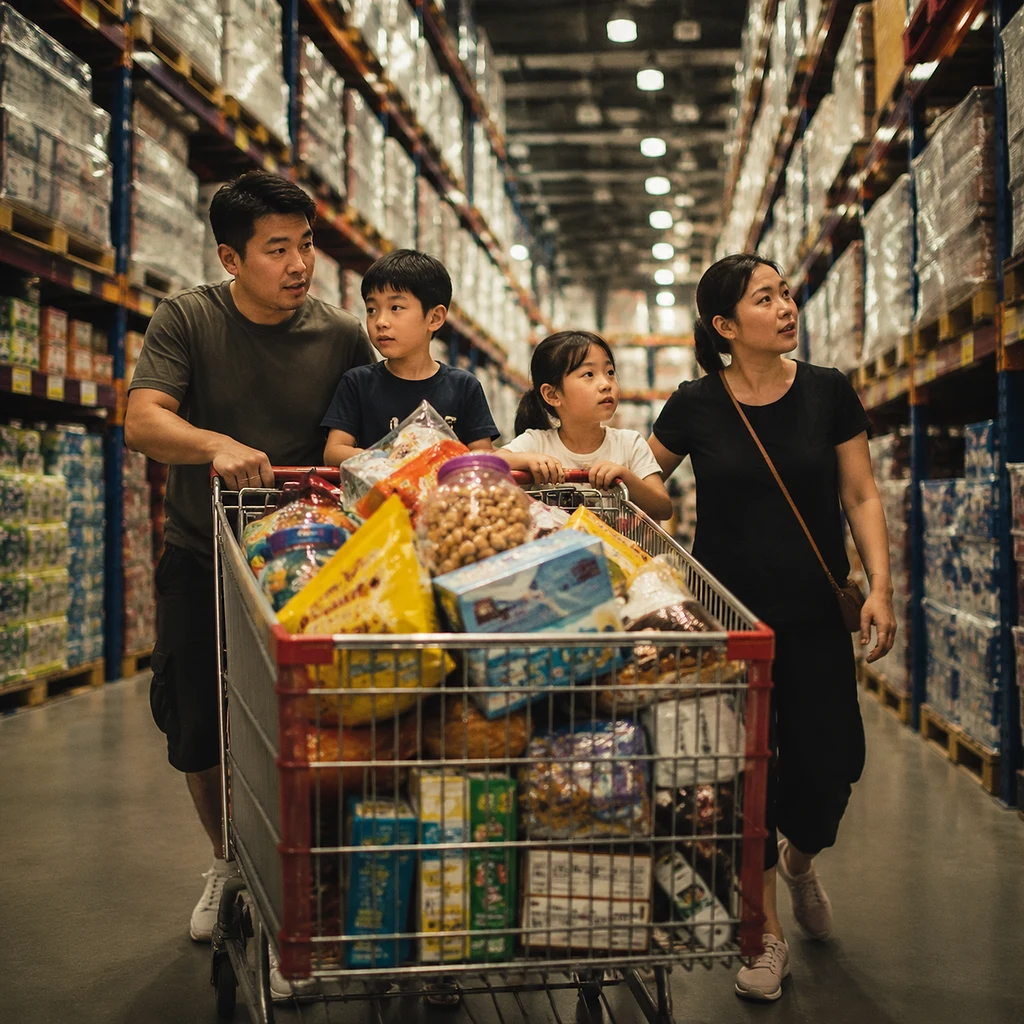
逆势突围:山姆会员店如何在跨国零售巨头退潮时破解中国市场密码
Sam's Club Thrives in China While Rivals Retreat
About this story
Walmart's Sam's Club thrives in China as foreign retailers exit — Sushang Bank's Fu Yifu on the membership formula. HSK 5-6 Chinese listening practice.
This is an HSK 5-6 Chinese listening episode that runs about 9 minutes. The full Mandarin script is shown with tap-for-pinyin and a line-by-line English translation, so you can listen and read at once — comprehensible input in the sense of Stephen Krashen's i+1 theory. It teaches 17 key vocabulary words such as 核心、细节、挑战 and walks through 5 grammar patterns, each explained in English with examples. The same news story is retold at 4 difficulty levels — use the level selector above to find the version that is challenging but still understandable for you.
Read at your level
原文Read the complete story in Chinese. Reveal pinyin and English only when you need them.
English transcript reference
When it comes to the rise and fall of multinational retail giants in the Chinese market, we've witnessed far too many poignant departures and contractions in recent years, yet against this backdrop of foreign supermarkets falling one after another,
Walmart's Sam's Club has charted a distinctly different upward trajectory.
This is not merely a story about a business model surviving, but a textbook case study in how to precisely decode Chinese consumer psychology and deeply implement localization strategies.
There was a time when foreign retailers could conquer the Chinese market simply by introducing mature overseas models, but today, this crude "copy and paste" approach has long since stopped working.
The reason Sam's Club has been able to gain a firm foothold in the Chinese market — even seeing "membership cards hard to come by" in some regions — is that it has truly cracked China's unique market code.
Let's start with one of the most representative details: the subtle changes in product packaging.
This might sound trivial, but it's precisely this meticulous attention to detail that reflects a retailer's deep insight into local lifestyles.
Take Member's Mark American-style steaks under Sam's private label — if sold entirely according to American standards, they would typically come in generous packages of over one kilogram.
For American families with large freezers who are accustomed to shopping once a week, this makes perfect sense.
However, Sam's operations team in China keenly recognized that such portions not only create pressure to consume for Chinese families but also pose a serious refrigerator storage challenge.
As a result, we see that steak packaging in Chinese stores has been precisely adjusted to between 450 and 800 grams.
Behind this change is solid data support.
According to the latest data from the National Bureau of Statistics, the average Chinese household size dropped to 2.51 people in 2024.
The shrinking of family structures directly drives the fragmentation and refinement of consumption scenarios.
That "stockpile mentality" warehouse shopping experience must be adapted to fit the premium real estate of core Chinese cities and modern families' dietary habits of pursuing ingredient freshness.
Beyond packaging adjustments, product selection localization is an even more critical move in Sam's counter-trend breakthrough.
During the recently passed Lunar New Year, if you walked into any Sam's Club store, you'd find that the shelves no longer held only imported butter and cheese, but were filled with items brimming with rich Chinese New Year flavors — copper gourd ornaments,
premium ginseng gift boxes, and various traditional dried goods.
This "East-meets-West" product selection strategy has greatly eliminated the cultural gap between the foreign brand and Chinese consumers.
Even hot items like nut gift boxes frequently sell out immediately upon stocking during the pre-Spring Festival period, demonstrating just how precisely they've grasped the psychology of holiday consumption.
On this topic, Fu Yifu, a special researcher at Jiangsu Bank, has pointed out incisively that Sam's successful expansion in China is largely because it has successfully tapped into the growing demand for "quality consumption" among China's middle-class families.
This isn't just about buying things — it's a projection of identity and quality of life.
Although the macroeconomic environment faces challenges, the middle class's standards for food safety, product quality, and shopping experience haven't decreased — they've actually become even more discerning in some respects.
Sam's Club has built a moat through strict quality control and differentiated product selection, satisfying this demographic's psychological need to "buy with eyes closed."
At the same time, its powerful instant delivery service perfectly solves the pain point of warehouse shopping where items are "too bulky to carry," making stockpiling no longer a burden.
In terms of expansion strategy, Sam's has also demonstrated a rhythm and approach that is distinctly different from its competitors.
As Sam's long-time rival in the US, Costco didn't enter the Chinese market until 2019.
Costco adheres to a more cautious, even conservative strategy of "buying land and building from scratch."
While this model ensures long-term asset value, it also significantly limits the speed of store openings.
Currently, Costco has only seven stores in mainland China, highly concentrated in the Yangtze River Delta and Shenzhen, and has yet to enter the Beijing market.
In contrast, Sam's pace appears much more nimble and aggressive.
In 2025 alone, Sam's opened 10 new stores in mainland China, bringing its total nationwide store count to 63 by year's end.
This expansion speed in an era when brick-and-mortar retail is generally struggling is nothing short of miraculous.
It's worth noting that Sam's reach is rapidly extending from increasingly saturated first-tier cities into second and third-tier cities.
Late last year, Zhangjiagang and Yangzhou in Jiangsu Province welcomed new Sam's Club stores, marking the official acceleration of its "market penetration strategy."
The logic behind this is actually very clear: as competition intensifies in first-tier cities, economically developed second and third-tier cities like Zhangjiagang and Yangzhou have steadily growing resident incomes, and because housing price pressure is relatively lower,
consumers' disposable income and willingness to spend are actually even stronger.
Furthermore, with the emerging trends of "returning home to buy property" and "reverse migration for employment," these lower-tier markets are gathering large numbers of young people with experience living in first-tier cities, who have high acceptance of membership-based supermarkets and have become Sam's new growth engine.
Of course, this rapid expansion is not without concerns.
The rapid replication of any business model inevitably places enormous pressure on supply chain management and quality control.
Over the past year, reports about food safety issues at Sam's have occasionally appeared in the media, undoubtedly serving as a warning bell for the breakneck expansion pace.
The core competitiveness of a warehouse membership store lies in "strict selection" and "quality control" — once quality control is diluted due to overly rapid expansion, it will shake the brand's foundation.
On this front, Walmart China's senior leadership clearly has a sober understanding.
At Walmart's 2025 investor conference, Walmart China CEO Zhu Xiaojing explicitly stated that the company would increase its annual quality control budget by 35%.
This statement can be seen as Sam's effort to rebalance "quality" and "quantity" while pursuing speed.
From the financial data perspective, Walmart's transformation strategy in China is clearly working.
In the third-quarter earnings report ending October 31st, Walmart China's total sales grew nearly 22% year-over-year to $6.1 billion — a growth rate far exceeding the 10.8% average of its international business division.
Among these, Sam's Club achieved double-digit transaction volume growth, becoming the locomotive driving the entire Walmart China business.
This is a very interesting "two-sided" phenomenon: on one hand, Walmart's traditional hypermarket business is undergoing painful contraction and adjustment, with store count plummeting from 412 in 2020 to 283 in fiscal year 2025;
while on the other hand,
Sam's Club is thriving vigorously on the same soil.
This actually reflects the profound structural transformation taking place in China's retail market: the traditional "big and comprehensive" one-stop shopping model is being replaced by more personalized, quality-driven, and experiential niche formats.
In this fierce market battle, Sam's faces not only its old rival Costco but also a powerful siege from Chinese local retail forces.
Companies like Freshippo, Yonghui Superstores, and Pangdonglai — known for its exceptional service — are all actively exploring membership store models or high-quality retail paths suited to China's conditions.
The "Hong Kongers heading north" consumption trend that has emerged in recent years has also brought unexpected incremental traffic to warehouse stores in Shenzhen and other cities.
Costco's Shenzhen store has revealed that large numbers of Hong Kong residents make cross-border shopping trips on weekends, becoming a significant contributor to its sales.
This phenomenon also indirectly confirms the cross-regional attraction of quality retail resources against the backdrop of Greater Bay Area integration.
Looking back on Sam's nearly thirty-year journey in China — from the long hibernation after opening its first store in Shenzhen in 1996, to the accelerated pace after 2016, to the current full-scale explosion — this is itself an evolutionary history of multinational enterprise localization.
It tells us that in a market as rapidly changing and massive as China, there is no permanent business model.
Only those enterprises willing to get down to ground level, truly understand the changing needs behind the "earthy charm" of Chinese families, and willing to transform their product forms and service details accordingly, can have the last laugh in this fierce elimination race.
The future retail battlefield will no longer be a simple price war, but an all-around competition of supply chain efficiency, product selection acumen, and insight into consumers' lifestyles.
For Sam's Club, how to maintain food safety standards while sustaining high-speed expansion, and how to keep innovating amid the relentless pursuit of local competitors, will be the greatest test it faces in its next phase.
Listen again
Try it without the transcript and notice what sounds clearer.
What vocabulary does this episode teach?
词汇Refers to the most important or central part of something. Often used in business to describe 'core competitiveness' (核心竞争力).
Small particulars or details. The text emphasizes that 'detail' is key to success.
To challenge or a challenge. Used here regarding storage space and market competition.
To be short of something. (Note: Though not explicitly in the text, related concepts like 'contraction' and 'limit' appear; '缺乏' is a standard HSK 4/5 word useful for discussing these topics).
To regulate or adjust. Used here regarding product packaging sizes.
HSK 1-4. economy.
HSK 1-4. international.
HSK 1-4. market.
HSK 1-4. brand.
Literally 'sink and float'. Metaphorically refers to the vicissitudes or fluctuating fortunes of a person or organization.
The process of adapting a product or service to a specific local market. A key business term in the script.
Idiom meaning 'too trivial to mention'. Used to describe the packaging changes that actually had a huge impact.
Describes senses or perception that is quick and accurate. Used here to describe the team's insight.
Idiom describing land that is extremely expensive, typical of city centers.
A misunderstanding or lack of communication between parties. Here refers to cultural barriers.
Idiom meaning 'to draw blood with one prick'. Describes a remark that is precise and to the point.
To be hypercritical or very particular about standards.
* beyond level超纲词
What grammar patterns appear in this episode?
语法之所以……(是因为/在于)……
A structure used to explain the reason for a result. 'The reason why [result] is because/lies in [reason]'.
山姆之所以能够在中国市场站稳脚跟……核心在于它真正破解了中国市场的特殊密码。
非但不/没有……反而……
Used to indicate that the result is the opposite of what might be expected. 'Not only not..., but on the contrary...'.
中产群体对于食品安全……的要求并没有降低,反而在某种程度上变得更加挑剔。
消费者的可支配收入和消费意愿反而更为强劲。
随着……
Indicates a correlation between two changing situations. 'Along with...', 'As...'.
随着一线城市竞争加剧,像张家港、扬州这样经济发达的二三线城市……
此外,随着“返乡置业”和“回流就业”趋势的显现……
值得注意的是……
A set phrase used to draw attention to a specific point. 'It is worth noting that...'.
值得注意的是,山姆的触角正在从趋于饱和的一线城市,快速向二三线城市延伸。
不再是……而是……
Used to negate one possibility and affirm another. 'It is no longer..., but rather...'.
未来的零售战场,不再是单纯的价格战,而是供应链效率、选品眼光以及对消费者生活方式洞察力的全方位比拼。
Proper nouns
专有名词Sources
来源Free account
Keep learning from this story
Create a free account to keep saved words and your preferred level together.
- Keep words with their story context
- Remember your preferred level
- Build your vocabulary over time